We see them everywhere we go. Highly detailed images saturated into the pores of skin, on shoulders, arms, chests, backs, feet, even hands and heads. Tattoos are a cultural staple not just in the United States, but worldwide as well. In different parts of the world, tattoos hold deep spiritual meanings, with various tribal patterns and images that correspond to different messages, morals, and stories. Different tribes consider ink to be a right of passage from childhood to adulthood, most prominently on the face, chest, and wherever else they may be visible.

However, in many countries, especially Western ones, facial tattoos, let alone tattoos themselves, are considered unprofessional, even taboo. One of the largest criticisms of the job market in the United States, and worldwide, is the rejection of potential employees because they may have visible tattoos. Most can easily be covered, but the fact remains, that people will always be wary around their fellow humans who may have a little decorative art on their bodies.
For many millennials, tattoos are attractive and appealing. They may symbolize rebellion, or a free spirit. Many find tattoos interesting, and the first question people ask is almost always, "what does it stand for?" Of course, it's perfectly fine if you get a tattoo for no other reason than you thought it was badass. But the fact of the matter is, not everyone is going to understand that. Most expect that you got the tattoo because it holds some special meaning to you, and when you say it doesn't, they're going to look at you like you're irresponsible. This is not always the case, but of course, assumptions always happen.
So you might be thinking of getting a tattoo sometime in the future, and if I'm right, it is likely your first one. As a bearer of three tattoos myself, I hope to give some advice on how to make your first tattoo an excellent choice that you won't ever regret. Because trust me, people make mistakes quite often with permanent body ink.
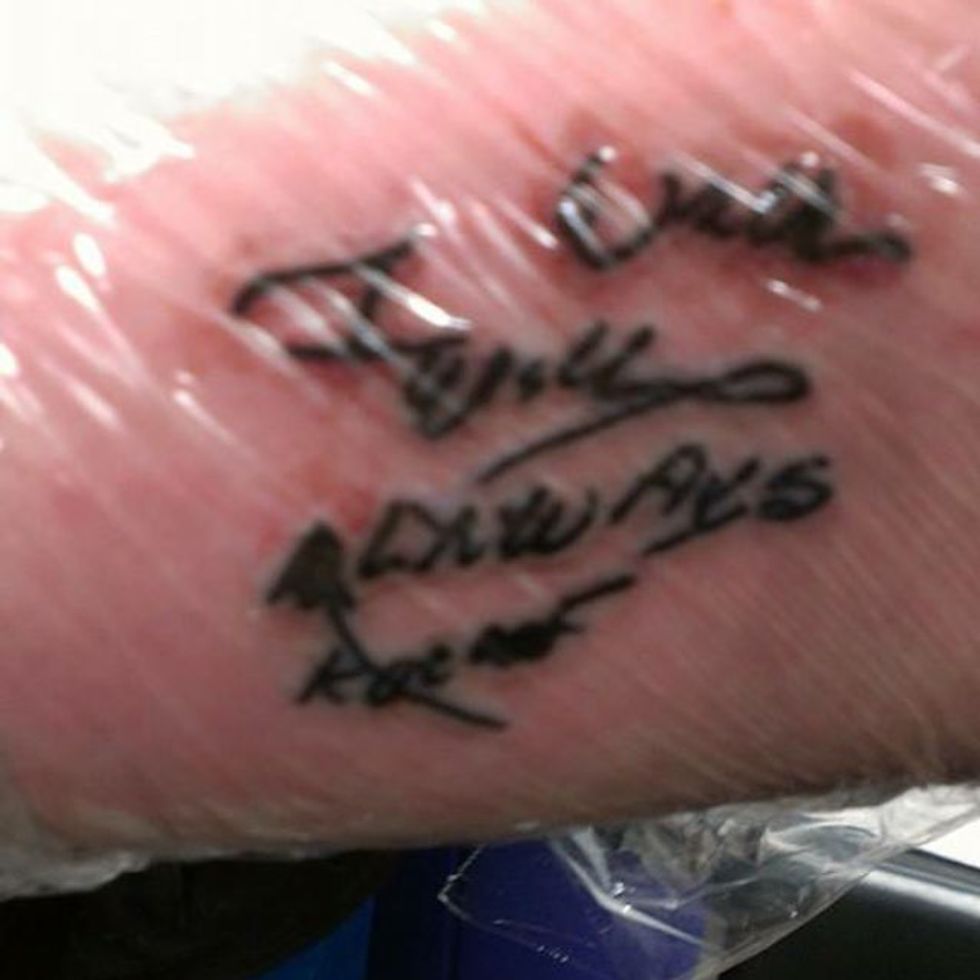
That's my first tattoo. It is my grandmother's handwriting, with her final note to me before she passed away, saying "I will always love you." I got it when I was 17, a year younger than the age where you can get a tattoo without parental consent. Some states will allow you to get a tattoo as young as sixteen, however, you must have the written permission of your parents. This makes getting your first tattoo even trickier to obtain if you are impatient, because you'll have to do some major convincing in order to allow your parents to sign off on it.
Many times, it seems to be that for underaged teens who want to get their first tattoo, their parents are more likely to agree if the tattoo they want holds some symbolic meaning. Once you turn 18, you can get whatever your heart desires. However, if you need your parents permission, and especially if they're footing the bill, they're not going to simply say yes to whatever design you pick. They're going to want to know what you want, and why you want it. Chances are, they will most likely also pick the shop you go and get it done at. For you 16-year-olds out there, do not fight it. The more arguing you do, the less likely they are to allow you to get the tattoo. My suggestion for under aged teens: go with something meaningful. There's plenty of time in the future for tattoos that just look cool or are complete random splurges. Get something meaningful, so if you decide maybe another tattoo is not in your future, you at least have something you won't regret having.
For those of you who are 18 and can choose whatever your heart desires, I would suggest that you too stay in the direction of something meaningful. As I stated, this is because if you decide not to get another one, you'll have one you don't regret, and also, it'll give you an idea of how the process goes.
For both age groups, I would recommend you start with something small. Tattoos are notorious for being painful, even if it's only slightly bothersome. Once you have an idea about your pain tolerance, then you can plan on going bigger and more intricate.
Location is also something important to consider when getting your first tattoo. The closer to the bone the needle is, the more painful it will be. This also goes with more muscular areas. For your first, an area with looser skin is ideal, like your forearm, bicep, and especially the shoulder.
Make sure you eat before you go to the parlor! The pain can be considerable for some, and if you're going on an empty stomach, there's a good chance you might pass out from the pain. Be sure to eat a snack and/or drink a soda before having your work done! You'll thank yourself later when it's all said and done.
Finally, you have to remember that the process of getting a tattoo is not over when you leave the shop. During the process and especially afterwards, you are going to bleed considerably. Your skin is traumatized, and it needs to be taken care of. Your artist will clean the wound with specialized soap and water, then wrap it in saran wrap. Your artist may give you different instructions, but for me, I was always told to leave the wrap on overnight. In the morning, take off the wrap. There will probably be a good deal of blood, but don't worry! The wrap is always tight enough to make sure none of it bleeds through. Your artist will give you a special soap or lotion to apply gently to the tattoo. Do this as soon as you take off the wrap, and rinse with warm water. Do this every morning and every time you get a shower. Especially when you get a shower, do not use bar soap! Use only the lotion the artist gives you. Usually the amount of time to do this varies, but I would safely suggest a week or two.
So, for those who don't want to read every single paragraph, here are the key things to remember when getting your first tattoo:
1. If you are underaged, go with something meaningful. Your parents are more likely to agree this way, especially if they are footing the bill.
2. Even if you're not underaged, you should still think carefully about what you want. Tattoos are permanent, and it is very expensive and painful to have them removed. Get something you'll be happy with for years to come, especially if you decide not to get another one.
3. Start with something small. Tattoos are a great indicator of how well you handle pain, so if a small tattoo is cosmically painful, you'll know not to aim for bigger. Small tattoos are also easy to cover if you're concerned about getting a job.
4. Location, location, location. Some parts of the body, like the feet, ribs, and hands, are going to be pretty excruciating because they're so close to bone. Start with the bicep or shoulder, where looser skin and fattier areas will mellow out some of the pain.
5. Eat/drink before you go. If you're enduring the pain on an empty stomach, you might pass out, which is just cumbersome for you and your artist. Eat a snack and drink water or a soda beforehand.
6. Take care of the tattoo when you get home. This is a permanent part of your body that you've been saving money to get. You owe it to yourself to take care of it so that years from now, it'll still look as great as it did the first day you got it.
Your body is a temple. Feel free to decorate it a little bit.