

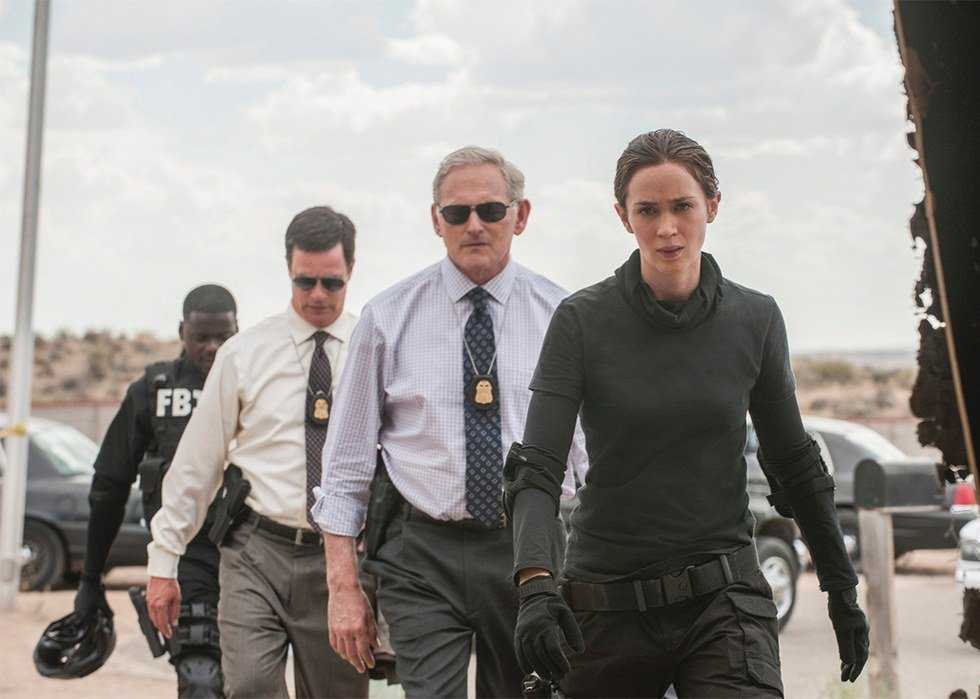
At first glance, the advertisements for Denis Villeneuve’s latest drug cartel thriller “Sicario” seem to portray Emily Blunt as an action heroine. Blunt’s career--while impressive overall--took a turn for the better when Hollywood unofficially deemed her cinema’s newest “badass female,” a title that came at the cost of her playing side characters in such male-dominated plots as “Looper” and “Edge of Tomorrow.” To say that Blunt gets the chance here to play a protagonist that also stays true to her new action persona would be a mistake, though. Instead, Blunt plays a detached observer, a character whose utter helplessness made it difficult to engage in a plot with no clear moral compass or much of anything at all to root for.
Similar to Villeneuve’s breakout film “Prisoners,” “Sicario” is full of characters whose actions are more than morally questionable. Opening on a kidnapping raid in Arizona, FBI agent Kate Macer (Blunt) along with her team discover that the house they’ve just invaded is full of dozens of dead bodies stored within the walls. Following this revelation, two police officers are brutally dismembered when they come across an explosive device hidden beneath the floorboards of the backyard shed.
In the aftermath, Kate is recruited by Department of Defense adviser Matt Graver (Josh Brolin) to help find the men responsible, more specifically the drug cartel boss Manuel Diaz (Bernardo P. Saracino). With the help of Matt’s mysterious partner Alejandro Gillick (Benicio del Toro), Macer and a team of elite agents head to Juarez, Mexico to root out the cartel leaders.
However, Kate doesn’t know she’s going to Juarez. In fact, Kate doesn’t know much of anything happening in the plot of “Sicario.” Whenever Blunt’s character isn’t asking for a cigarette or lamenting over her need for a drink, she’s often questioning the motives of both Matt and Alejandro. Blunt ultimately becomes background noise to a plot where she’s almost never clued in, making it harder to remember why she was even recruited in the first place.
The protagonist’s lack of power to do anything at all in the plot made it increasingly difficult to find a character worth rooting for in “Sicario.” The script’s leisurely pace, only to be broken up between scenes of graphic violence, torture and grisly images, creates an overall sense of dread and anxiety that rarely lets up. While Villeneuve’s refusal to shy away from such bleak scenes isn’t a bad thing, the script often leaves you wondering why we should be caring about this at all.
If there’s anything to be taken away from “Sicario,” it’s the immense directing talent of Denis Villeneuve. With the help of the masterful cinematographer Roger Deakins, Villeneuve pulls off making a film full of ugly violence that avoids resulting in a numbing effect. Each scene of conflict, whether it's the showdown on the Juarez highway or the film’s climactic set piece, is as much of an adrenaline rush as the last. And Deakins’ keen sense of framing within these scenes is just as top
notch as any of his other work.
While the dismal outlook of "Sicario"’s script will keep audiences at a measurable distance, it’s also a supremely well-made film from an important emerging director. "Sicario"’s greatness lies in its production value, though its unglamorous story and lack of clear protagonist will surely mark a challenge for anyone looking to connect.