

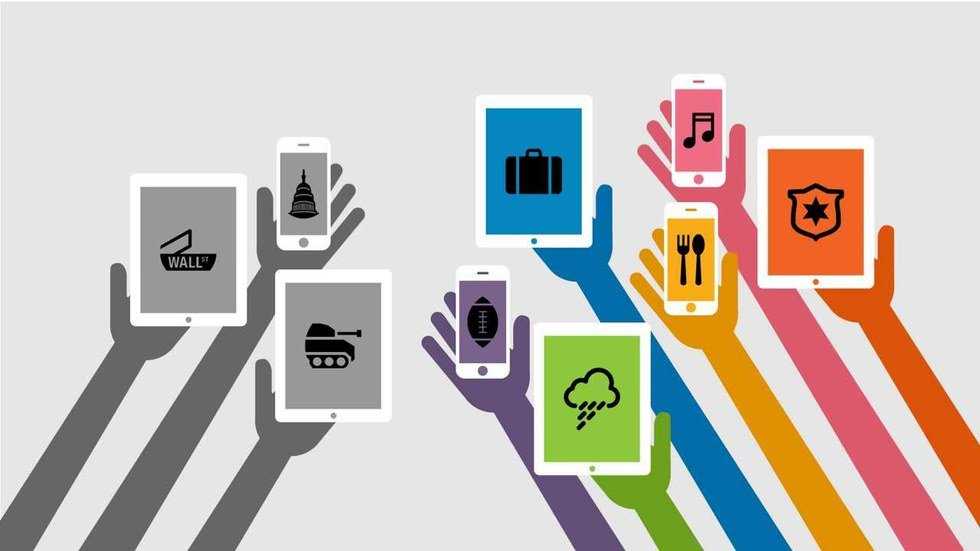
Society, as anyone middle-aged or older will tell you, is changing rapidly from the familiar. Part of that change, sensibly enough, is how we look and talk about what is happening within our society. The 21st century has marked an influential shift in the modality of the relay of information. I've already explored in broad terms the influential effect of the internet on today's tech-savvy populous. Now I turn to examine what effect the internet is having on the way news is disseminated in today's society.
Perhaps one of the most notable changes in the spread of information came with the advent of social media. The Pew Research Center found that, as of 2014, more than 50% of internet users frequent some combination of "two or more social media sites." The same study also found that of those who choose to use Facebook, Instagram, and Twitter, all of 70%, 49%, and 36%, respectively, use these social media platforms daily. How does social media factor into the spread of news? The Pew Research Center also did a study which ultimately found that 60% millennials (and 51% of Generation X) relied on social media- specifically Facebook- for their political and governmental news.
The issue that presents itself here regards the legitimacy of Facebook, indeed social media in general, when it comes to the unbiased dissemination of news. Facebook has been under fire recently for everything from its choices on "trending topics" to the nature of its newsfeed algorithms. While it is easy to throw blame around, I, personally, find those people seeking to use social media as their sole or even primary news source to be most at fault. While Facebook, Instagram, and Twitter may be a great place to catch up on what is going on in your friends' lives, it does not seem like the appropriate place to be informed objectively on politics and other preferential matters. The main issue I have with social media as a news outlet is that, in surrounding yourself with only like-minded people, whether that be via the people you follow, the pages you like, subgroups you are a part of, etc., you are actively limiting the news to which you are exposed to a specific, uncontested dialogue.
This selective sourcing of news isn't exclusive to social media anymore, either. Apple News, which has come installed by default on mobile Apple products since iOS 9, has potential to share this same issue. By allowing you to pick and choose which topics and, perhaps more questionably, which specific news outlets show up on your feed, one could presumably tailor the information they see to a very specific, limited narrative. This is, of course, not to say that there is an inherent issue with the Apple News app itself. Rather, the issue arises from the potential the app creates for one to largely bias the information that they are presented as a whole.
Long gone are the days that my father and I would drive to our local corner store to pick up a Sunday paper. That used to be a semi-religious practice for us and certainly one we seldom skipped. I, like many of my generation, did not truly appreciate at the time what that bundled stack of paper and ink represented. Now, my father reads the news on his iPad. I still haven't found a news outlet with which I am entirely satisfied. The presentation of news is constantly changing, and I find that to remain open-minded, more and more effort is required. In the face of a society which aims to simplify everything for us, we must remain vigilant if we want to remain just.