We made some noise and SeaWorld finally listened... or did they just get busted? SeaWorld announced that this will be the last generation of captive orca whales. They are completely ending their orca breeding program. SeaWorld also is developing natural orca encounters, no more entertainment shows. SeaWorld is partnering with the Humane Society of the United States to protect the ocean and begin more conservation work. Even though all of these things are great, did SeaWorld only change because they got caught? They have kidnapped orcas from the wild, kept them in small tanks, forced them to perform and put them in unnatural settings. It has been great that society has publicized what has been going on behind the scenes at SeaWorld. Blackfish has certainly helped to change SeaWorld as well.
The popular movie Blackfish is about an orca at SeaWorld named Tilikum. He killed several people while he was stuck in captivity and the film follows each story; why the deaths occurred, and how orcas should never be kept in captivity. The film showed the cruel treatment of the animals in captivity, the lives of the trainers, and the pressures of the multi-billion dollar sea-park industry. The film shows many orcas being kidnapped in the wild - baby orcas taken from their mothers, both ocra's crying for one another. It is a heartbreaking scene to watch. Tilikum was captured in the wild in Iceland in 1983. He was first brought to Sealand, and then to SeaWorld in 1992. He killed one trainer in Sealand and two at SeaWorld. Killer whales are wild animals are never meant to perform or directly interact with humans. The killer whale is at the top of the food chain, sharks are actually part of their diet. Tilikum has bred 21 calves, ten which are still alive. In March 2016, SeaWorld announced that Tilikum’s health was deteriorating. He was two years old when they captured him in 1983, which makes him 35 years old. Orcas in the wild far exceeded this number in age. Orcas in the wild have an average life expectancy of 30 to 50 years—their estimated maximum lifespan is 60 to 70 years for males and 80 to over 100 for females. The average age of death for orcas at SeaWorld is just 13 years old.
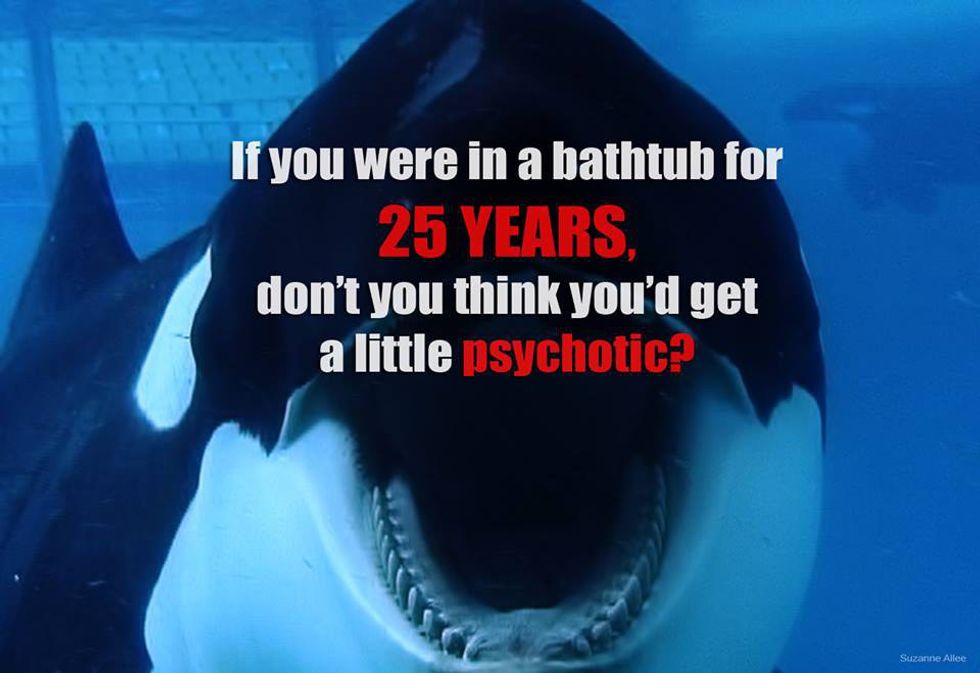
SeaWorld confines orcas, who swim up to 100 miles a day in the wild. The tanks that they are confined in are the size of a bathtub in relation to how many miles they typically swim in the wild. Orcas would need to swim 1,208 laps (around the perimeter of the tank) or 3,105 lengths (back and forth at the longest part of the tank) in the park’s largest tank to equal what they’d swim in the wild. Oftentimes orcas who are incompatible, are forced to live in tight quarters together. The resulting anxiety and tension cause fights between the orcas. In the wild, orcas have strong social bonds that last for life; their social rules prohibit serious violence against each other, and when fights do occur they can find space to flee. In captivity, there’s nowhere for them to go, which leads to injuries and death. PETA is calling on SeaWorld to develop ocean sanctuaries in which orcas could be rehabilitated and finally have the opportunity to engage in natural behavior that visitors could observe from nearby “whale watching” centers.
This is where we come in. As long as we keep making noise, SeaWorld will have to change their ways. It’s time for SeaWorld to change and free the imprisoned orcas.