
Rare blue watermelon:


Two moons in the sky:
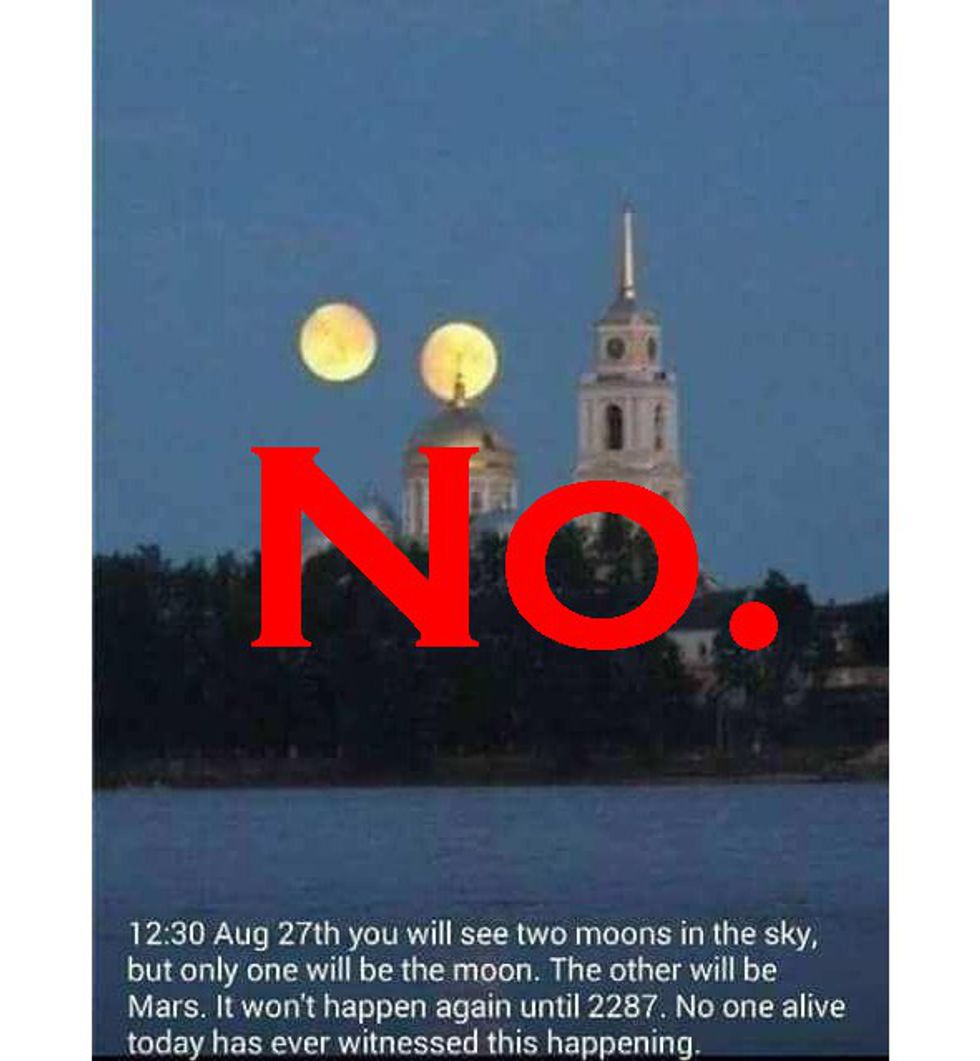
We’ve all seen the pictures: Blue watermelon, two Moons, diseases that cause purple eyes and no body hair and no periods, and some of the posts commonly shared on Facebook and other media sites. Some are plain to see as hoaxes, but others are more difficult to figure out. So how do you determine what is fact or fiction? Not all websites are credible, even ones that may try and pass themselves off as such, for example “mostextremenews." In a world where information is spread like a wildfire by the simple click of a button, it is hard to keep yourself informed, so what are some ways to avoid hoaxes?
1. Stick to news sites that you know to be credible, such as CNN or NBC.
Now all newscast programs have some sort of bias, and a lot of times will exaggerate stories to entertain the masses, but it is hard for news programs to outright lie due to reporters and the dangers of people who are educated on a certain topic calling the news report out on it.
2. Search who funds that research.
This is one of the least interesting things to do, but it will help you to see what biases there might be for certain scientific research. For example it was discovered that Ocean Spray funded the research that “proved” that cranberry juice prevents UTIs, and so that research has now been thrown out due to bias, but women everywhere still swear by cranberry juice. If you see that a company funded research that would have some sort of gain by a certain conclusion of the experiment, then you should know to be slightly more cautious about the legitimacy
3. Any articles that contain the words proof or proven!
This cannot be stressed enough, nothing in science is ever proven, it is simply not rejecting a hypothesis until an experiment If an article contains either of words, immediately reject it
4. And finally, read some science journals.
It takes extensive research for an article to get published in a science journal, both by the scientists involved in the research, and outside scientists to test the legitimacy of it. It is the simplest way to keep up with science, and although not the most fun, it is the most credible.
And just remember; if something sounds too fantastic to be real, it probably is.