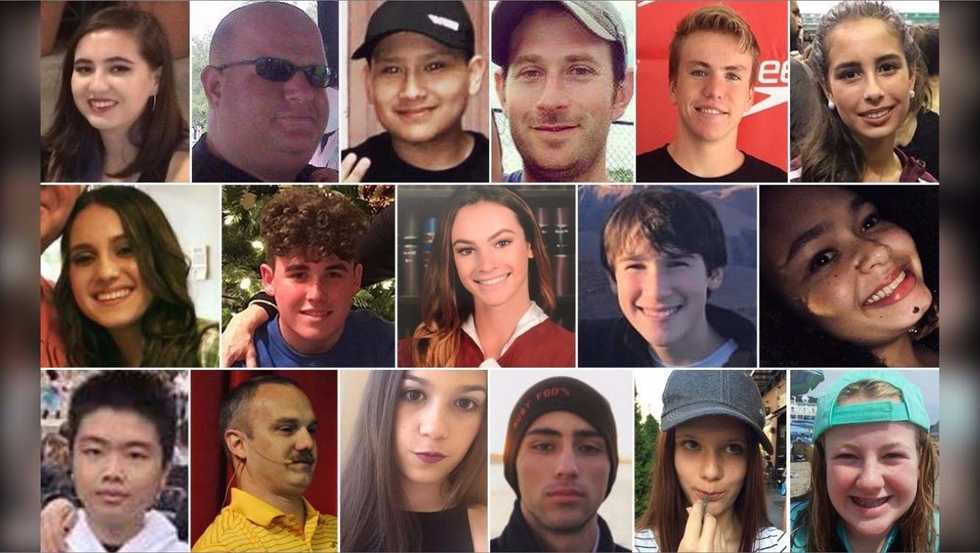
People were shocked after Columbine (1999). They were shocked after Sandy Hook (2012). Now it is 2018 and 17 more people are slain after a shooter entered the Marjory Stoneman Douglas High School campus in Parkland, Florida and opened fire. This shooting has since knocked Columbine from the list of the worst U.S. mass shootings, four of which have taken the lives of those simply attending a normal day at school.
All throughout social media and the news, people are once again calling for a change in policy regarding gun control, being criticized for bypassing the mourning of the victims, which typically follows immediately after a school shooting. Somehow, the following events after these tragedies have become more or less formulaic, especially for politicians.
Congressman Ted Deutch of Florida has received much counsel from his colleagues for what to expect after this sort of tragedy, since so many have dealt with this at some point in the past. It is simply impossible to deny this act of violence as a “commonplace” in this day and age; there have been 212 school shootings in the 21st century; these have resulted in 227 deaths and 278 injuries. Although the statistic of the amount of school shooting is disputed due to different guidelines (Ex. a gun being discharged on a school campus versus a gun being discharged and causing injury and/or death to others), the most important number to reflect on is the deaths and injuries that have resulted.
Along with the “procedures” that politicians have after this kind of tragedy, the public also has a similar reaction from one incident to the next. The vicious cycle ensues on the news, social media, and beyond: tragedy, thoughts and prayers, ideas for political action, and soon quantified as a statistic and forgotten by the masses.
A man reflects on Columbine and its coverage compared to what we can expect from the most recent school shooting in Parkland:
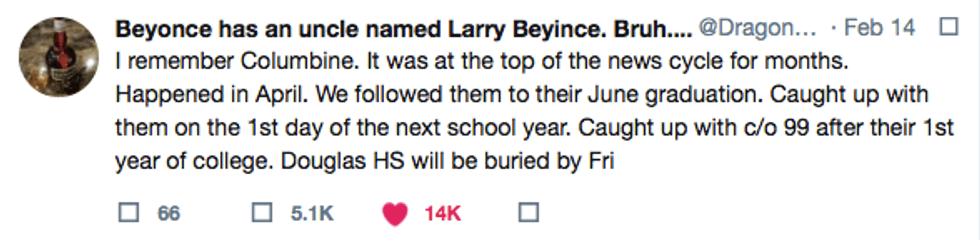
I saw the story of the shooting in Parkland while exiting class and I felt many things, but I was not shocked. I have since spent much time after this tragedy to reflect on why this seemed like an expected occurrence to me. I thought back to Sandy Hook and how scared and confused I had been. How could this happen at a place where a child is supposed to feel safe? A place where I had been just 3 years earlier: elementary school.
Sandy Hook was the first school shooting that I was able to understand the levity of the situation. I was thirteen and suddenly had to deal with underlying fears that maybe this could happen at my school, to my friends, and to the faculty I interacted with 5 days a week. The introduction of lockdown drills began and procedures were formed. Sandy Hook faded away with time just like Columbine had, but this time it left peoples’ minds faster.
The country saw many bills come and go after Sandy Hook, which were defeated in the senate in early 2013 (i.e. the Assault Weapons Ban of 2013 and the Manchin-Toomey Amendment). The reality of how often mass shootings occurred became a factor that was fresh in many minds. That is when the lack of change gave us all a reason to forget.
As time continues to move on from Columbine and Sandy Hook, numbers continuously climb of those killed in mass shootings in the United States in recent years (2015, 2016, 2017). These tragedies, and deaths that accompany them, keep leading us to the same place: waiting for someone to take the opportunity to prevent them.
A basic right that exists in the United States is our ability to speak up for what we believe in. Yet for many, it stops there. Change cannot occur if one does not act on the beliefs they seem to carry so strongly. Being active in your politics and remaining informed are just a few ways that tragedies like that of Parkland, Sandy Hook, Columbine and the other school shootings that remain nameless to many don’t remain “the new normal”, as former chief of police Bill Bratton had dubbed these horrific acts.
I hope to not let the tragedy that occurred February 14, 2018 at Marjory Stoneman Douglas High School in Parkland, Florida slip from my mind as days pass. I hope that students and faculty do not continue to grow up to feel as though school is not a safe place. I hope that change will finally come; something that will alter the stigma of school shootings in America.
"Every American must commit to taking action to end gun violence — we must demand more than 'thoughts and prayers' from our lawmakers, and they must find the courage to be part of the solution and finally put a stop to this."
- Shannon Watts, founder of Moms Demand Action for Gun Sense in America.