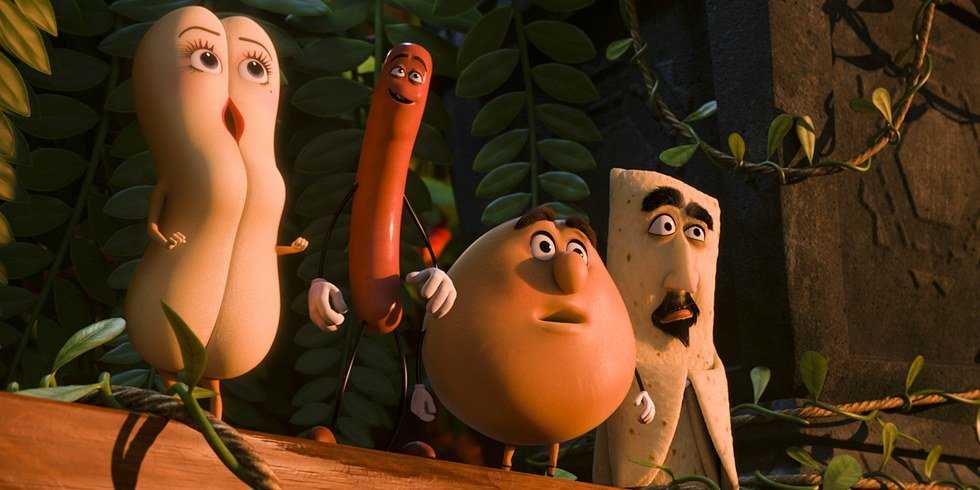
In a landscape of CGI animation dominated by talking animals and singing princesses making billions of dollars, the twisted love child of Seth Rogen and Even Goldberg, "Sausage Party" inspires to be a drastic diversion from the norm. Taking its name as vulgar as possible, the film follows the same path as other adult animations like “South Park” by being as dirty, crass and overall inappropriate as possible. However, also playing from the playbook of Matt Stone and Trey Parker, "Sausage Party’s" plot is constructed with a deeply rooted allegory that explores religion, gender and death underneath all of the drug and sex jokes. If Stone and Parker have proved anything, it is that creating a happy medium of the two is very difficult without the story falling apart, becoming too preachy or coming out into offensive territory. So the question is do Rogen and Goldberg have the ability to walk that fine line with such finesse? For the most part, yes.
"Sausage Party" plays out like "Toy Story" in a grocery store, where food is completely contentious and greatly anticipates to be chosen by the gods (humans) to leave through the main doors and into the great beyond. With the 4th of July season in swing, for Frank the sausage (Rogen) and Brenda the bun (Kristen Wiig), it means they can finally lose the purity of their packaging and be free to enter each other. However, after an accident throws them off the shelves, the horrible fate of what becomes of all food in the hands of the gods is revealed to them. Frank, who has questioned the proof of the afterlife suddenly has the confirmation of his suspicions, while Brenda is still a firm believer of the great beyond. The parallels to religion are very prevalent and central and the film makes every effort to thin the line between allegory and reality. Even to the point where two conflicted characters in the film are a bagel with a stereotypical Jewish accident and a lavash named Kareem Abdul Lavash who fight over their holy shelf space. In fact, a majority of the food products in the film are based on racial, religious and/or gender stereotypes such as a bottle liquor named “Firewater." If just that name alone offends you, then perhaps you should avoid "Sausage Party," however, they are not just used for cheap laughs. Rogen and Goldberg attempt to use these stereotypes to illustrate the divides that we set up around ourselves based on superficial attributes and appearances. It’s not always quite effective as the two probably hoped it would be, but it is enough to prevent from writing off the film as completely juvenile. Ironically, What really helps carry the ongoing plot is just how much it goes all in with its R-rated aspirations from having a villain that is literally a walking douche to portraying a supermarket orgy. "Sausage Party" is at its best when it lets its dirty nature run wild.
All of these comments are very indicative to "South Park" as well, when they made the jump to the big screen back in 1999, yet what prevents "Sausage Party" from reaching that same acclaim is its shortcoming in pageantry. Despite having heavy theological themes, the film never feels profound with its dialogue, and, for the most part, still paces itself off of the typical animated film template. The result at times makes the story feel like a fun deviation from the norm rather than a deep and challenging narrative. In many ways, that is a good thing, as its messages in diversity and tolerance need to be enforced during this political landscape, but one can’t help wishing it took the time to go deeper. Also, the quality of animation might be enough to throw some audiences off. The simplistic design is a nice touch that never comes off as too flashy, but for seasoned animators or animation fans, there will be notable moments where the rendering becomes choppy. Much of this probably has to do with the film’s micro-budget of $19 million, which was allegedly achieved by forcing some animators to work with unpaid overtime. Although this does not lead in judgment to the film itself, it is a reminder of the difficulty creatives face in the entertainment industry. Working on a film like "Sausage Party" would be a privilege alone for a seasoned animator in a mostly family friendly market so for them to have to potentially endure such unjust treatment is heartbreaking. The conclusion of the film does leave a lot to be desired as well and comes off as a bit like mugging, a hindrance of one of Rogen’s other creative efforts, "This is the End." Although, it does provide setup for what could potentially be a pretty interesting sequel.
"Sausage Party" isn’t quite the Pixar of adult animated movies, but it is a fun diversion and one of the funniest films this year. When the film goes all out in the absurdity and debauchery of its concept, then it's at the height of its comedic chops. Rogen and Goldberg have crafted something that is genuinely entertaining and clever with a theological subtext that perhaps is not quite as deep has they think it is, but still positive and important none the less. Its strong use of stereotypes might cause knee-jerk reactions from more conservative filmgoers, but given time, they may see their reason for using them. Although the animation is B-grade at best, it still has a charm to it that is appealing, even if the corners they cut are gapingly noticeable. Despite all of this, "Sausage Party" does prove to be a fun time at the movies in the summer infested with dull sequels and duds. Here’s hoping "Sausage Party 2" doesn’t become one of those in a summer blockbuster season of the future.