I have a controversial announcement to make — my favorite Nickelodeon show is "Rugrats."
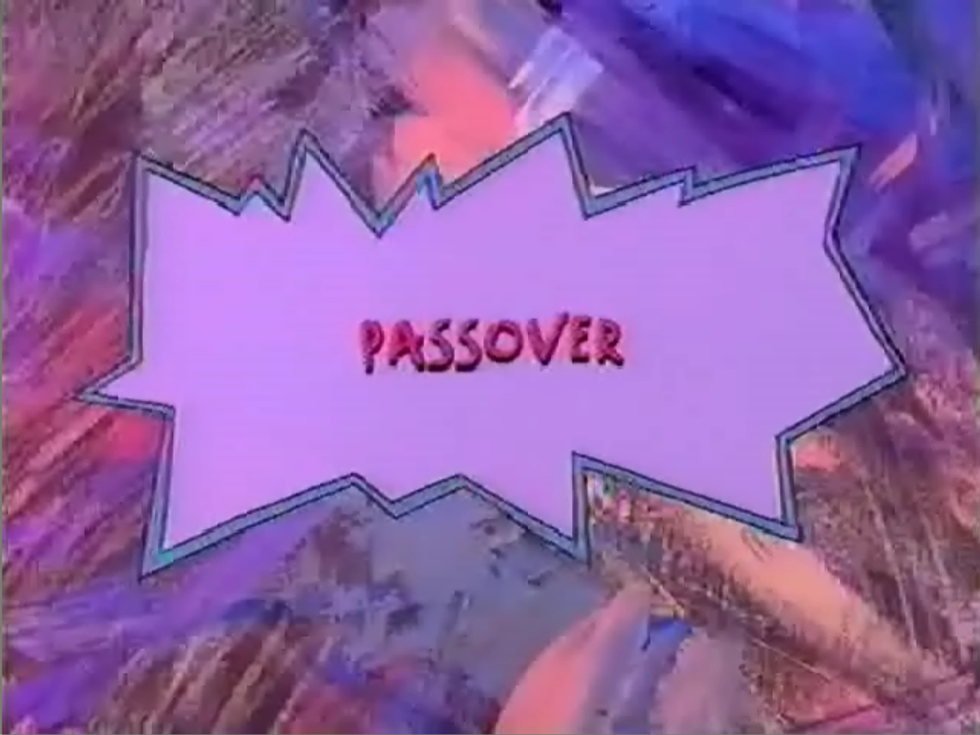
Yes, I know that "Spongebob" is a classic, and quoting "The Amanda Show" never gets old, but Tommy, Chuckie and Angelica hold a special place in my heart (and it’s not just because Tommy is supposedly based on The Doctor). My love for the Pickles’ gang springs from two very important episodes: "Rugrats Chanukah" and "Rugrats Passover."
As a young Jewish girl, I always felt left out during holiday seasons. I did not relate to the Christmas revelry crowding the radio, and I had never experienced Easter like the Peanuts crew. I had my eight nights of Chanukah and my eight days of Passover, but popular culture never seemed to care much about my important days. So when I first realized that Tommy was also eating matzo, I was thrilled to see my life represented on screen in the mainstream.
Tommy’s grandparents, Boris and Minka, were my grandparents. My grandparents were also immigrants with heavy Eastern European accents who sprinkled Yiddish phrases into their speech. I was able to relate to the chaos in synagogue during the Chanukah episode, and I understood Angelica’s moans when her mother told her she could not eat cookies on Passover. I couldn’t help but smirk at the thought that for once I was on the inside of all of the cultural jokes. I loved the idea that Christian children were being exposed to my religion in the same way that I could never avoid theirs.
As a Jewish girl living in America, I learned about Christianity from a very young age. It is an instrumental part of American culture. I never had to go out of my way to learn about it; it was always just there. Somebody might look at adult shows like "Curb Your Enthusiasm" or "Entourage" and say that Jewish people are highlighted on TV quite enough, but little kids don’t have access to HBO. They are not (or at least should not be) seeing the extravagant Hollywood bat mitzvah hosted by Ari Gold or the Jewish high holidays as told by Larry David. Instead, children watch cartoon Christmases in countless different fictional worlds. They have no way to know about my holidays because, for the most part, my holidays are not being broadcasted to them.
Watching "Rugrats" might have been the first exposure that non-Jewish children had to Jewish stories and traditions, and the show seemed to realize that. It did a very good job of presenting the holidays in a way that was not only entertaining, but also accessible for members of all faiths.
Notably, Tommy’s mom and grandparents were the only Jewish characters on the show. His friends and the rest of his family were not members of the tribe (although they were not all Christians — in the Passover episode, Chas, Chuckie’s father, says he’s “not really anything.”). Much like non-Jews in real life, the cartoon goyim didn’t know much about the Jewish holidays, but ideology did not stop anyone from learning about and experiencing Judaism. As Grandpa Boris taught the characters about why the Seder night is different from all other nights, many viewers were hearing the story for the first time, as well.
It might seem weird for me, a white girl, to write an article about the importance of representation on screen. After all, every actor nominated for an Oscar for the past two years has shared my complexion. Some people even joke that Jews control the media. But in the increasingly anti-Semitic world in which we live (for proof, see that “joke” about Jews controlling the media), having my stories shared has never been so important.
A friend of mine at a small liberal arts college in the midwest was recently told that she does not understand discrimination because she is “passing as a non-Jew.” Because my friend doesn’t fit the description of what a Jewish girl is “supposed” to be like, somebody was trying to erase her undeniable cultural history of persecution. Didi Pickles' hair is bright orange, not a stereotypical dark brown. Does that take away from the fact that pogroms likely forced her parents out of Russia? I wear shirts that expose my shoulders even though traditional Judaism dictates that my shoulders should be covered. Does that take away from the fact that my grandparents are Holocaust survivors?
"Rugrats" is so important to me for two reasons. The first is that hate is often born from ignorance. The person who accused my friend of passing as a non-Jew clearly has a very narrow perspective of Judaism. Perhaps if that person had watched "Rugrats" as a kid, she would have grown up with a better understanding of different faiths and cultures and would be more comfortable with the unfamiliar in her adult life.
The second reason is because, during holiday times, network television is flooded with nothing but Christmas and Easter specials, leaving non-Christian kids hopelessly searching for a sign that their cultures exist outside of their own little bubbles. In a world filled with pastel eggs and Christmas miracles, "Rugrats" was the only mainstream program about my life. As a little girl who had no Santa Clause or Easter Bunny to believe in, I felt like I was missing out when I saw all the fun the Christian families on television were having, but I never saw my own festivities.
There is nothing more exciting for a child than seeing him or herself on screen. That could mean seeing faces with their skin color or seeing people practicing their traditions. As a kid, I saw myself in Tommy Pickles, the diapey-wearing, screwdriver-wielding baby boy. All these years later, I still do.