
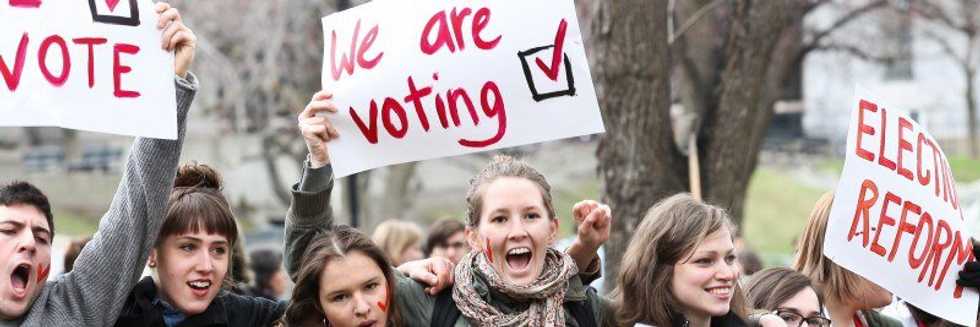
You have a Bernie sticker stuck to the back of your laptop. Your friends laugh about the ridiculous things Trump said in his speech, even share the video on Facebook to share the joke for all to see. Maybe you speak up in class, argue with a few kids on social policy and gain praise from your professor for being so politically involved. All these things make you a typical college student, idealistic and full of ideas. When it really comes down of it, will you vote in the primary or national election?
Many college students who identify as being “interested” in what’s going on in the political world aren’t actually registered to vote in their home state. On National Voters Registration Day, only a handful of students at my own university actually came to register for their home state, even with all the paperwork laid out for them. There are political clubs, groups, and courses all at our disposal, and yet the amount of millennials who actually cast their vote, according to the Boston Globe, is only about 19.9%. So why is there such a disconnect between political interest and political action?
Media can play a huge role in the lack of political action taken by college-aged students. All around us are attack ads and angry tweets, emphasizing the competition between candidates but excluding the real policies, they stand behind. Videos are edited to take out what is believed to be “boring” content, leaving only the incriminating and outrageous comments made in debates and interviews.
With all this negativity being portrayed in the media, it is easy for millennials to feel disenchanted with the political process, as well as unable to clearly decipher the important values that they can agree with.
Instead of airing commercials encouraging the youth to educate themselves on the candidates’ policies, they continue to air slander and petty competition. Our generation spends a good amount of time of the internet, so why not air commercials that support voter turnout and education? Subconsciously, college students are bound to consume the media presented to them. For our attitude to change towards voting, media representation needs to change as well.
Another obstacle that many university students face in their voting pursuits is the difficulty we have to go through to obtain an absentee ballot. For many of us, the state we go to school in is not our official residency. Even though some of us are registered to vote in our own state, we still have to go through the absentee ballot process in order to cast our votes in our own primaries. In such a digital age, it can be a pain to be unable to register online for absentee voting, especially when physically going to our own registry offices can be impossible. Instead of catering to the needs of out-of-state students, the system lets possible future voters slip through their fingers. I’ve heard more than once that people just couldn’t get an absentee ballot in time, rendering them unable to vote in the primary, even if they wanted to. If every state made it possible to obtain an absentee ballot online, or even at a resource center on campus, many more students would be able to have their voices heard.
Our generation’s vote is so important to our political system. As future doctors, lawyers, engineers, and thinkers the future of our country lies in our hands. Missing the chance to vote, either because of disenchantment or inconvenience, can be detrimental to the voice of millions of young people who will be most affected by whoever wins the presidency in November. Our country needs to step up to the plate and attract more millennials to want to vote, or else a huge number of the population will end up unsatisfied and unheard in the political process. We as young people can.