The Witch is the feature film debut of Robert Eggers. It's both encouraging but actually more slightly discomforting when first time directors make movies that are so near perfection, so impossible to shake from the mind. American Beauty, Being John Malkovich, Capote, and of course Citizen Kane, were all made by first time directors. Whiplash, my favourite film of 2014, was also made by a first time director, based on his own short film. I feel a fresh energy in these films. Something is in them that can't be created by experienced filmmakers. Seeing these films, knowing they are the starting point of a potential career, adds an edge, a virginal excitement at the possibilities that are available for these young visionaries. They have been given a chance to prove their worth, and they prove themselves a thousand times over.
The Witch is, unsurprisingly, a horror film, but don't go expecting to jump out of your seat in fright, or wait until you release a scream of terror. These actions will never be necessary. Eggers masterfully draws you slowly into the story as it plods along with dread in it's veins. It's set in the mid-17th-century in New England. It tells the story of a family of English Puritans, recently having moved from England to the New World, who at the beginning of the film are banished from their community by a panel of religious elders. The reason for their ousting is never explained, although it is hinted that it has something to do with the father William's inability to follow the rules set forth by the religious elders. Does he recognise something wrong in their leadership?
It is hard to understand their reasons why, but the family decides to make a home in an abandoned clearing that is right beside a massive, forbidding forest that can only mean danger and death to us metaphorical-happy viewers. The wife, Katherine, is a pious, God-fearing woman, who is the mother to Tomasin, a fresh-faced daughter who we sense knows something the others don't, maybe not consciously, but there's something that stirs in her being. There is also Caleb, the loyal son, who is left confused by the things he is told and made to repeat about God and original sin. Then there is Jonas and Mercy, the two plump youngsters, who are never cute and playful, but sneering and disobedient. There is also a new baby, Sam, who is stolen from the family when Tomasin ventures too close to the wood. Who steals the baby?
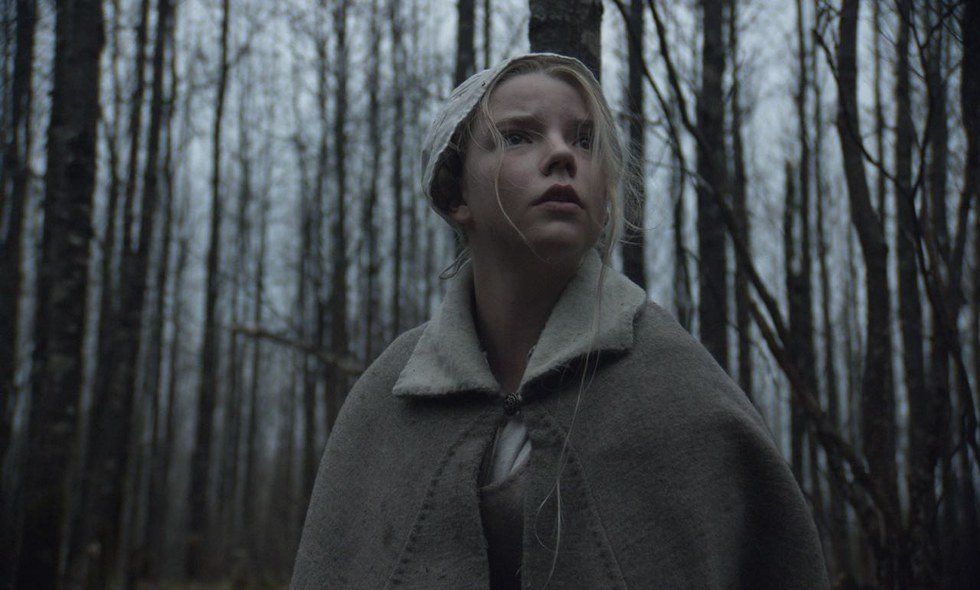
The main focus of the film is on Tomasin, who, in an ideal world, devoid of suspicion and religious hysteria, would be sweet and innocent. But she is a victim of the Puritanical mind. It is heartbreaking to watch the mother berate and mistreat Tomasin because she was with Sam whenever he disappeared. We see Tomasin struggling to be a righteous woman, but there's a force in the wood, that pulls her ever closer, as the family falls apart.
We see the form of this evil force in a haggard, disgusting, bent-up old woman, who we glimpse in ambiguous lighting, naked and carrying out a bloody ritual on what we can only guess is the sloppy remains of baby Sam. The montage of images Eggers creates, of the witch preparing her ghastly ceremony is some of the most horrifying and uneasy images I have seen in a horror film.
There is some bloody violence in the film, but so much of the horror comes from what we are unable to discern or understand. For me, that's what makes a horror film great: not being shocked or grossed out, but rather made to feel unhappy, unaware of what is going on, anxious and agitated. Every element in the film achieves this end, beginning with the meticulous detail of the clothing and the settings, bringing a tangible realism to the supernatural happenings. Egger's color palette is all greys and browns, evoking the colorless world the settlers created for themselves, vulnerable to the attack of mischief and evil. The music is voices and strings, rising in haunting crescendo, emoting a hair-raising sensation, particularly when they first encounter the wood. The characters seem constantly confined within dark rooms, amidst dense trees that are tall and villainous and sloping attic ceilings.
Robert Eggers' research for this film was intense, and at the end we are informed some of the dialogue was taken straight from contemporary accounts. Another good horror, The Conjuring, also claims to be based on true accounts. This may be so, but there is also a sense of embellishment to the story for entertainment's sake. The Witch is not the same. We are shown a world that is just as it was. It was another time, a time so far away from us, so distant that we look on it as a chance for fiction, or a time only historian's must deal with. Eggers film is just that, a film, but it is also a folktale, a parable, an attempt to show us the consequences of fear-mongering, of establishing a society based on patriarchal dominance and unquestioning devotion to an ideology. Tomasin has the desire and the will to do what is expected of her, but in the end she is helpless to resist the dark and foreboding evil of the witch.