You probably know Sam Mendes for his Bond films -- "Spectre" and "Skyfall" -- but under his belt also lies a very respectable entry in the realm of mob films -- "Road to Perdition," also starring Daniel Craig, though as a much less likable character. This is a critique of that film based upon Aristotle's six elements of drama and shall thus contain spoilers that would greatly diminish the film's impact upon first-time viewers. So, in case this movie managed to slip under your radar, I would highly recommend seeing it prior to reading on; and if you are still here, let us begin by delving into that which stands out to an audience the most.
Plot
The story revolves around an Irish mob in Depression-era Midwest. Our protagonist and antihero, Michael Sullivan (Tom Hanks), is working under a man named John Rooney (Paul Newman). Despite not being related by blood, the two share a father-son relationship. Rooney's son, Connor (Daniel Craig), on the other hand, is envious of Sullivan. The two's relationship only goes downhill as Michael's older son, also named Michael (Tyler Hoechlin), accidentally witnesses Connor impetuously murder a man while on an assignment. Claiming the boy would talk, Connor attempts to murder Sullivan's family, ending up leaving only him and Michael Jr. alive. From this point forward, we see the father and son embark on a journey of revenge against the people who gave them everything, just to take it all away in the end.
Structurally, the plot is very linear. It tells a story that spans roughly six weeks and does so from start to finish, without any flashbacks or distractions. It does not shy away from foreshadowing either and might even seem quite predictable to an observant viewer, for better or for worse. The story develops fast, and based on a graphic novel, a lot is told through visuals. A great example of this is when Maguire (Jude Law) receives an order over the telephone to kill Sullivan and his son. During this scene, we do not hear the order itself; instead, his targets are revealed through the sketch he makes while talking. The film also includes some metaphorical shots such as Michael Jr.'s bicycle covered in a sick layer of snow as he flees home with his dad -- this denoting his loss of innocence. Another example is when Sullivan is killed while seeing his own reflection in the glass window, his falling body revealing another hired killer, Maguire, behind him -- this signifying that the life he led was what killed him in the end.
Character
"Road to Perdition's" characters are well-acted, yet too established. Not much development is given to any of them, except Sullivan and his Son. This is excusable, as the entire story occurs over the period of barely two months, but still, the fact remains that their actions are foreseeable. This was also the main point of criticism in the late Roger Ebert's review, where he compared the film to a Greek Tragedy whose impact was muted due to characters' fixed and blatant characteristics. Nonetheless, the film manages to make its otherwise cold hearted mobsters likable. Seeing Rooney torn between sacrificing Connor or Sullivan, and seeing Sullivan shoot the man he looked up to is very impactful. Michael's growth and the chemistry he develops with his father is heartwarming and all the personages compliment each other perfectly.
Theme
Here, the film gets very interesting. One of its most unique aspects is its focus on two characters, two Michaels. Both their stories have their own respectable themes. While Michael Jr.'s story is a "Coming of Age" one, Michael Sullivan's is one of "Complexity of Human Relationships." The film also pays a great deal of attention to its plot and due to cinematographer Conrad Hall's award-winning work, it carries a beautifully unique visual style; but more on that later.
Language
Another of the film's strong points, the voices fit characters thoroughly. Bodyguards talk in a very coarse manner and the higher ups' words are harsh and reserved. Connor's and Rooney's manners of speech are as far apart as their personalities and every exhibit of anger sends shivers down one's spine. All this builds up tension during every vocal confrontation as the words sound like they will be replaced by gunshots any moment.
Melody
Tense and adventurous at the same time, the score sets a tone for the film perfectly. It's as if it's showing the world through both the Sullivan's and Michael Jr.'s eyes; former mostly seeing it as a journey towards revenge, while the latter as an adventure.
The sound design makes the scenes all the more powerful. A great example of this is when Michael Sullivan is about to kill Rooney. As he starts firing away at the guards, the sounds of the world are muted, only the music playing. Once all guards are dead and Sullivan emerges from the darkness, the sound of rain slowly fades in. As he shoots Rooney, only the sound of his Thompson is heard. Standing surrounded by corpses, the music starts to fade back in.
Spectacle
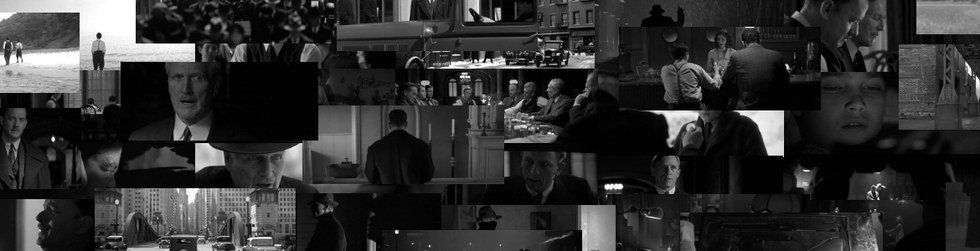
This is the aspect of the film that got it the most praise. Conrad L. Hall did an amazing job with the cinematography. Roger Ebert said he created "a limbo of darkness, shadow, night, fearful faces half-seen, cold and snow;" I could not agree more. Still, what I find amazing is that even midst all the rain and the snow, the atmosphere feels comfortable and cozy, in its own strange way. The costumes are spot-on and the amount of work put into a recreation of 1930s Chicago is astounding. The vast landscapes and the empty highways of the countryside inspire freedom, while the pompous architecture of the city underscores the mafia's power.
"Road to Redemption" is a breathtaking ride from start
to finish; well worth watching. On a scale of zero to five, I give it a
solid three.