
Pablo Larraín's Neruda is a film that's eponymously about a poet and strains hard to not actually be about him, mostly with great success and entirely with compulsive watchability. It'll be criticized (not entirely wrongly) for being poetic, an indulgence of flowery language that circles around Pablo Neruda, one of the floweriest poets of the modern era. But it's an arresting work, a proper art film that steals (not copies) from the masters and creates its own world that grabs you from beginning to end.
I must preface that I really know very little about Pablo Neruda. I liked his poetry at the beginnings of my foray into the Spanish language, but I drifted away from him as I burrowed deeper into Spanish. And I know even less about Chile, aside from some of the basics of Pinochet (a lot of which comes from Larraín's previous film NO). I watched the film in Madrid, which meant there weren't subtitles.
Now, I've lived for over a year in Spain, studied it as my major in university, and am good enough to direct a short film in the language, but it's not quite perfect or nuanced enough to understand every detail of the Chilean dialect. As someone who's learned most of it in Spain, I can reasonably say watching the movie is like if I were an immigrant to London who learned British English and then tried to watch The Wire: it's not the biggest difference in the world, but there are certain subtleties lost.
With that all in mind, it's no small matter how affecting I found the movie. It revolves around the (presumably made up) Inspector Oscar Peluchoneau (Gael García Bernal) and his hunt for Chilean poet Pablo Neruda (Luis Gnecco), whose communist ties in the late '40s force him into hiding, much to his annoyance and dismay.
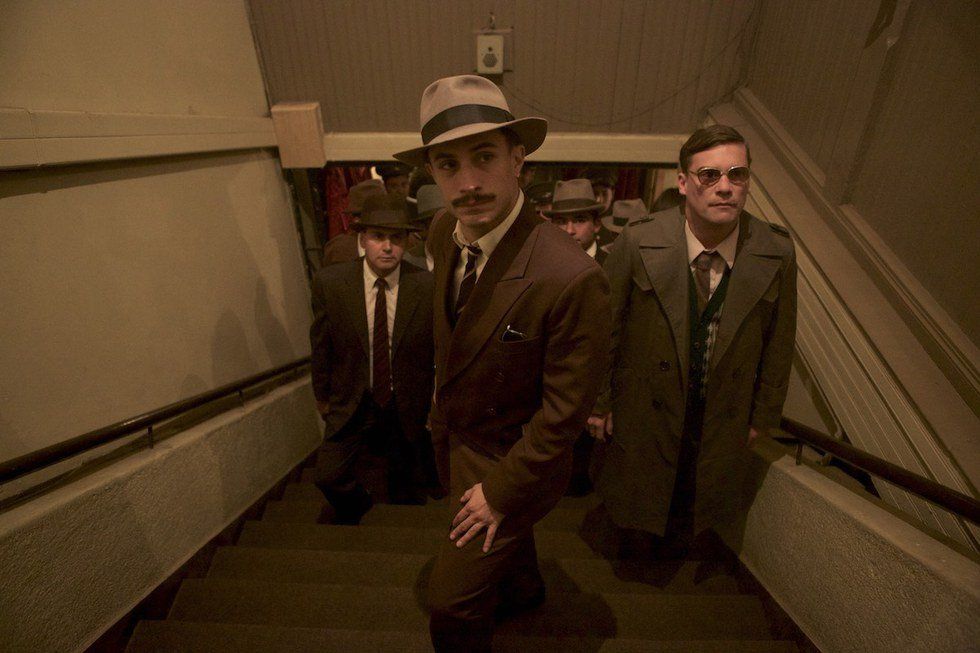
While Neruda, with his great fame and colorful personality, is at first the more engaging character, the movie succeeds in the tightrope act of pivoting more to focus on Bernal's character. And it's to Bernal's credit that he doesn't come off as a bland everyman that's meant to draw us more into the story. With more than a few obvious parallels to The Conformist, Bernal is the spineless bureaucrat, a man with no guiding moral principle nor conviction. Dressed like a Latino Alain Delon, he's all surface and no depth, and what the film does brilliantly, instead of accepting this as a narrative device and moving on, is that it makes his realization that he's essentially nobody (and even fictitious) the core of the narrative. He's a Pirandello character in search of an author, and maybe the poet Neruda will give him some purpose, the Philip Marlowe he wants to be but can't.
If that sounds too artsy and pretentious, it has to do with the fact that it is, to a certain extent. But it didn't bother me in this case because I never got the sense the film wasn't already aware of this. It knows it's a poem, a film that goes for the fences. If it stumbles, so be it. One of its more irritating aspects is that few conversations in the movie seem to adhere to the basic physics of the space-time continuum. Almost every scene features characters holding a single conversation in different places at different times of day, the dialogue all occurring in chronological order but clearly impossible to have actually occurred because the editing jumps back and forth among these settings. But so what? At least the filmmakers are making a brave choice: shunning away the form that's expected of a film. It's a film of ideas and emotion, not of turns and plot that carry a story along a straight and narrow path.
The film's self consciousness extends beyond the script and editing, even. The cinematography is truly a bizarre mix. I initially avoided NO for Larraín's choice to shoot the film on camcorders from the '80s, thinking it to be a pompous attempt at verisimilitude. After seeing the film, not only did I get used to it, but I conceded it was the best format to shoot that particular film in. It not only immersed you in the world but helped blur that line between documentary and fiction, seamlessly cutting in protest footage and TV commercials creating a universe, one that actually existed at a point in time.
In Neruda, the film is obviously shot on digital, maybe an Arri Alexa. But the color treatment looks like it's imitating three-strip technicolor. And the lenses are anamorphic, mostly with very short lenses. So it's a bizarre combination of the 21st century, the late '40s, and the '70s, respectively. I can't figure out why Larraín chose to shoot the film this way, other than it looks interesting. And I can't fault him for that, despite the fact there are so many lens flares in it that it'd make J.J. Abrams flinch.
I know I'm harping on a lot of the film's more negative aspects, but they're minor quibbles when compared to the grandiosity of the film. It really is a breathtaking and befuddling work, a weird arthouse film that's more operatic and just BIG than the great majority of indies coming out now, especially non-American ones. It helped reaffirm my love for genuinely offbeat films, like a shock to the system. Does it succeed on every intellectual level? Definitely not. Did it make me feel? Oh, hell yeah.