“Marriage is about repetition. Every night the sun goes down and the moon comes up and you have another chance to be good. Romance is not about repetition.” As a theatre artist, you hope to be as consistent with your performance as possible, but you always self-indulge in your work with the expectation that it come out perfectly, only to result in imperfection. Despite this, you should be willing to enjoy your time onstage, and expect some imperfections along the way.
MacArthur Fellowship winning-playwright Sarah Ruhl truly emphasizes this in her backstage romantic comedy “Stage Kiss,” which recently opened at the Hippodrome Theatre in Gainesville, FL. This production, under the direction of Tim Altmeyer (who appeared on Broadway in “High” opposite Kathleen Turner), marries the conflict of passionate love and compassionate love with the slapstick physicality you would expect in a backstage sex comedy.
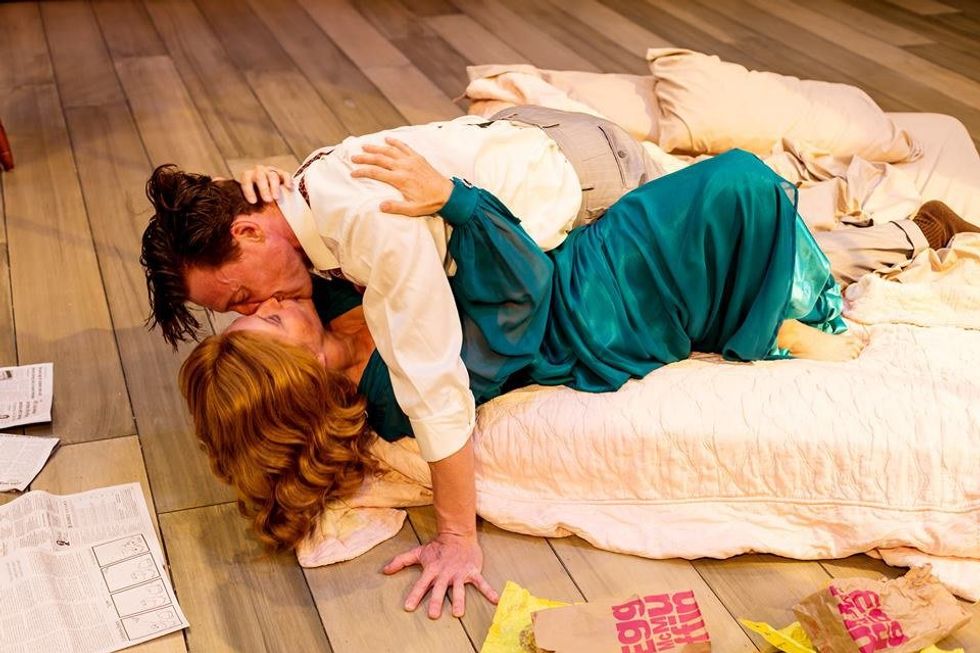
First premiering at Chicago’s Goodman Theatre in 2011, “Stage Kiss” would open at New York’s Playwright’s Horizons three years later. This is one of Ruhl’s more recent works, having written award-winning dramas such as “The Clean House,” “Dead Man’s Cell Phone,” “Eurydice,” and “In the Next Room, or The Vibrator Play.” The play is a true “Life Imitates Art” loves story concerning two actors/exes—known simply as “He” (David Patrick Ford) and “She” (Stephanie Lynge)—who meet after twenty years of estrangement when cast in a poorly-received 1930’s Melodrama called “The Last Kiss” opening in New Haven, Connecticut.
We view the two lovers from auditions to opening night as they prepare for a stage kiss that alters their lives (not forever, though). While this onstage “show-manse” continues after the play closes, their director (Gregory Jones) casts them in an “edgy” poorly written original play set to premiere in Detroit. As the two work on this production, She realizes the mistakes she is making by leaving her financially-sound-yet-super-sensitive husband (Michael Krek) and vile, profanity-spewing teenage daughter, Angela (Summer Pliskow), for an almost childish romance.
With the Hippdrome’s three-quarter thrust staging, Altmeyer is able to provide his actors with the opportunity to move freely onstage. Unlike previous productions at the Hipp, where sightlines were easily blocked due to the space’s seating arrangement, this production allows the actors to be seen from multiple angles. While the pacing of Ruhl’s text can be choppy and random, Altmeyer is able move the play at a pace that would rival the door-slamming backstage farce “Noises Off” without milking a joke.
Despite this, no moment of pathos is spared for the sake of cheap laughs. One notable and touching moment is during the final scene of Act II, where “She’s” opening night reunion with her husband is interrupted by “He’s” final goodbye to his onstage lover.
As “She”, Lynge (Broadway: “Beauty and the Beast”) charms the audience with her spot-on comic timing and honest vulnerability onstage. Lynge also puts her legit soprano voice to use when singing the two or three musical numbers (including a duet of “Some Enchanted Evening” with Ford). Lynge even pulls off singing “badly” in an effective manner. Ford (National Tour: “The Full Monty,” “Footloose”) is able to bring a sense of humility and quirkiness to his leading man character (given his short stature and the spontaneous choices he makes).
Similarly, both characters know how to distinguish the mannerisms made between their actor personas and the lovers they play in “One Last Kiss.” Some of the silliest moments delivered by Lynge and Ford as a pair include their opening night performance of the aforementioned play-within-a-play with Ford in crutches due to a rehearsal-related injury, as well as their random Irish and Brooklyn dialects in the second play.
Andrew Quimby plays the role of Kevin, a humble yet poor player who frequently brings his fellow actors near the brink of insanity due to his antics. His particular role serves as a source of comic relief from the main love triangle. Quimby, like Ford, is able to break any boundary onstage while staying true to his character.
The most memorable moments onstage come from Quimby, especially when his character overacts during rehearsals—to the point where he continuously gropes and kisses Lynge during the frequently-occurring kiss scene of the 1930’s play-within-a play. In Act Two, this overacting continues when he attempts a poor Southern accent in a stereotypical 1970’s pimp suit with bellbottoms, platform shoes, and cane (courtesy of designer Amanda Moore).
Krek, as She’s husband (who is as deep with words as proficient with numbers), is capable of becoming the straight man in this absurd comedy; juggling the infidelity and fantastical mindset of his wife (and her ex-lover-slash-scene-partner) with the anger and rebelliousness of his teenage daughter. Krek remains reserved throughout the evening, but manages to deliver a moving monologue about what it truly means to love someone, expressing his devotion to his wife while reminding her that she needs to focus on her own needs (including there for her daughter).
Pliskow, unlike most actors in this play, tends to approach her character in a one-or-two dimensional way: or so it seems. While her comic delivery is strong, she tends to use the same stereotypical speech pattern associated with a typical teenage girl. However, by the end of the play, we are able to see Pliskow use this character’s persona as an act of stoicism when expressing her desire for a stronger relationship with her love-struck and absent mother—displaying emotional vulnerability without breaking down or shedding a tear onstage.
Scenic designer Mihai Ciupe creatively and functionally creates three scenic locations (an audition studio, the set of the play “The Last Kiss,” and a dilapidated studio apartment in the East Village) with less than 500 square feet of stage space. Additionally, with a running crew of five technicians (under the tutelage of stage manager Amber Wilkerson), scene changes were relatively quick and well-timed, rather than detracting from the play’s tempo. Several elements of Ciupe’s design that are consistent with the play’s various locales include a hardwood floor treatment and two murals of couples passionately kissing (with their eyes blacked out during the second act, representing blind love).
However, every minuscule detail in the show’s various scenic location is put on display in this design—from the art deco French window and marble columns used in the “Last Kiss” set to the various brand name junk foods on a functional kitchen cabinet that appear in He’s run down apartment.
When designing the costumes for this show, Amanda Moore was able to capture every detail into the apparel that each character sports. The colors worn by each character in real life represents their personality: from Pliskow’s Angela in all black to Ford’s He in funky Native American ties and faded jeans. The 1930’s attire in the first play-within-a-play was period accurate and did not detract from the overall visual picture, but the 1970’s attire in the second play-within-a-play—with striped turtlenecks, bellbottoms, and miniskirts—seemed to be intentionally mismatched for the purposes of being downright absurd.
Robert P. Robins’ lighting design was simple yet effective in concept and execution. Very few colors outside of the standard blue or white were used (except for the occasional pinks and purples on the 1930’s window/cyclorama during “The Last Kiss”), and there were no fancy effects or strobe lights in use. The sound design, courtesy of Amanda Yanes, was equally to par with the remaining technical elements. The sound cues (ranging from various gunshots to instrumental accompaniment for two musical numbers) were placed at proper levels, and the timing of each cue was on point. Due to the size of the Hippodrome’s auditorium (approximately 300 seats), the lack of microphones was an asset for this production, even with actors occasionally breaking into song at select moments of the play.
If you are in the Gainesville area (especially if you are a student at UF or Santa Fe College), "Stage Kiss" is a production you don't want to miss. This production, with a well married blend of humor and catharsis, will allow you to think about the true meaning of love while laughing at the absurdities that come with backstage comedy.
Running Time: 1 hour and 30 minutes, including a 15-minute intermission after Act One.
Credits: Written by Sarah Ruhl; Presented by the Hippodrome Theatre (Lauren Warhol Caldwell, Artistic Director) and the University of Florida School of Theatre and Dance (Dr. Jerry Dickey, Director); Directed by Tim Altmeyer; Scenic Design by Mihai Ciupe; Costume Design by Amanda Moore; Lighting Design by Robert P. Robins; Sound Design by Amanda Yanes.
Cast (in alphabetical order): Brittany Caldwell, David Patrick Ford*, Gregory Jones*, Michael Krek, Stephanie Lynge*, Summer Pliskow, Andrew Quimby.
*Member of the Actors' Equity Association, the Union of Professional Actors and Stage Managers in the United States.
Opened: September 2, 2016. Closing: September 25, 2016.
Tuesday/Wednesday/Thursday at 7:00pm; Friday at 8:00pm; Saturday at 5:00pm and 8:30pm; Sunday at 2:00pm and 7:00pm.