
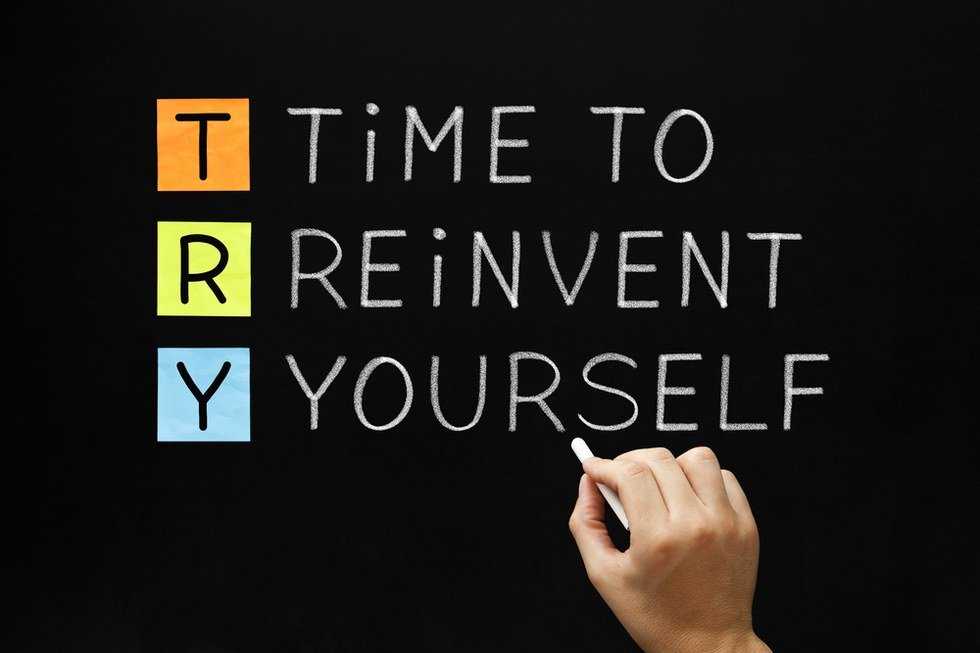
In just a few weeks, the Fall 2015 semester will begin, and it’s got me thinking about self-reinvention. Who do I want to be this year? What can I do differently? Who is the “New Me” going to be?
As people, especially of college-age, we’re constantly reinventing ourselves. Sometimes, we do so subconsciously, just by tweaking our everyday behavior. Other times, it’s more obvious. You might strive to project a professional image at a new job, or maybe you want to try out a different style because you're attending a new school.
There are plenty of articles out there that address the “New You” ideal. Why look back when you can start over? The “New You” can be smarter, fitter, healthier, nicer, better. (As long as you follow 10 easy steps.)
But what happens to the “Old You’s”? Do they just gather dust on a shelf with your 2000s boy band CDs and insecurities of years past? Do they disappear when you click “delete” on old Facebook photos? Is there some sort of “Old You” purgatory where they all remain for eternity wondering what they did wrong?
Well, the answer hit me quite simply. The “Old You” doesn’t go anywhere; it’s still part of you, hence the “you.” Much as we try to pretend, those dweeby, little sixth-graders with braces and oddly-shaped hair who we once were have not vanished. They’re still inside us, albeit, in a much less prominent form.
But, here’s the thing, I resent my past selves; I’ll be the first to admit it. I can’t look at a picture of myself from 2006 to 2010 without cringing. I find talking about my elementary and middle school years torturous, mostly because I remember myself as a stubborn, bitter know-it-all. I adored high school (no, really, I did), but I realized within the last month of my senior year that I spent four years pleasing other people in order to feel well-liked. I remember the bad parts of my past selves, and so I’d rather not think of them at all.
This is something I need to stop doing, and I strongly encourage anyone who feels similarly to do the same. Because how ridiculous is it to hate the “Old You”? Resenting who you were before is the same as resenting who you are now; both are parts of you. In order to be fully self-confident, we have to accept ourselves, even our selves from 2005.
With respect to our past selves, it’s easy to have tunnel vision and not consider the context surrounding who we were. Maybe as a teen you were kind of a snob because that’s how your friends acted and you weren’t sure how to break away from them. Or maybe you lived in a small town in high school which fed your naiveté. Chances are, you were narrow-minded at 13 because you were, well, 13.
And where would we be without the lessons we learned as our past selves? I, for one, would still be spending time with friends who didn’t truly care about me and wearing paisley-printed pants (with a matching headband). I’d still be scared to sing in front of an audience, and I’d still be running from conflict like a marathoner from the starting line. In other words, I wouldn’t have learned anything.
Rather than think, “I’m better off now,” we need to recognize that there were good and bad parts of being our past selves, but those good and bad experiences helped us become who we are now. Sure, maybe being a people-pleaser meant that I was a little behind in the understanding-myself department, but four years of paying close attention to other people fostered a sense of empathy in me that is a huge part of who I am. I might have looked like a complete dork in my middle school years, but eventually I learned that I didn’t have to ask anyone’s permission to change the way I looked, which is one of the most empowering discoveries I’ve ever had. I can pinpoint the exact moment when I decided to spend time only with people who make me feel happy and confident: at a summer camp when I was 16.
Our past selves are not to be ashamed of; they aren’t some sort of mutated version of us that should be hidden away in a dark corner for no one to see. They’re a step in the process. When you’re making a cake and you put all of the ingredients together, they don’t look appetizing at first; they’re just brown goop. But just because the cake isn’t finished doesn’t mean that the batter is bad or disgusting; it’s just on its way to becoming something delightful (that won’t cause salmonella poisoning). The same goes for our past selves; they should not be disregarded, as they are a vital part of creating and recreating who we are.
We need to take another look at self-reinvention. The “Old You” should not be despised, criticized, or forgotten. It should be analyzed and understood because figuring out which moments in our lives changed us is key to improving our lives in the future. We should appreciate what we’ve learned in the past and be thankful that we have the capability to change.
So, go ahead, work hard to improve yourself. Get those straight A’s, run that extra mile, do that thing you’ve been wanting to do. But when you’ve done those things, don’t beat up who you are now because you hadn’t done them yet.
How do we move forward? Yes, by striving to be better, to be different, but also by becoming comfortable with dusting off those Old You’s and saying, “Thanks for getting me to Now.”