
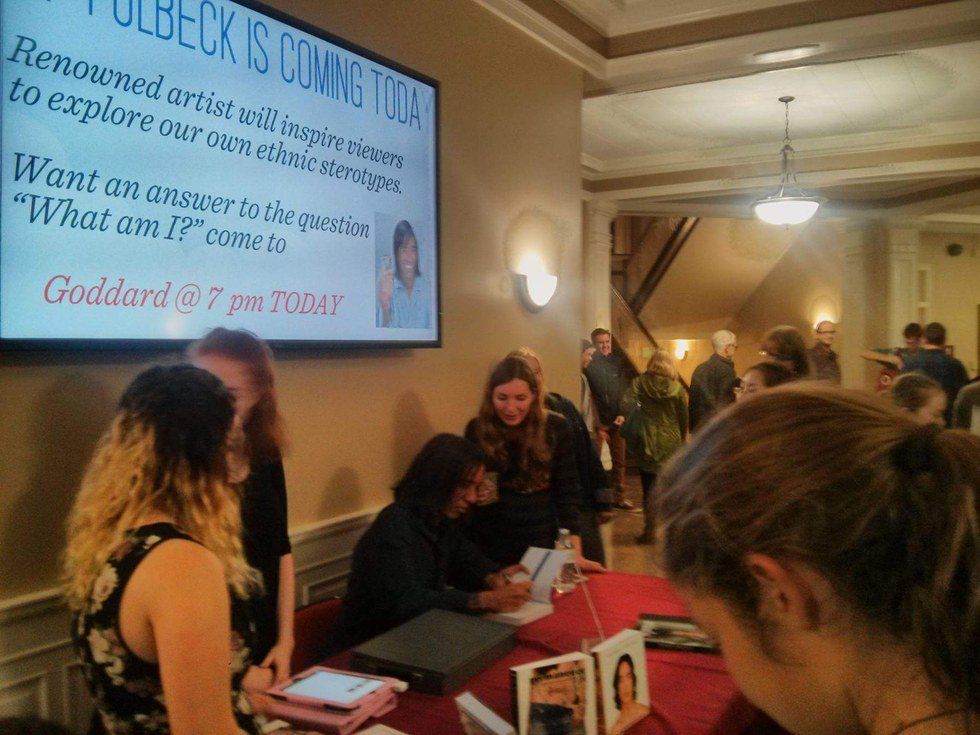
I met a man who devotes his life’s work to helping others grapple with their identity and explore the concept of mixing identities for the betterment of the human condition. The most important thing, he told us in his presentation, is to insist upon who you choose to be because, if you do not, others will do it for you, and this is not always a situation you want to be in.
Kip Fulbeck is a Chinese-American artist, teacher and surfer. But, of course, this brief description does not and cannot encapsulate all that Kip is about. I do not think I could adequately capture the essence of a person in writing, but I would like to share some of the most important points I believe he made in his presentation at Earlham on Friday, September 30.
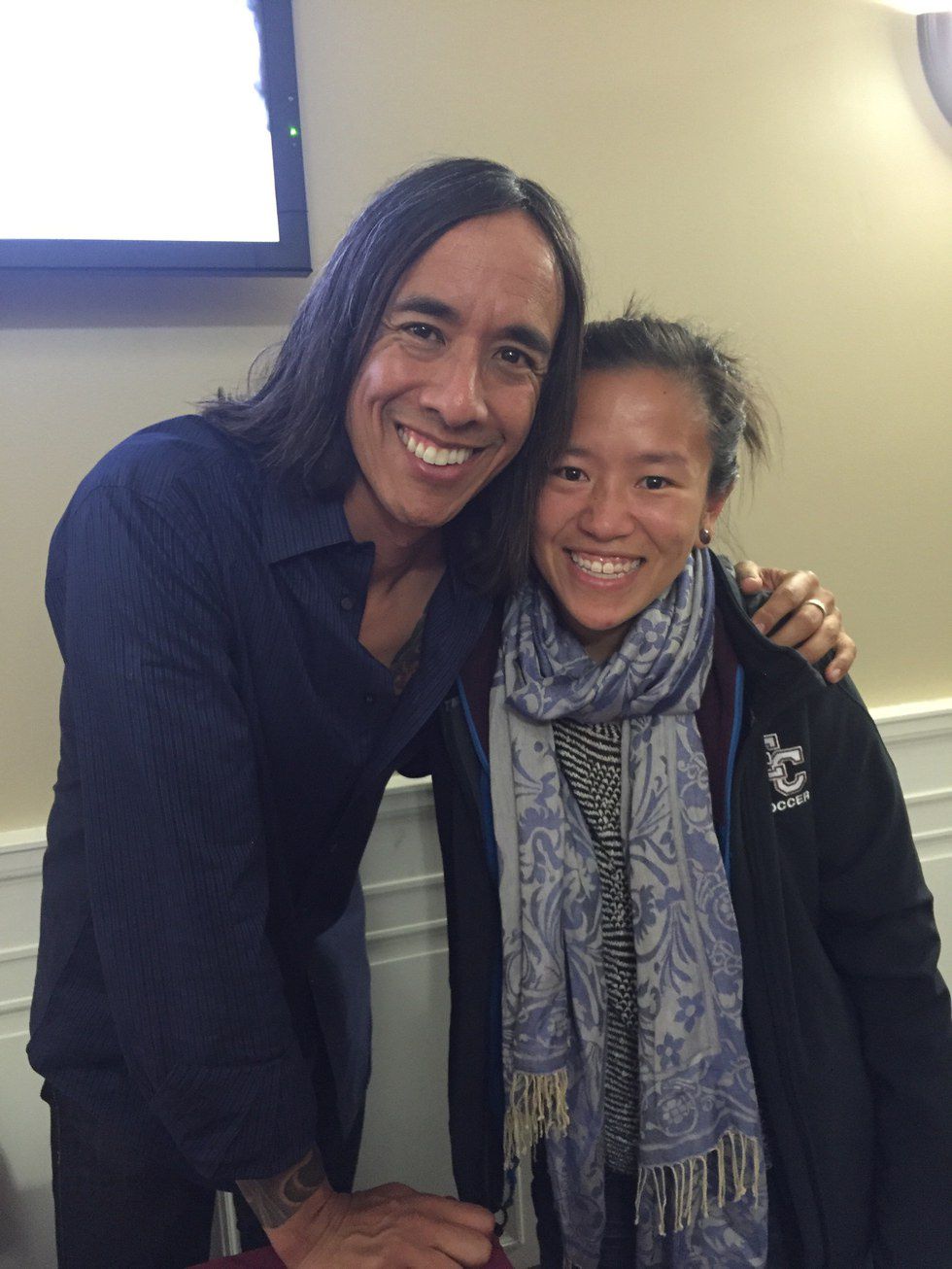
“Her tears didn't matter to me,” Kip told us in a story about a former student. Kip has an awareness of self, identity and the human condition at a deep, under the surface level. That girl’s tears will not make me treat her any differently than the next person. We all cry.
In his classes, Kip tends to “take people far out feet on the branch” so that when they are confronted with their vulnerabilities in terms of self and identity, they are comfortable in the real world stepping out on a limb. I respect this. Our personal comforts and ability to confront ourselves is a vital part of our lives as we figure out how to get a long (and disagree) with one another. With a comfort and sense of self, comes a new feeling of one's place in the world.
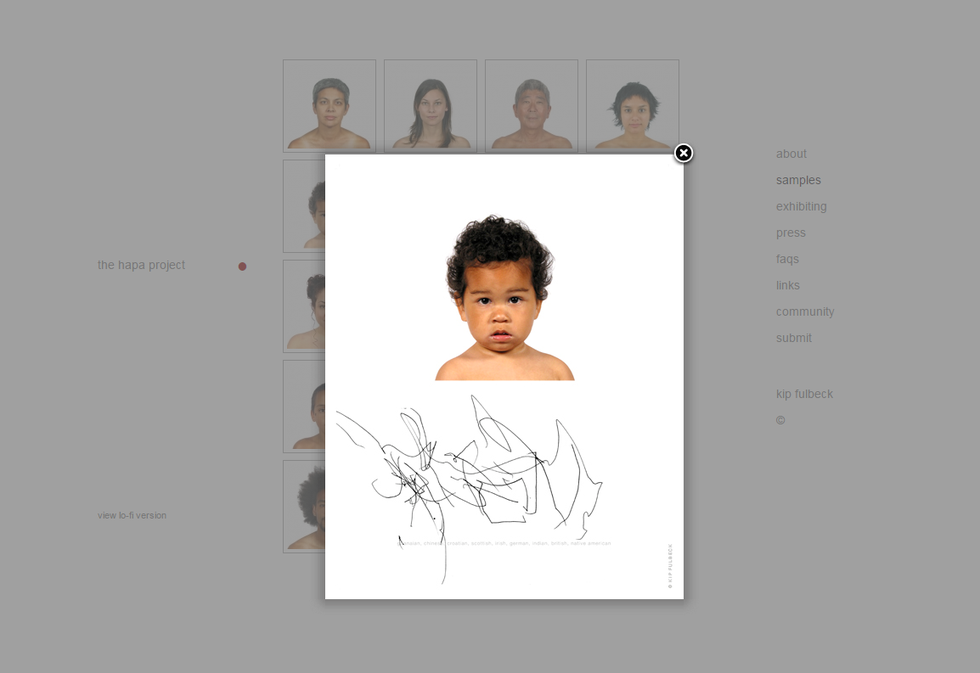
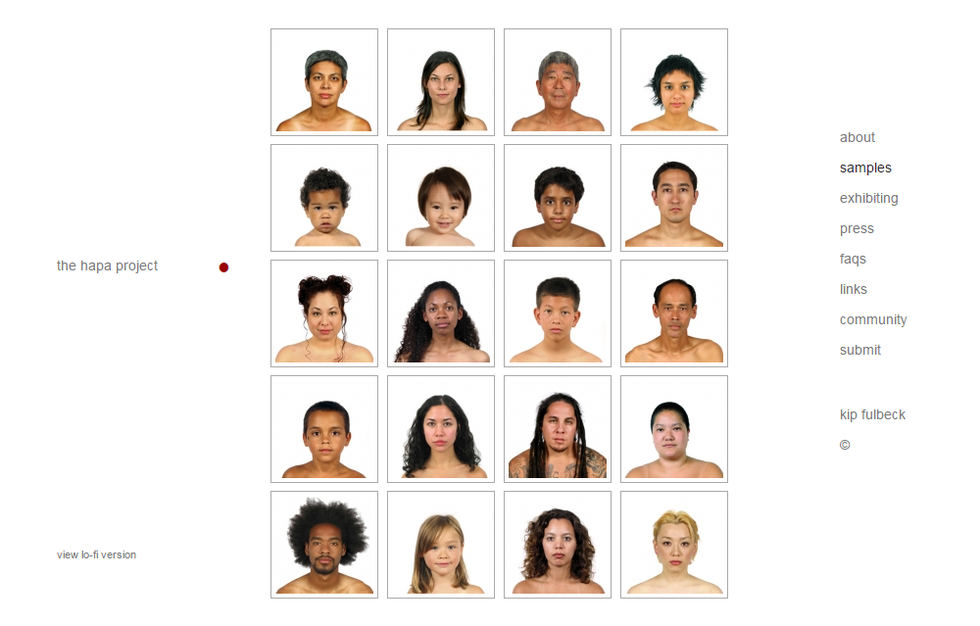
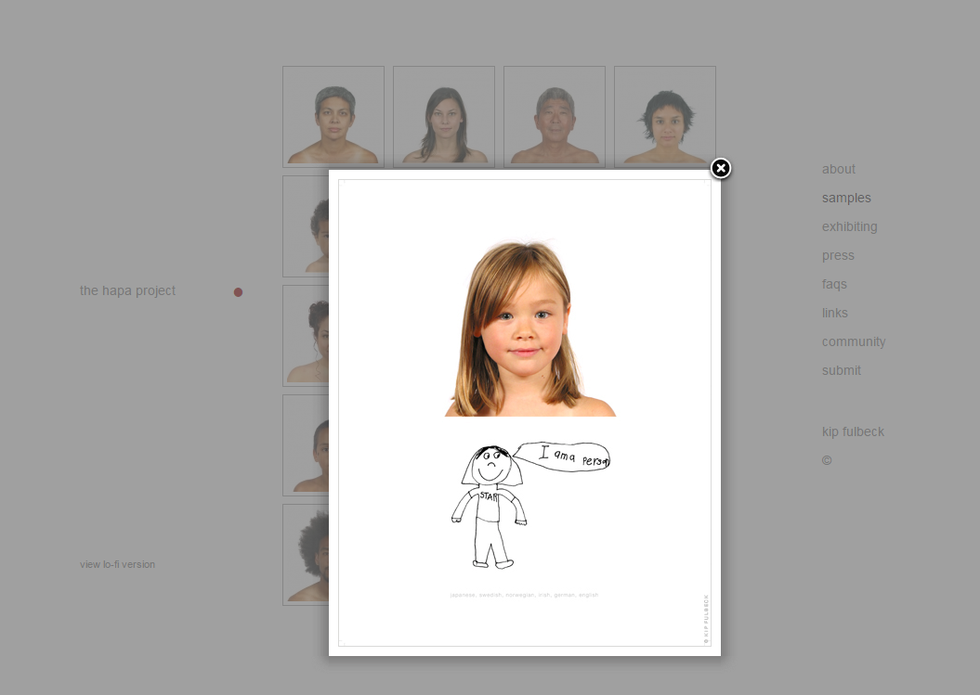
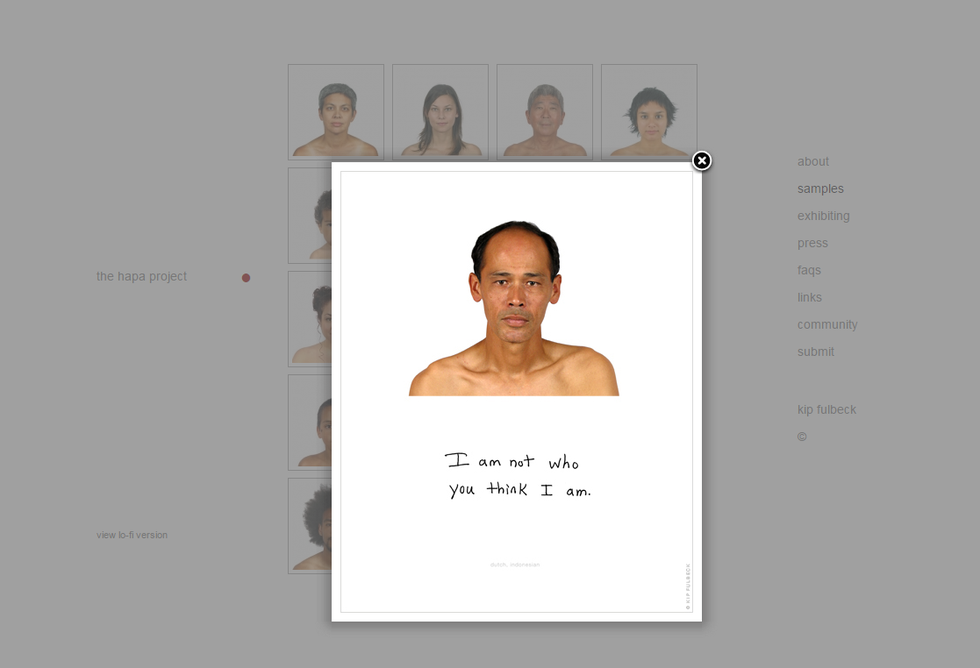
As a Chinese-American Adoptee, I felt a bit conflicted, at first, as to where my identity fell into his notion of hapa. Hapa, is a term that refers to someone with Asian or Pacific Islander descent. For the purposes of his project, he accepted photos of anyone, whether or not they had mixed biological identities. According to Kip's website:
“identity is a personal process and i’m adamant that it should be a personal decision, not one made by a community, a government or others”
fulbeck also states that despite its utilization of common racial classifications, the hapa project is fundamentally a project about identity rather than race: “it’s about identity using race as a starting point.” he argues that race in itself is not biologically determined, but socially created
And throughout his presentation, I gained a better sense of his project as not just about hapa, but about all identity however you choose to define it. Identity is way more complicated than boxes you're asked to check mark on a census, or job application or standardized test. The important point he drives home, is not what you are, but what you choose to be. I choose to be me. I would prefer not to check a box, or label myself, but a label can help someone understand, in a split second some information about me.
But I'm still thinking on my choice for my identity. Choice in the 21st century can be difficult, in terms of our consumeristic culture, and our severely digitally social community. Kip had thoughts on this too.
In this “block-and-like” culture, that Facebook brings, we have created an unrealistic way to deal with opposing views, which he believes are crucial to moving forward. Socratic (philosophical) discourse is framed to help us live with one another. Kip says, if he has a neighbor who could potential harm him, he cannot simply “block” him, Kip must find a way to get along such that his family is safe.
He told us to “pick your battles” because there is a bigger picture at stake. He cautioned us to consider how activism could take a counterproductive turn. Activism that appears passionate and well intentioned, can be received as shutting down discussion and opposing views. I agree. Which begs this next question that was asked (paraphrased): How then, do we determine how much listening to an opposing or harmful perspective can be helpful and when does listening perpetuates this unsafe ideal? To this, he responded with a few crucial points (in no particular order):
1. Listen. Do not shut people down. Offer yourself up to listen, and really listen. (If you can figure out how to “poke holes” in their argument this can be helpful long term.)
2. Pick your battles. We don’t have to win every single one.
3. Get a seat at the table. Present yourself as someone who others want to be at the table with, for discussion of important issues.
4. Dialogue. It is all about critical thinking and dialogue. Recognize that Facebook has removed our ability to think in this way.
Another student asked about diversity and inclusion. At first, I thought he didn’t really answer the question, but I think an answer could be read between the lines. He appeared to make the point of “diversity and inclusion” obsolete, particularly in higher education, because he spoke to the common definition of diversity and how we need to reconsider just how diverse, diversity really is. Perhaps, this is where we need to widen our lens-challenge our current perspectives?
Kip would not identify himself as a “diversity speaker,” because all too often “diversity” is reduced to race. He emphasizes the range of ways to interpret diverse people, there is diversity in age, socioeconomic class, religion-choice not to be religious, sexual orientation, gender identity, height, physical size, to name a few. But, I wonder, how do we grapple with this fact, when in reality, the issues of race, particularly African Americans in the country so desperately needs to be addressed and healing needs to begin? While diversity is well beyond "Black and White" how do we include enough, while seeking justice for a lengthy history of injustice that results in the hate, violence and dispair America is feeling today?
I asked Kip what advice he had for student activists who are trying to make a difference in the world, but who are also at a point in their lives of “critical-mass,” so to speak, when the world is opened up wide to them — our perspectives are being challenged, and there is much work to be done (both for social justice and academics). Find ways to not burn out. He is in this for the long term. He asked another student who shared her interest in becoming an immigration lawyer, how will you make sure you stay in the business for 20 years, not just four. Because four years won’t do me any good, but 20 years, you can make a difference. His approach may seem selfish, but he speaks for all of us, and I get that.
I truly met an inspirational human. He is a teacher in California and has a knack for pursuing the human condition through art, an open heart, humor and composure. He ended his presentation with an adorable clip of his two kids, one of whom kept toppling over as she ran along the beach — it was adorable. Here, he reminds us what we’re all here for: The future. Our children.