
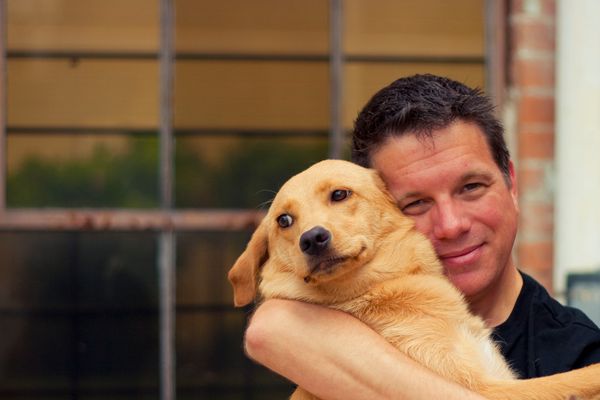
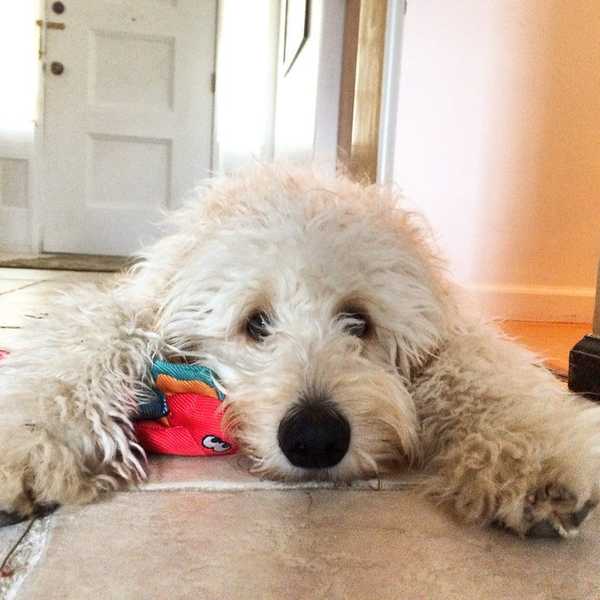

There's been a lot of discussion about dogs not liking to be hugged, prompted in part by a study done by Stanley Coren, a Ph.D. whose research focuses mainly on dogs. I was inspired to give my say on it by my pal, Teddy, who has some other thoughts that he asked me to share.
The "study" (John Oliver, "Scientific Studies," at the bottom) that started all of this was a casual observational study, based off of Internet photos of dogs being hugged. The pictures were sorted into three categories; the dog showed signs of being agitated, the dog was at ease, or the dog appeared neutral (Coren). That's not fishy, objective, or bad science* at all. These pictures are just 250 randomly chosen photos of people hugging dogs. The person, whether it was a stranger, the owner, or a child, unaware of their strength (or weird smells) wasn't accounted for, or how long the hug had gone on — since these were pictures, it was assuredly for a while, and probably longer than most dogs like to be detained, whether the initial embrace was nice on all ends or not.
*Bad science: a study with multiple uncontrolled variables, widely accepted in the science world (or at least the science world of every school I've been to) as nonsense, because there are too many factors to have reliable results.
The Washington Post was quick to point this out in their opposing article, which also highlights the lack of a peer-review, or the publication of his actual data. In the Post's article, Coren himself admits "this is a casual set of observations," which doesn't discount his findings immediately, but does leave more room for interpretations on his un-replicated casual findings (Feltman).
There's a picture of me, hugging a friend's dog close, and it's obvious he's trying to get off my lap. However, there was a plate of food just out of his reach, and he was struggling to get to it. Does that mean that he doesn't like hugs? No, because he leaps into your arms when food isn't a part of the equation. The plate didn't make it into the picture, though, so if that one was used by Coren, it would have been counted in the first group, without consideration for unseen circumstances.
Teddy disagrees with the initial study in a big way — whenever people are seated on the floor, he most often comes to sit in front of them, with his head high above yours, puffing his chest in your general direction, waiting to be pet. He'll sniff around your face and hairline while he waits for you to get the memo. Wrapping your arms around Teddy, or any big dog, is therapeutic, warming, and feels even better when he puts his head on your shoulder. Hence, why a lot of schools have therapy dogs come in around finals week, when students need it most.
Of course some dogs are unsettled by a human wrapping their arms around them, which is fair, sometimes I am too, and I'm guessing you've struggled with an unwanted hug before. Each dog is different, with a different personality, quirks and needs. Don't approach a dog you don't know without some indication that it'll be OK, kids.

John Oliver video:

















