

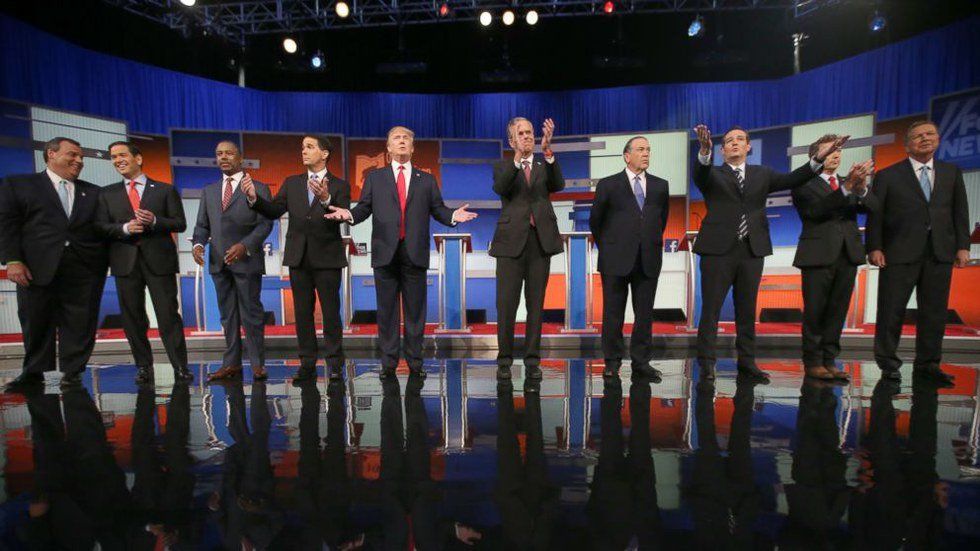
Donald Trump is a show. He says he has no time for political correctness, when in actuality he has no time to engage in meaningful debate or conversation. This disengagement has gotten to the point where, in the first Republican debate on Fox News, the monitors were clearly asking questions meant to hurt the candidate.
On Anderson Cooper on August 7, Ari Fleischer noted that Donald Trump has thin skin, questioning his ability to deal with foreign affairs as he complains about the “fairness” of a debate. Responding to Trump who says that the political world is not fair, Fleischer advised Mr. Trump to get used to inequitable tactics. The same commentator noted that Trump's skills lie neither in building bridges nor making nuanced points. Trump yells and screams and makes unsupported, unsubstantiated statements, growing noticeably frustrated when others openly disagree with him. He seems like an absurd child rather than a political heavyweight.
But Paul Krugman wrote an article recently arguing that Donald Trump is only equally as absurd a figure as the other candidates in the Republican field. He pointed specifically at Jeb Bush and Marco Rubio, arguing, “While Mr. Trump is definitely appealing to know-nothingism, Marco Rubio, climate change denier, has made ‘I’m not a scientist’ his signature line.” So the problem with Mr. Trump, therefore, and what seems to truly scare the Republican Party, is that he showcases how ridiculous certain party positions are. To many liberals, he openly argues what others in the field are thinking. To conservatives, he is nothing more than a caricature of this liberal fear–a sideshow distracting Americans from politics as usual.
The other problem with the debate is that Mr. Trump spent a shockingly short amount of his time answering the questions that he was asked. This is nothing new, but for someone who, according to CNN, spoke for 10 minutes of the debate, compared to Mr. Bush’s roughly eight minutes, most of that time was spent attacking the monitors, Mrs. Clinton, and making seemingly wild accusations. For example, he contended, for not the first time, that the Mexican government sent over undocumented workers who were previously criminals and drug lords. Mr. Trump has never apologized for making politically incorrect remarks; he instead makes jokes about his candidness. But a president’s job is to work with interest groups and diplomats to better the country and further its interests. How can a person that has systematically alienated every interest group and country do this job?
This question leads me to doubt the validity of the leading Republican candidates today in general. The recent attacks on Planned Parenthood, for example, made clear how willing the candidates are to forget, not acknowledge, or not bother to learn the facts of an issue before they decide their opinions. Abortions make up only 3 percent of the medical services offered by Planned Parenthood, and none of them are federally funded. Congress passed the Hyde Amendment in 1976 blocking this from happening, yet pundits continue to make abortion the centerpiece of the debate. As a general trend of the night, politicians relied on lines or, in Jeb Bush’s case, the coincidence of the housing bubble during his time as governor. They fought with each other on stage and shouted over each other. And the only thing any of us learned from the debate was that the candidates on stage were too afraid to stand up to Trump’s racist and sexist remarks; this suggests that they may be unable to engage in serious, possibly uncomfortable presidential business such as working with foreign leaders.