
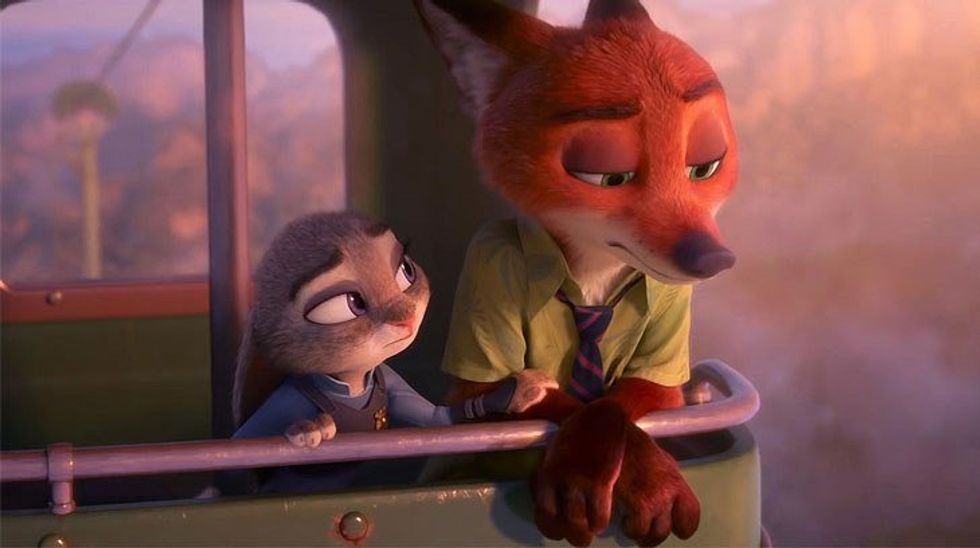
Walt Disney Studios were not playing around when they created their newly-released animated movie, Zootopia. Since its opening day on March 4, 2016, the movie has taken in $307,386,397. Oh, and it also has a 98 percent rating on Rotten Tomatoes, which is kinda a big deal. I recently went to see the movie, and let me go ahead and warn you here that I am an English major. And what do English majors love to do? Analyze. So, analyzed I did.
Since growing into adulthood, I've heard that many animated movies that are primarily directed towards children, contain secret meanings hidden within them that usually only adults can pick up on. I had never really given the concept much thought, but since seeing Zootopia, I am a firm believer in these animated hidden meanings. While watching Zootopia, it's hard to miss the almost direct metaphors that are used to exemplify things in America's modern society.
*Spoiler Warning*
1. Zootopia = Utopia = America
Zootopia sounds oddly similar to Utopia doesn't it? A definition of "utopia" is: an imagined place or state of things in which everything is perfect. In the movie, Zootopia is a "modern mammal metropolis" that is "a melting pot where animals from every environment live together - a place where no matter what you are, from the biggest elephant to the smallest shrew, you can be anything."* And doesn't this description sound a lot like America? The "melting pot" country? The land of opportunity and freedom? Yeah, I thought so too.
*cited from http://movies.disney.com/zootopia
2. Judy Hopps overcoming the bunny stereotype
Judy Hopps, the protagonist, is a small bunny who has big dreams of becoming the first bunny police officer. People laugh at her - even her parents laugh at her - and remind her that she's just a bunny and that's all the world will ever see. Overcoming stereotypes is an issue for Judy, and it is also a relevant issue in our own society today as well. This could be related to any kind of circumstance going on where someone is saying that you can't be what you want to be.
3. Sympathizing with the meter maids
In the movie, Judy ends up fulfilling her dream of becoming a police officer, only to be limited on the first day at her new job when Chief Boso assigns her position as a mere meter maid. Judy worked hard to be a police officer! And now she's just going to be cast aside as if she can't handle solving a missing person case just because of her physical appearance? Judy hates being a wimpy little meter maid because what she really wants to do is solve the bigger issues in the city. However, she has to do her job and pass out tickets. This is relevant for adults in America because I think it's safe to say that we all loathe the meter maids who ticket us after even just one minute past our meter time. It helps remind us that hey, those people are just doing their jobs.
4. Biased news media
The basic plot of this movie involves predators being targeted to attack prey, and then the news media just so happens to always get word of it and broadcast it for the world to see. Basically, members of a species-supremacist conspiracy have a special blue serum that when injected into a predator, makes them go ballistic and violent towards small prey, which is totally out of their character. The head member of the conspiracy knows when a predator has been injected and calls the news to alert them of it. None of the violent animals are actually that savage before they are influenced to do so, and that's the only side of the story that the news media is showing. News media in our culture is definitely biased, usually only showing one negative side of a story.
5. Police officers supporting and protecting the city, not tearing it apart
The police officers in Zootopia end up becoming biased against all predators in the city because they're afraid the predators could snap at any minute and become wild. Instead of supporting and protecting the civil predators, they're neglecting them and refusing to tolerate them because of the given stereotype. This is a clear correlation between police brutality towards African Americans in today's society.
The anthropomorphic film provides an important message that is useful for everyone, regardless of age, about resilience, diversity, and the importance of being yourself. It speaks to specific issues in today's society and does so in a vibrant, humorous way that accredits it as the biggest opening of all time for a non-Pixar Disney animated film.