I'm sure just about everyone knows about the movie Letters to Juliet staring Amanda Seyfried. I'm also sure just about everyone who has seen it, loves it, thinks it's adorable, and has added visiting Juliet's Wall to their bucket list. It definitely made it on mine. So, when I had the opportunity to travel abroad, being 100% Italian, there was no question that I would be traveling to Italy. Where in Italy was the question, though seeing the movie definitely narrowed down some options. One of the cities my mother and I would tour in was to be Verona, the place of Juliet's Wall. Juliet's Wall was the only reason I wanted to go to Verona, and that is probably one of the only tourist selling points of the city.
Verona looks like any other city, windy roads and bad drivers and pedestrians. Because it's Italy it has squares that are solely for pedestrians and cobble stone streets. Aside from that, there are small shops and restaurants and clothing stores. There was even a Disney Store. A few blocks down from the Hotel of Juliet and Romeo, is a store called The House of Juliet. This is where the wall is.
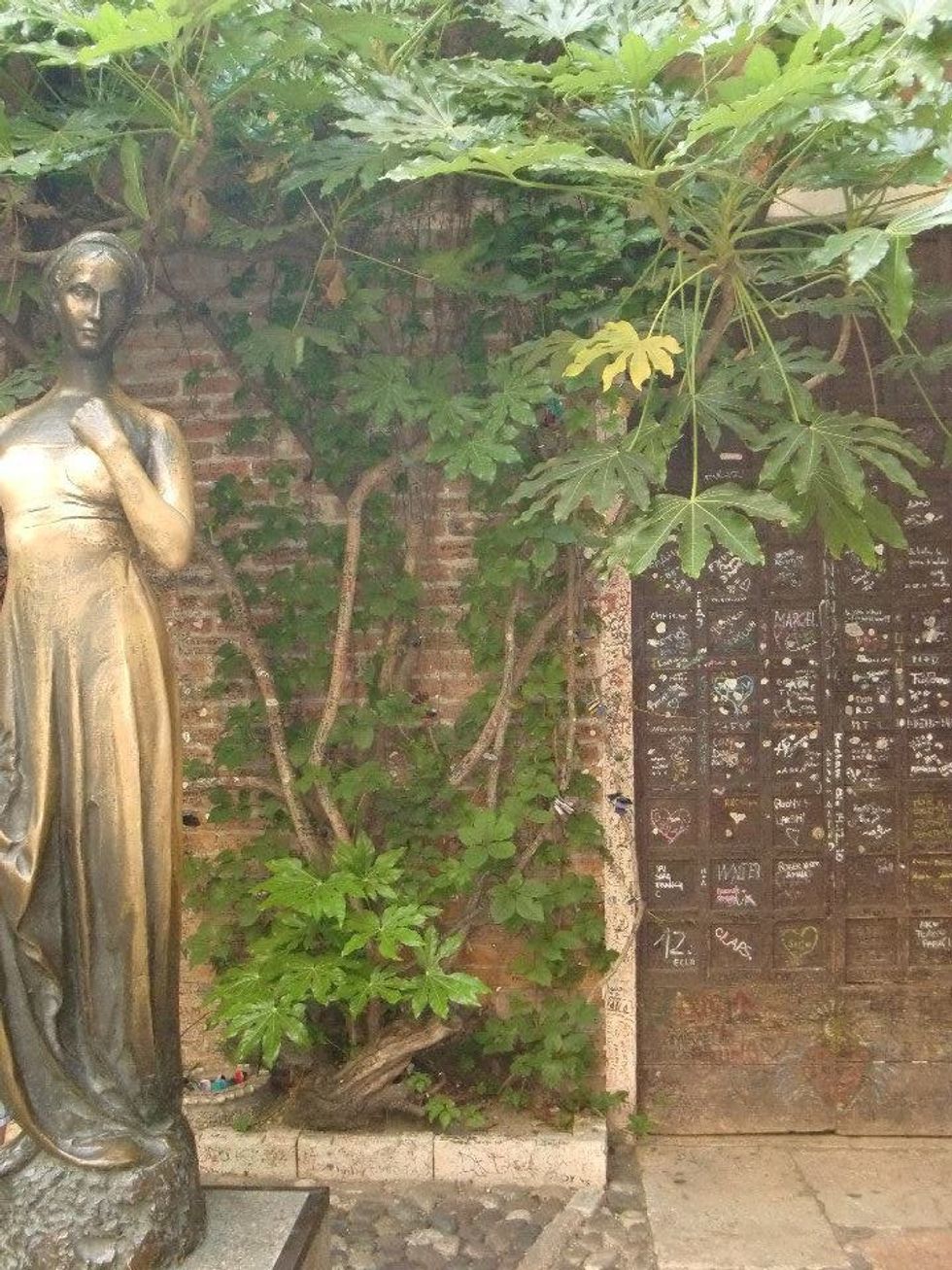
People first enter through an iron gate, and then a short stone tunnel, which leads out into the clearing with the wall, the balcony, the statue, and the buildings around this little clearing are actually shops with souvenirs. This was an obvious difference from the romantic, classic, secluded scene the film portrayed, but not even the overt ploy to get people to fish money from their pockets took away from the scene that people managed to create.
For starters, in this stone tunnel, there was graffiti, but not the profane kind. People were expressing love for one another on the walls, and though it's not normally something that adds to a historic type of appeal to a place, it did in this case. The play Romeo and Juliet by Shakespeare is all about all consuming (to the point of unhealthy) love. And this profession of love made by dozens of people only added to the romance of the space.


There were also mail boxes posted all around the space, so people could drop their letters in them. No one was posting them on the wall or in the wall, they were placing the letters in one of the mailboxes.

If a person wanted to, they could buy tickets to explore the museum inside, which was filled with props and historical information on the time period Romeo and Juliet is told in. On one of the floors of this museum, is a room full of computers with a language setting, so someone can change it to almost any language, so a person could email Juliet.

The statue of Juliet is real.

(Though it was apparently a tradition to take a picture with the statue with one's hand over her right breast. This is a custom that confused me and one I didn't participate in).
The balcony is real.

And people can even go on it.

On the stone walls and metal doorways, there was more graffiti written. There was also metal gates that remained closed in this clearing, that seemed to be there for sole purpose of people locking padlocks on the rungs.

On many of these padlocks were names and dates. Despite the fact that these locks were obviously bought at the neighboring shops, the romantic notion of writing one's names on locks and locking it there for seemingly all eternity is undeniable.
It's not nearly as classic as the movie portrays it, and clearly a tourist trap, but it's still romantic and interesting and historical in it's own way. One might even say it's something that can only be appreciated if one is a fan of Shakespeare or play. "A fool's paradise" (II.iv.159), if you will.