


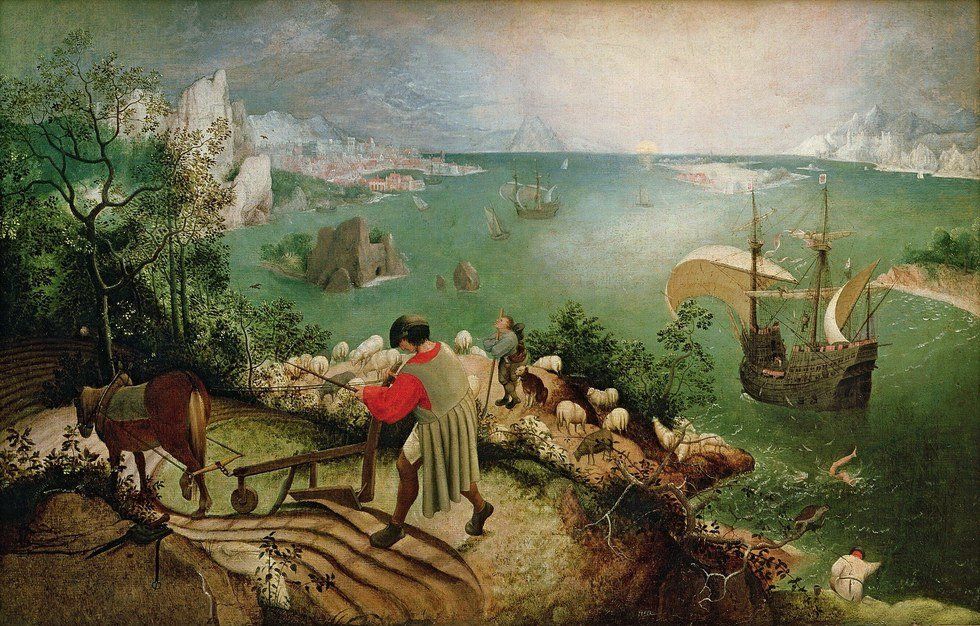
Everyone knows suffering, that state of acute pain which dominates our attention and reigns over our motivation, but W.H. Auden, in his poem “Musée des Beaux Arts,” observes how poorly many of us understand the human position of suffering, how far too often someone else's suffering receives as relief little more than a back that's leisurely turned away or a blind eye. Auden commends the “Old Masters” for depicting the suffering of others as rarely receiving morally adequate attention from those aware of its taking place(line 2). However, in a subtly frustrated tone, Auden encourages the reader to ask whether merely realizing the vast impact of affliction is enough to quiet a conscience. Ultimately, Auden equally grieves both the pain of Icarus and the inaction of the plowman and the delicate ship. Auden hopes that the reader, through ruminating on these lines, will begin to treat the suffering of others as the weighty subject that it is.
The poem is fittingly entitled “Musée des Beaux Arts”(Museum of Fine Arts) as perhaps its most significant stylistic aspect is its allusions to three paintings by the Netherlandish Renaissance painter Pieter Brueghel, each of which Auden would've seen at the MuséeRoyaux des Beaux-Arts de Belgiqueas he was living in Brussels, Belgium: “The Census at Bethlehem” (lines 5-8), “The Massacre of the Innocents” (lines 9-13), and “Landscape with the Fall of Icarus” (lines 14-21). These allusions serve as a foundation for the discussion of suffering in this ekphrastic poem.
The speaker begins by contrasting the understanding of the “Old Masters,” wise poets and painters alike, presumably, with the ignorance of the many as they go on “eating or opening a window or just walking dully along,”untouched by the suffering taking place in the world, in their communities, even right next to them(line 4). This reflection has a sobering effect on the reader. Additionally, the reader detects a tone of discontent or frustration as the speaker dejectedly acknowledges the simultaneous existence of distant pain and dull walks.
The vague, allusive imagery in lines 5-8 evidences that the speaker is frustrated, in part, with the sort of ignorance thatspecifically results from physical or impersonal disconnection. The children “skating at the edge of the wood” would not specially care whether Bethlehem were experiencing joy or sorrow, perhaps because they're unexposed to the action, being far away, or perhaps because they're too young to understand(lines 7-8). In either case, the children are inculpable for their ignorance. All the same, these non-personal barriers contribute to the brokenness in the world, and this frustrates the speaker.
This discussion of inculpable ignorance is continued through the imagery in lines 9-13. These lines vaguely describe a “dreadful martyrdom”running its course; meanwhile a dog and a horse behave as though nothing is out of the ordinary(line 10). This scene, by juxtaposing the mundane with the horrific, provokes more frustration than the previous scene. A dog and a horse, in close proximity of the brutal crime, directly observe it, and yet, as beasts do, feel nothing, do nothing. The dog, unaffected by the forsaken cries, goes on with its innocent, doggy life (line 12). The horse, in complete ignorance of the agony and sorrow just ahead, minds its business and “scratches its innocent behind on a tree”(lines 12-13). These animals may as well be just walking dully along, taking their place as part of the scenery. The speaker seems to prompt a comparison between beasts and those who face injustice only to neglect to take action. Both agents abandon humanity.
The speaker introduces irony to further characterize this ignorance as innocent but harmful nonetheless. Ironically, none other than the torturer himself, the inflictor of pain, owns the horse. It gallops and slows and veers and halts all at the command of a wicked man. The speaker seems to observe that, sometimes, a person can become so morally unaware that they, without intending to, aid those who intentionally harm others. While this type of ignorance isn't quite condemnable, it is certainly dangerous.
In the final stanza, the speaker draws a distinction between this innocently harmful behavior and another sort of behavior, one characterized by a callous attitude toward the suffering of others. In this scene, the speaker uses apathetic language to describe a ploughman and a ship turning “away quite leisurely from the disaster” as though Icarus’ death were unimportant(lines 14-15). The characters in this scene behave similarly to those in the previously described scenes, but, in contrast with the innocent children and the oblivious animals, the seamen on the ship and the ploughman are both close enough to directly witness the tragedy and mature enough to understand what they witness. These characters should know better.
Judging by his position, the ploughman probably noticed a commotion, but in the painting, in that moment as Icarus takes his last breath, the ploughman continues to plough dully along as he had been minutes and hours before. Perhaps the speaker would grant that the ploughman, though a direct witness of Icarus’ fall, was too far away to intervene. Even so, the speaker criticizes the ploughman’s callous attitude toward the tragedy. From the perspective of the ploughman, the sun, reserved, merely “shone as it had to on the white legs disappearing into the green water,” and means no more than to carry on doing its duty in casting light on Icarus' pain (lines 16-19). According to the speaker, the ploughman, with this attitude, wouldn’t have cared to intervene even if he would’ve had the opportunity.
As for the nearby ship, the speaker describes the seamen as observing the tragedy through an emotionally distant lens. The seamen must have seen the fall, heard the splash, but the ship sails calmly onward to its destination. In portraying the seamen as feeling excited to have been where they were at that special moment, the speaker mocks them. Perhaps, when they land, they’ll tell the first person they see the amazing tale about “a boy falling out of the sky,”but their story won’t include any rescue missions, or feelings of remorse(line 20).
In light of these observations, the reader can conclude that the root of the speaker’s frustration is the failure of the characters in this scene to react to the tragedy they witness like a human should. “The ploughman may have heard the splash, the forsaken cry,” but he only noticed something insignificant, the contrast of the white legs on the green water(lines 15-19). For the ploughman, the white and the green are just unimportant details of the landscape. As for the ship, witnessing the plunge was a privilege on such an ordinarily boring evening. According to the speaker, these characters are guilty of non-morally considering a moral event.
Finally, it’s important to understand the relationship between the “Old Masters” and the moral problem that the speaker intends to identify in this poem. The speaker regards the “Old Masters” higher than the ploughman and the ship, but, ultimately, the speaker wouldn’t necessarily consider these masters moral role models just because they understand the human position of suffering. These masters may understand a universal human truth, that moral inaction often results from inculpable ignorance or callousness, but, with all of their understanding, they weren’t able to prevent the dreadful martyrdom or the tragic accident. The speaker must be asking the reader to strive for more than a mere understanding of the nature of suffering.
In conclusion, Auden accuses the reader of turning leisurely away from disasters as if they were just unimportant failures, unusual events (line 17). Auden writes to encourage the reader to examine his or her life, and ask: am I so concerned with places to get to and things to do that I’ve become numb like the ploughman, or the delicate ship? In addition to experiencing conviction, Auden hopes the reader will recognize a dichotomy between merely understanding the human position of sufferingand responding to it. Auden seems to argue that first we all must embrace our humanity and empathize with our suffering neighbors so that we may find the motivation to fulfill our moral obligation to them, to turn toward important disasters and take action.
Citations:
Greenblatt, Stephen. "The Twentieth Century and After, W.H. Auden." The Norton Anthology of
English Literature: The Major Authors. 9th ed. Vol. 2. New York: Norton, 2013. N. pag. Print.
















