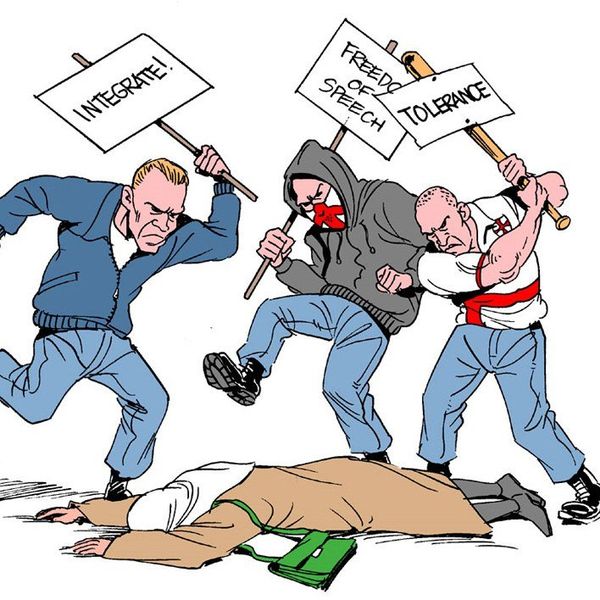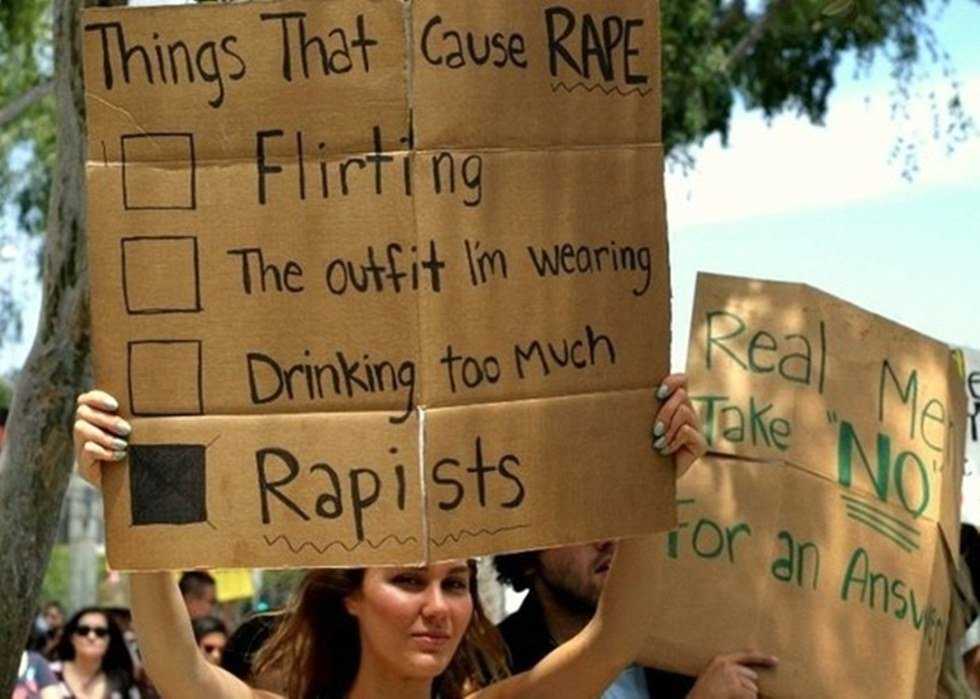
According to the Department of Justice, on average, 293,066 people (age 12 or older) are raped each year. Every 107 seconds someone in America is raped. Out of 100 rapes, approximately 46 are reported. Of those 46, 12 result in an arrest, 9 lead to prosecution and only 3 rapists spend a single day in prison. Based on those statistics, I think it's fair to say that an overwhelmingly large percentage of people who are not in prison have sexually assaulted someone.
And in comes the question: do we live in a society that perpetuates rape culture?
To answer this question, we must ask ourselves “what is rape culture”?
According to Marshall University, the definition of rape culture is "an environment in which rape is prevalent and in which sexual violence against women is normalized and excused in the media and popular culture." It goes on to say that rape culture is perpetuated through the use of misogynistic language, the objectification of women’s bodies and the glamorization of sexual violence, thereby creating a society that disregards women’s rights and safety.
This definition begs more questions than it gives answers. Firstly, what defines rape as "prevalent"? 100,000 sexual assaults per year... is that prevalent? Or 500? Or even 15? And if 3,000 is prevalent, why is it prevalent? Do we measure it by saturation, say, 70% of people know someone that has been raped? Is there a prevalence barometer? Do we judge it by number of assailants, victims, events or all three? How does one appropriately measure this and interpret that data to draw statistically significant evidence?
Secondly, can sexual assault ever not be prevalent in modern society? That's like asking if you can remove murder or theft. The answer is a clear and resounding no.
Thirdly, how do we combine this knowledge with our understanding of being human? Is there an objective threshold for what is wrong and what is right?
There are two possibilities. Either all sexual acts require written proof of consent. Or rape requires proof of nonconsent. Of course, you can imagine why constantly and continuously proving consent would be an absurd idea.
So we're left with the only other feasible path, which is prosecution. To prosecute rape, the victim needs to confront their attacker in court, consult with police, get medically tested and by some means find proof, valid evidence of a lack of consent. Since this is in a criminal court and not a civil one, it has to be proven beyond reasonable doubt. So, you can imagine why only 3% of rape cases end in a conviction. This is a hugely invasive and damaging process to rape victims.
It seems to be a common misconception that rape is often treated lightly and dismissively in America. In all reality, the true issue lies within our deeply flawed criminal justice system. After a rape has been committed, it cannot be reversed. You have to stop the act before it happens. The saying, "Don't teach how not to get raped, teach not to rape," is a pretty baseless idea, since 98% of rapists know exactly what they're doing and do it anyway.
Very few perpetrators don't know it's not wrong. They just don't care. You can't teach empathy.
Studies also show that there is no “typical profile” of a rapist, so there's no way to discern whether a person has committed sexual assault before. Often, they're the people who we least expect; people with friends and families who love and care about them, who could never imagine their loved one committing such a violent and horrific crime. Given the seriousness of the crime in America, rape is a secret that many keep to their graves.
Rape is often talked about as if it is something only a specific type of person, those born without a moral compass, are capable of, but this is entirely untrue. In "Once a Rapist? Motivational Evidence and Relevancy in Rape Law," Katherine Baker writes, "The prevalence of rape [is] in all social classes, among all races and by all sorts of men.…singling rape out…fosters the prevailing view that rape is different from other crimes because rapists are 'crazy.' It is precisely this view of rape as psychopathology that allows the criminal justice system to ignore many rapes that do not fit a psychopathological model." Baker goes on to say that we must unpack the term "rapist." Is someone who has raped more of a "rapist" than someone who has killed is a "murderer" or than someone who has lied is a "liar"? Baker asks, "Are all rapists alike in an essential way that makes them rapists?” There is no inheritable “rapist gene." Anyone can be capable of rape. There is no psychological archetype.
The pernicious idea "Don't teach women to 'be safe.' Teach rapists not to rape." is actually, in a way, dangerous.
It is impossible to completely eliminate any crime without eliminating free will entirely. As a result, it is essential that women learn how to defend themselves, so as to make themselves less vulnerable and as a result, less feasible targets. Any other option is genuinely unrealistic.
Additionally, it's really not as simple as “teaching men not to rape.” Rape is not solely committed by men against women though most research tends to focus on that particular area. Research has not been thoroughly conducted on rapes executed by men against other men, or by women against men. Not to mention that research on rapes carried out by women against other women is essentially non-existent.
Another issue on the table is how men are taught to perceive "consent." Imagine this scenario: You're a man and it's your birthday. You're confusedly and drunkenly dragged into a pile of naked women as a "birthday present," totally disoriented. This is treated as an exciting and celebratory event. Had you been a woman, though, this situation would have been perceived very, very differently. This seems to be a huge part of why men don't perceive consent the way women do. We have a very different view of giving consent between genders. So when men say "I mean, maybe it's not that big of a deal," it's because they perceive consent very differently from women, and those end up being two polarized ideas that are communicated very poorly. While it seems to be true that men view consent differently from women, I believe we all view rape as an inherently negative thing. However, our main problem lies with hypermasculinity and victim blaming.
Entitlement to women’s bodies is not something that is just "taught." Young men are generally not raised to believe that sexual intercourse is something that they are entitled to with or without consent from the other party.
We see that rapes are prosecuted, and in the media, we're shown that forcing someone to have sex is wrong. However, we also have the media giving off messages that rape can seemingly be excused in some circumstances, such as the woman was drunk, a rape conviction will ruin the young perpetrator's life. So another large part of finding out whether or not we live in a rape culture is on how we consume media. When people follow blindly like sheep, then yes, rape can easily become normalized by society.
Back to the original question: is our society a rape culture? I can neither say yes nor no, because morality is murky. Rape is a murky topic. Anything involving moral and cultural ideals is going to be murky, and when there's a stigma surrounded by it, it's even more difficult to talk about
So, are we, the people, creating a society that disregards the rights and safety of women? It's something that only you can answer for yourself. The answer is based on one’s morals, which are not objective in the slightest; morality is subjective. When it comes to instances of sexual assault, nobody should be drawing conclusions for you. When the media's first question is: "What was she wearing? Was she sober? How was she acting?" that's just one example of the ways people can attempt to justify rape, or sweep it under the rug by putting the blame focus on the victim and what the victim could have done differently. It's every individual's responsibility to end what they deem to be part of rape culture. If you are asking those same questions, then you probably are part of the problem.
But if we make a true or false checklist based off of Marshall University's definition, here's what we find-
Are there many instances of rape? - Of course.
Is sexual violence normal? - No. It's not.
Do we use misogynistic language? - I'd go with a yes.
Do we objectify women's bodies? - Yes, yes we do. A lot.
Do we glamorize sexual violence? - Unless you count certain erotic fetishes, no, not in the slightest.
Do we sweep rape under the rug? - Of course not. Most of us all tend to find rape appalling, and we demand that rapists be brought to justice.
Based on those answers, that leaves us with a 3:3 ratio, resulting in a literal tie. So that definition alone cannot answer the question of whether or not Western society perpetuates rape culture.
So these are factors that need to be considered when we think about rape or rape culture. Ponder them and draw conclusions for yourself. Think about the reasons why we do, or do not, live in a "rape culture."
DMS Ultraviolet Spray for Self-Defense
The above is a link to a self-defense website. This isn't pepper spray, but ink spray. Use it in place of mace to prevent blowback; it will stun the attacker enough for you to get away. It has temporary ink that shows up under ultraviolet light, so if the perpetrator washes the ink off their face, it will still show up under a black light, making it easier for police to find them.