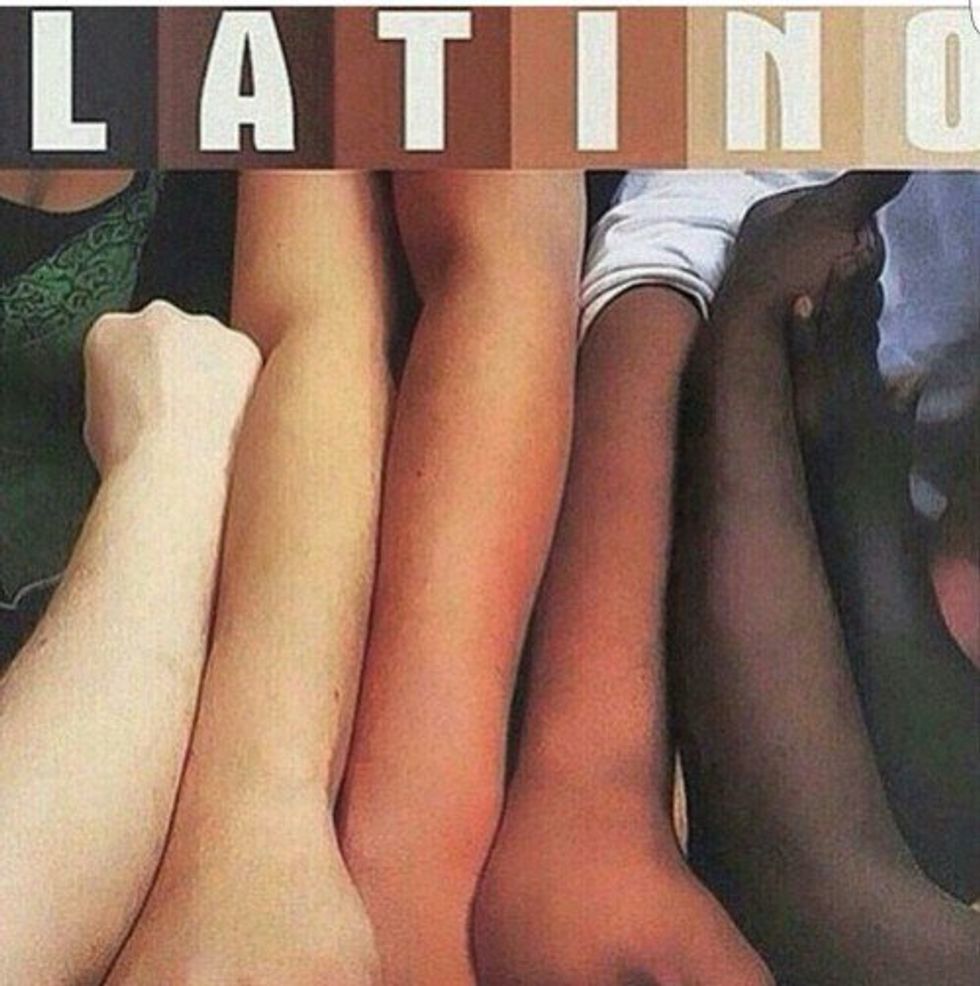
"What 'type' of Latino are you?"
I didn't know I was raceless until I was in high school. Of course, I knew my grandparents had come to the U.S. from Puerto Rico in the 50s and my parents were both born and raised here. I knew my culture, my heritage, my país. I understood that we were in a different position from many of Latin@s or Americans, based on the territorial status of Puerto Rico and America's continuous colonialism.
As with many people of color, my racialization began with an application. The "Common App" to be exact, one application to rule them all when applying for college. I had seen these questions before, of course, as we are constantly asked to define, redefine, and categorize ourselves the moment we step into a classroom or take a standardized test (of which there are so many). I don't know what it was about this time, but I just needed to ask my mother - which one do I choose?
My ethnicity is Puerto Rican. "Ethnic" as defined in Merriam-Webster's online dictionary, is "of or relating to races or large groups of people who have the same customs, religion, origin, etc." My race was never something I consciously differentiated. My race is Puerto Rican, on both sides of my family. Or so I thought.
My parents had to inform me about the ways in which this country prefers we identify: check the "Hispanic/Latino" box and then choose a race. Are you White? Black? American Indian/Native American? Pacific Islander? Asian?
Neither. I always blanked at these questions because I had already answered what they wanted to know - what else could they want from me?
My father told me straight. We have no racial identity because Latin@s come in all different colors.
Mindblowing. It still didn't answer my question, though.
My skin is not black or dark brown. My skin is relatively pale in the winter, although it has a beautiful knack for tanning over the summer. I don't pass as white, maybe because of my skin or my hair. My name also helps identify me, since it's difficult for white people to pronounce. There's been only one time I can remember when someone thought I was not Latina. A Latino man asked me if I was from Greece.
My ancestors are a mix of indigenous Taínos, Africans, and Spaniards. This, I love. While I am not dark skinned, denying my African roots would be an erasure. While I am not white-passing, I benefit from my lighter skin in a society that fears, marginalizes, and oppresses darker skin.
It was almost bothersome to not have a race, to lack a racial identity in a country where race is one of the most valued identifying categories. I felt almost as if I was missing something that everyone else was able to claim but that I could not, in all truthfulness, assert. I felt lost because I could not participate in the racialized definitions that (probably) some white men created to put me and others like me into a box.
Latin@s are often grouped together as if it were a race, an entirely different racial identity. That is also an erasure of the multiple and various racial identities many Latin@s do claim. One of the most important being that of Afro-Latinidad, which makes up about a quarter of U.S. Latin@s, according to the Pew Research Center. Yet, when listening to election reporting, it's the "Black vote" and the "Latino vote" as if both categories were consistently mutually exclusive.
Going back to that race/ethnicity question, I no longer try to put myself in one box. I will choose Latin@ as my ethnicity but after that, I don't think I can truly and honestly categorize myself based on these notions that I have to be one or the other. I am many and I will not let anyone diminish that.