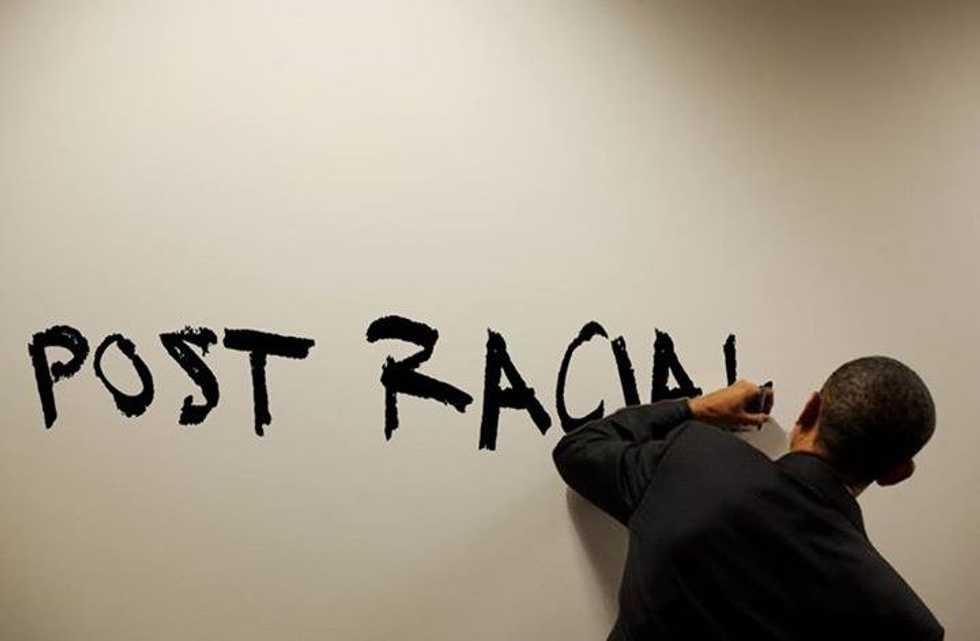
More than seven years after the election of Barack Hussein Obama, race relations have taken a turn for the worse in America. While blatant acts of racism are still widely condemned for the sake of political correctness-though pc is being increasingly maligned- many hateful ideas still persist and have even been heightened by the first mixed race presidency.
The day after the election of President Obama, most American TV screens were awash in self-congratulatory glow (except for FOX news). Pundits, celebrities, and average citizens alike assumed that America had finally gotten over the ‘racial question’. The United States had finally fulfilled Martin Luther King’s dream of an equal opportunity society. But as time passed and political goodwill evaporated, so did the theoretical unifying force of a multi-ethnic nation. Soon after, incidents took place that would sow doubt to the idea of a post-racial America.
The Southern Poverty Law Center has tracked race-based hate crimes since the 2008 election. It has documented the sharp increase in the number of “patriot” and militia groups in the years following the initial Obama election. “What seems certain is that President Obama will continue to serve as a lightning rod for many on the political right, a man who represents both the federal government and the fact that the racial make-up of the United States is changing, something that upsets a significant number of white Americans. And that suggests that the polarized politics of this country could get worse before they get better,” said writer and researcher for the SPLC Intelligence Report, Mark Potok. Between the years of 2008 and 2010 alone, SPLC data shows that militia groups increased six fold.

Focused on the issues of anti-immigration and other anti-minority stances, these anti-government groups have tapped into a hidden anger in the hearts of some white Americans. “Hate groups topped 1,000 for the first time since the Southern Poverty Law Center began counting such groups in the 1980s,” says Potok. These forces have come together to form a potent brew of hate that in some cases, exceed anything comparable in the post Civil Rights age. An AP poll measuring attitudes and prejudice calculated by an implicit racial attitudes test, found that the number of Americans with anti-black sentiments jumped to 56 percent, up from 49 percent during the last presidential election. In both tests, the share of Americans expressing pro-black attitudes fell.
Individual instances of violent hate crimes since the election of President Obama also abound. On the night of the election, there were hundreds of racially motivated instances that went mostly unreported by the mainstream media. Only hours after Obama's election, a predominantly black church in Springfield, Mass., was torched. Three white men were arrested just days before Obama's Jan. 20 inauguration and charged with conspiring to deprive church congregants of their civil rights. A University of Alabama professor reported that an Obama poster was ripped off her office door. When she put up another one, somebody wrote a death threat against Obama and a racial slur on it. White-nationalist radio show host Hal Turner wrote on his blog that his "inauguration dream" was for somebody to send an explosives-laden unmanned drone or chemical-filled balloons into inaugural crowds. In a follow-up posting, Turner maintained that Obama, congressmen and senators attending the inauguration deserved to die, as did African Americans ("sub-human simians") and liberals ("mentally-ill Whites") in the crowd. Nearly a month after the election on Dec. 6, 2008, Obama campaign volunteer Kaylon Johnson was accosted by a group of white males. The three men assaulted Johnson while shouting "Fuck Obama!" and "Nigger president!.” The pummeling left Johnson with a broken nose and a fractured eye socket that required surgery. Incidents such as these make it increasingly difficult of making a positive assessment on American race relations.
The Emerson College Polling Society conducted another poll on race relations in America. According to their data, 61 percent of African-Americans believe race relations are getting worse in the United States. As a whole, 44 percent of poll respondents said race relations are not getting better, with 41 percent of Caucasians and 42 percent of Hispanics holding the same view. These varying opinions on the state of race relations are also split along racial lines. More than half (53 percent) of African-Americans believe that minority groups have fewer opportunities. About 39 percent of Hispanics and 27 percent of Caucasians agreed that minorities are not on an equal playing field.
An even more telling example to show the divergent views between various groups would be Gallup's annual Mood of the Nation poll, which asks Americans to rate the present standing of the U.S. on a scale from zero to 10 with zero being the worst. White’s views on America have traditionally been more optimistic than non-whites but that has changed since the 2008 presidential elections. “More than half of whites (53%) were positive about the country's current trajectory in January 2008 -- 10 months before the presidential election. After President Barack Obama's first year in office, that percentage fell to 35%. Four years later, that figure is roughly the same,” said Gallup Poll analyst Justin McCarthy.

Since 2008, whites' and nonwhites' views about the nation's trajectory have been moving in opposite directions. Some would argue that while there has been more focus on the race issue, it has always been this way in spite of the election of the first African-American president. Josh Pasek, an assistant professor of communication at the University of Michigan, said, “President Obama’s election did not initiate a post-racial era. Racial tensions have always been a defining feature of American political life, and the nation’s first black president has not notably altered this dynamic.” According to an analysis done on voters, "…these results suggest that anti-Black sentiment seems to have increased slightly in America over the course of Mr. Obama’s term and that this sentiment may be shaping evaluations of Mr. Obama’s presidency…,” says Pasek.
In the background of white resentment at what is seen as minority advancement at their expense, is a feeling that black life, especially young black life as inferior. In the last two years, three major cases have shed light on what African-Americans describe as a double-standard when it comes to the prosecution of black murders. Trayvon Martin was an unarmed 17 year old who was shot and killed while walking back home from a run to the store in Sanford, Florida in 2012. After a lengthy trial and national attention, his killer George Zimmerman was found not guilty of all charges. During the trial, questions of the black teen’s social media profile were brought up and his character was attacked. According to a Gawker report, white supremacist hackers broke into Martin's email and social networking accounts, and leaked his private Facebook messages in order to portray him as a juvenile delinquent looking for trouble. Another recent example is Ramarley Graham, an unarmed 18-year old black teen who was shot and killed by NYPD officers in the bathroom of the home he shared with his grandmother in the Bronx. The accused police officers were not indicted in the 2012 killing. Finally, on Nov. 2, 2013, Renisha McBride, 19, was shot in the face with a shotgun by 54-year-old homeowner Theodore Wafer in Detroit after getting into an accident and knocking on Wafer’s door for help. Wafer’s trial on second-degree murder charges is set to begin in June. (Update: Wafer has since been tried and sentenced to a 17 year term after being found guilty of second-degree murder and manslaughter and is currently awaiting a new hearing.)
In this highly polarized atmosphere, images of Trayvon, Ramarley Graham and McBride can conjure both an image of pain and tragedy, and an image of fear and thuggery. That is the nature of the problem with race relations. Perception is in the eye of the beholder. The perception from all sides seems to point to worsening relations for the foreseeable future, worsening relations that cannot and will not be solved by eloquent speeches by the president or beer summits.