

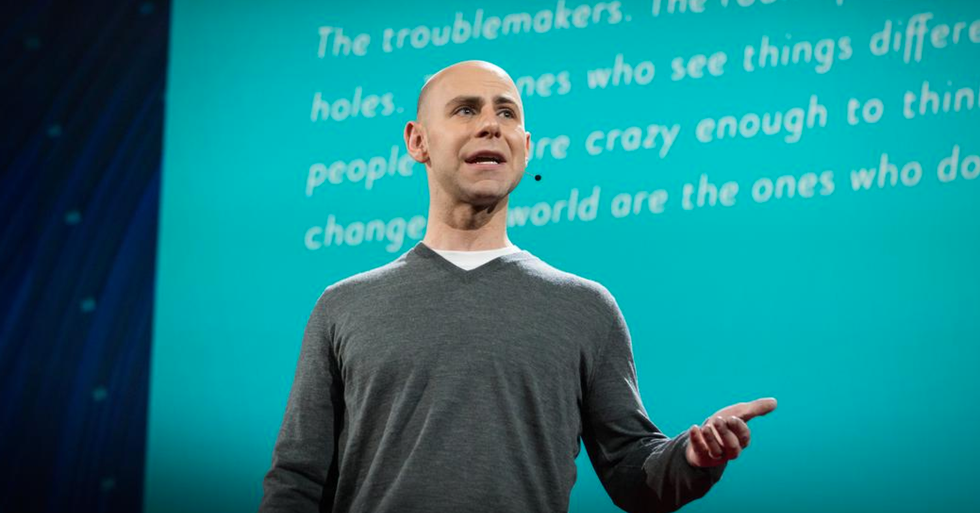
In a Ted Talk, author, professor, and self-proclaimed precrastinator Adam Grant discusses why he taught himself to procrastinate. The criticized “vice for productivity,” he says, may actually serve as a “virtue for creativity.”
The right amount of procrastination leaves time to develop original ideas. When a procrastinator learns of the impending task, it is kept active in the back of his mind, which allows him the opportunity to develop “divergent” and “nonlinear” ideas. Although it seems admirable to precrastinate, which Grant describes as having the compulsion to complete a task as soon as possible, it hinders one’s opportunity to conceive alternative ideas. And quite similarly, waiting too much time to complete a task before a deadline will not allow the task-taker enough time to consider creative alternatives for the final product. Original thinkers, therefore, fall between these two extremes of procrastination.
Grant has spent years analyzing how to identify original thinkers and what qualities make them so successful. Along with the anxiety that accompanies procrastination, original thinkers, like most people, experience a great deal of fear and doubt. What sets them apart, though, is how they manage these emotions.
Our creative process usually goes through a few phases of doubt. Grant describes that the doubt can either be energizing or paralyzing. Original thinkers are able to channel their doubt towards improvement, using it as a springboard for better ideas, whereas others are defeated by their self-doubt, using self-doubt as a stopping point in order to avoid failure.
Grant explains another benefit of “doubt” with something called the “Web Browser Study.” Research shows that Firefox and Google Chrome users are more successful in their careers as opposed to Internet Explorer and Safari due to the quality of “nonconformity.” Firefox and Google Chrome users had to doubt the pre-installed, default browser options then take the steps to seek and download alternative browsers. The difference in success between these people is not a result of the browsers they use, but rather the tendency to reject the simplest option and search for better solutions, even at the smallest level such as internet browsers.
Grant also points out that, although we rarely see original thinkers fail, they fail far more than other people. The reason is that these individuals are more afraid of failing to try than they are of failing itself. Originals fail the most because they try the most, and their successes are far more recognized than their many failures.
Everyone possesses some form of these traditionally negative qualities; the most innovative people are no exception. But perhaps, “not in spite of these qualities,” Grant proposes, “but because of them, [original thinkers] succeed.”
If you'd like to hear more, go to Adam Grant’s full talk.