

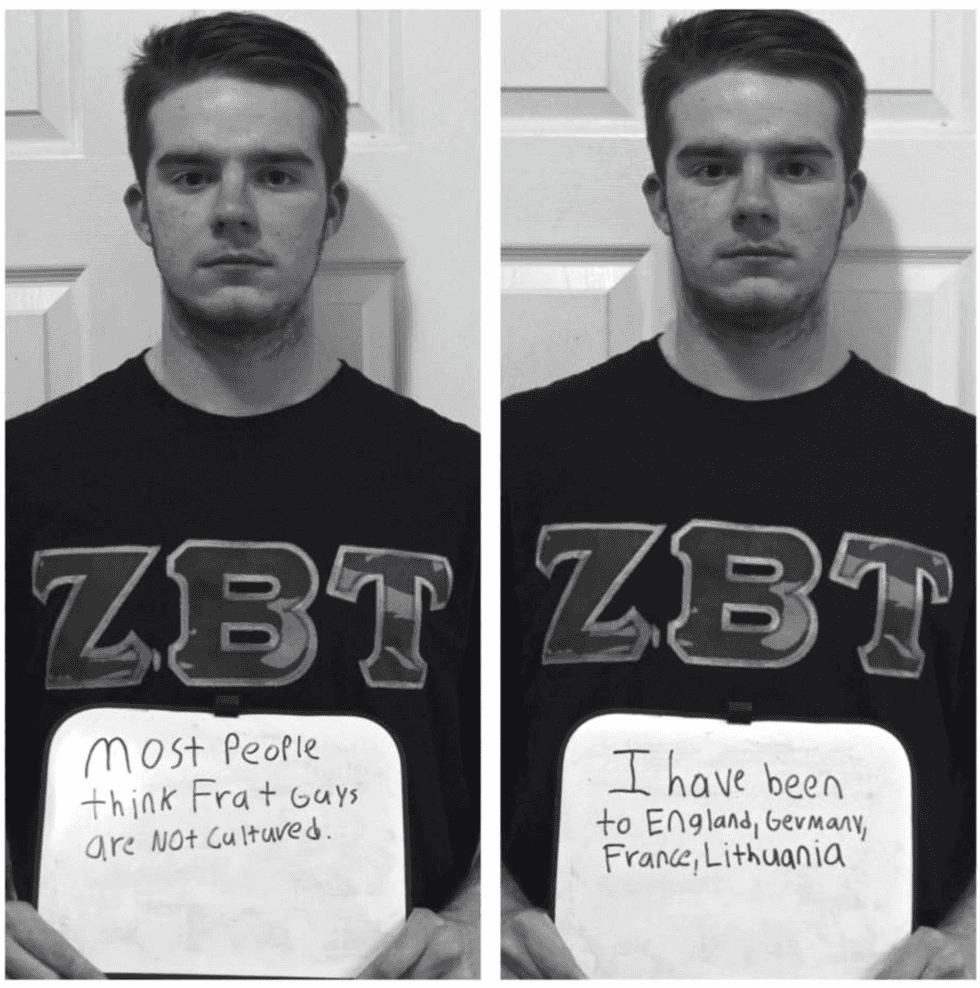
On May 7, graduating York College senior Kayleigh Dumas, a member of the Sigma Delta Tau sorority, uploaded to her Facebook page a digital photography project entitled “We Are Not Our Stereotypes." Essentially, what the project aimed to accomplish was a changed mindset about what those involved in Greek life are like. In each photo, a fraternity or sorority member was shown with a whiteboard. On the left, a Greek stereotype was written, and on the right, something about that person or what they had accomplished was written to disprove the stereotype. In theory, this idea has at least a little bit of worth. But Dumas' project did little to change perceptions about Greek life; if anything, it made a case against it.
Examples of stereotypes included some of the classics -- that Greek members are entitled drunkards who spend Daddy's money and have no regard for others -- and ranged to “uncultured," “stupid," and (for sorority girls) “girly." The outrage, however, came mainly with the responses in each picture. Perhaps the best example of this is a boy with patchy facial hair and a ZBT sweatshirt, whose left board calls him “uncultured," only to be refuted by his right board -- “I have been to England, Germany, France, and Lithuania."
Quite obviously, these pictures garnered a lot of criticism. In the comment section of the BuzzFeed article that made this project go viral, angry readers discuss their concerns. Most revolve around the same common idea -- that this project does nothing to change the problem outsiders have with Greek life, and if anything, it perpetuates the entitlement that is symptomatic of Greek life as a whole. For example, shooting down “frat guys have easy majors" with “I am a biology major" does nothing to disprove the stereotype.
The first problem with Dumas' photos is the way she went about the project as a whole. In one photo, a bearded York student's stereotype says that “all frat guys wear Vineyard Vines, Sperrys, and Ralph Lauren," to which his response is that he wears other expensive brands. Another stereotype claiming, “frat guys are dumb" is met with “Kappa Delta Rho -- highest GPA on campus."
All of this is anecdotal. It's basically like using an underprivileged child who is also very good in school to entirely disprove the stereotype that the underprivileged, as a whole, lead lives of crime. If anything, fraternities and sororities show the power of representation as a whole, and that it's up to the organization to look good, not just individual members. In other words, one fraternity having a high GPA doesn't say anything about the academic successes of Greek life as a whole, and anyone with a third grade education can reach this conclusion.
The real reason this project is not only unhelpful, but also destructive, is because it isn't necessary. In the United States today, stereotyping is a problem. It's a stereotype that people who wear head coverings at airports are potential terrorists. It's a stereotype that black male teenagers are dangerous and often commit crime. But what this project said was that the stereotype that “frat guys" are “uncultured" is on that level -- that this stereotype is so potentially harmful that it necessitated an album full of whiny complaints meant to push back against something that isn't there. This photo album stands, then, as living proof that those in Greek life are entitled: if they cannot ignore such baseless comments as “you're dumb," it's fair to assume that they have never been forced to encounter stereotypes any harsher. If a participant in this project were called a terrorist, it would wouldn't surprise me if their reaction were anything short of a nuclear meltdown. Sadly, this is the reality for many in airports across the nation.
Can the images that surround Greek life be potentially harmful? Maybe. But the benefits of Greek life itself outweigh any of that by about a million tons. What Greek dues provide to their members simply can't be put in to words. As a member of one, I can vouch for this. Part of what comes along with Greek life, then, is accepting what it means to be part of an organization. Being in a fraternity or sorority means open and easy access to friendship, support systems, academic success, brotherhood or sisterhood, an active social scene, and connections for the future. But it also means that people may have a certain image of you.
Is it incorrect to say that the stereotype of Greeks as partiers is true? Not at all! Most fraternities frequently throw parties. Is it also incorrect to say that some of the stereotypes, such as “all Greeks are wealthy" or “all Greeks are stupid," are blatantly false? Of course not. It's up to all those in Greek life to accept that criticism will always exist. There will always be problems with a system whose members can afford dues. There will always be critics of the party scene behind Greek life, because three Greek letters provide a name to which major news networks can blame a death.
Greeks encounter stereotyping, but ultimately, so does everyone. The need to address this stereotyping is absent, because Greek life as a whole is pervasive in colleges across the nation, and will stay that way for the foreseeable future. It's up to everyone, especially those in fraternities or sororities, to take this as a lesson.
If you've been offended by someone calling you “dumb" or “uncultured," think about what it may feel like to be called a racial slur or live in a community with no one supporting you, and then do your best to help out. Stereotypes are harmful. But let's address that where it actually hurts.