

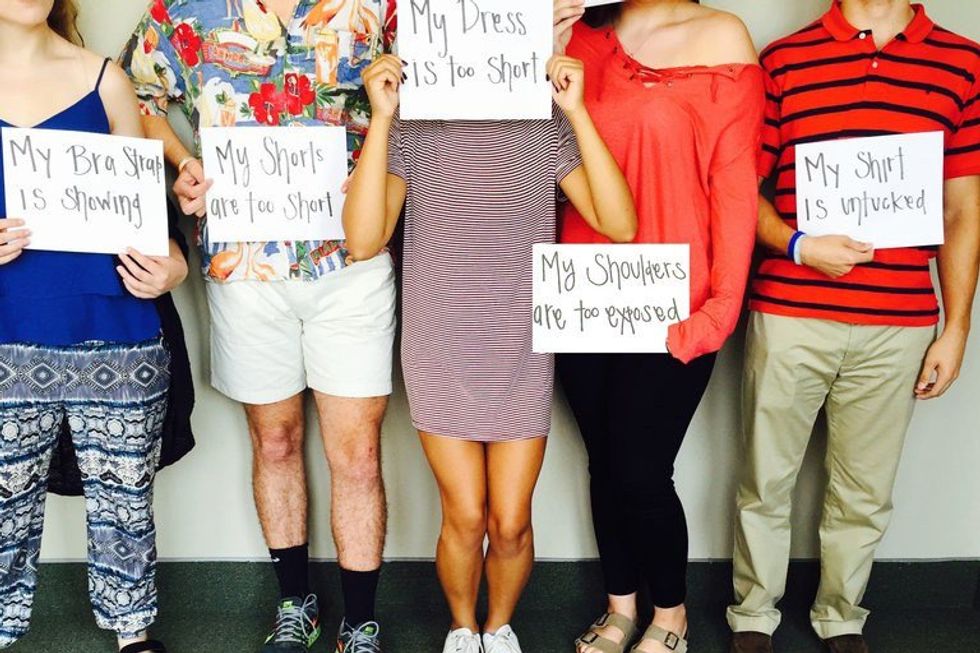
Special notes for the female students:
Tank tops are not allowed unless you use an over garment.
If you plan to wear leggings, you must wear a top that covers your behind.
If you plan to wear shorts, it must be knee-length. Remember that you might be volunteering at a High School, surrounded by teenage boys. You will attract enough attention just by being there. Please dress modestly! You will want to look respectful to everyone at all times.
The chaperones reserve the right to ask any student to change their attire if they deem it to be "inappropriate."
I recently received this in an email sent to people from my college participating in a service trip to Peru in May. I didn’t think that dress codes targeting women specifically carried over to college, but this week I found out that they did. Rather than simply shaking my fist and griping about this, I figured I’d use this opportunity to talk about why dress codes like the one above are seriously problematic.
(Before I go on, I’d like to state that I’m not passing a judgement about the intention of the college when I speak about this. I’m trying to highlight the harmful rhetoric that comes along with thistype of ruling and language in an attempt to start a dialogue.)
These “notes” were addressed specifically to female students, and there wasn’t a comparable set of notes for male students. Having stricter dress codes for women teaches us that there is something shameful about female bodies compared to male bodies. If the above rules about apparel are necessary, then they must be addressed to everyone. Just because a guy is less likely to wear leggings doesn’t mean that women should be called out for it specifically. Polarizing dress code rules not only naturalizes the idea that there are different levels of modesty for different genders, but also enforces a gender binary that is damaging to anyone whose gender identity doesn’t conform to the male/female dichotomy.
The most irritatingly problematic portion of these notes is the idea that the female volunteers will be a distraction because they’ll be around teenage boys. Let’s break that down a little bit because it’s packed with messages of inequality. First, stating that women must be aware of the way they dress so as not to be a distraction is blaming a person who is being sexualized for being sexualized. This is a mild form of “she was asking for it; look at what she was wearing.” Something better than asking women to stop themselves from being sexualized is teaching students not to sexualize people, because that’s getting to the root of the problem.
Second, this idea assumes that only men will be distracted by only women. Is it impossible for women to be distracted by men who wear cutoff shirts or pants that tightly hug their behind? I can’t tell if this idea implicitly assumes that women can’t be distracted by sexual urges or values men’s attention more than women’s. Perhaps it’s both. What I’m getting at here is, saying “Remember that you might be surrounded by teenage boys,” and “you will attract enough attention just by being there,” promotes an idea that there is a distinct group that can sexualize and a distinct group that can be sexualized.
Can we end the dress codes that target women much more than men? I don’t want to keep reading stories about girls being sent to the office for immodest dress, which is really a subjective concept. I want to stop grimly laughing at the hypocrisy that girls are punished for “distracting boys from class” by being removed from class. I want an end to this rhetoric that naturalizes the sexualization of women and blames the victim for it.
Please, no more expecting and demanding modesty from girls; write your “notes” to everyone and expect modesty from everyone. These targeted rules, while seemingly well-intentioned, are harmful, and we need to change the way we handle dress codes, because this just isn’t working.