

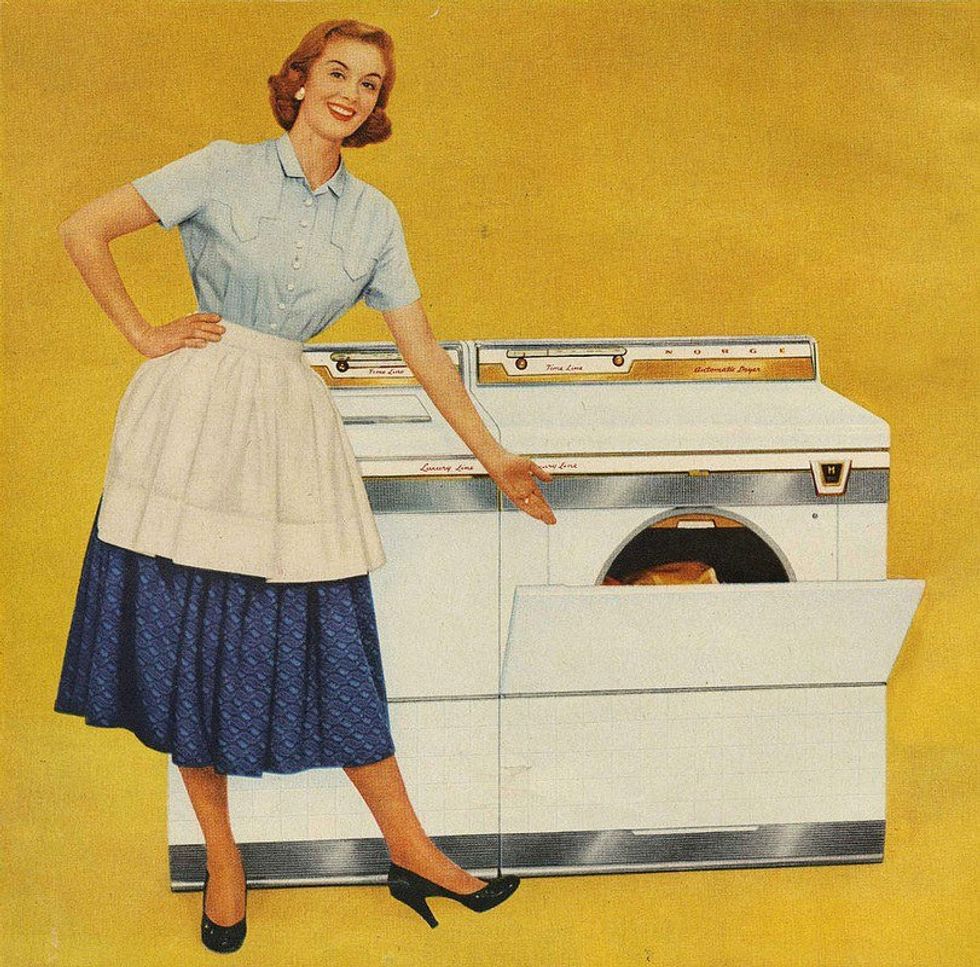
As Americans, we have two categories of mothers: working and stay-at-home.
We arbitrate these women according to the quantity of contact with their children, as well as the qualities of their personal and professional lives.
Under this archetype, no mother can win.
Mothers who stay at home are seen as old fashioned or lazy. Many times they are judged for focusing only on the lives of their children, and not their own identities.
Working women, especially in high paying professions, are often considered unmotherly and neglectful to their “family duties.”
Women who choose to be the breadwinners of their family are deemed unmotherly, simply because of their possession of talent or power that is utilized outside of their family unit.
This two-pronged categorization of American mothers causes working moms, and those who choose to stay at home, to frequently be deemed failures on both sides, in either their family or professional lives.
The growing pains of the continually morphing American family model and ideals are apparent in the contradictions seen within our two category system of mothers.
We expect women to now be part of the work force. They are held to higher standards than they have been in recent history to be exceptional in their fields of work. Women are frequently encouraged to pursue important professional careers and achieve higher educations. Those who do not work are sometimes deemed dead weight for the movements to fix problems such as adequate representation in positions of power, and the gender wage gap (which is majorly caused by time women take off from work to raise children and tend to families).
However, simultaneously, women are expected to be the home keepers of the family in our society. The lasting family mold of husbands as breadwinners causes us to view the occurrence of women as one to be a problem.
Women who want to balance family and passion for a career are faced with judgment from public ideology. Women who choose to stay at home have the same problem but from another side.
So how can mothers win?
We have to update the way we view the American mother.
They are not purely entities made up entirely of their children’s lives, even if they choose to stay at home. They are not simply embodiments of their chosen professions either, if they choose to work.
In order to change how we view mothers, we have to begin to consciously choose to attempt to understand the complexity of the balance of passions in all of their lives.
The roles of women in the American workforce and family dynamic are insurmountably complex and multifaceted. The assumptions we make about mothers (and furthermore, fathers) who may choose to work, or stay at home, must be broken down in order to usher in a new flexible dynamic that is accepted for raising children.
As a society, we are in a phase of conformity to an original family dynamic VS the creation of a brand new one.
The truth is, neither of these options is the wrong answer.
Each family is going to work best in a different way according to its members' passions, and ideals. Simply because they do not match yours does not make them less functional.