
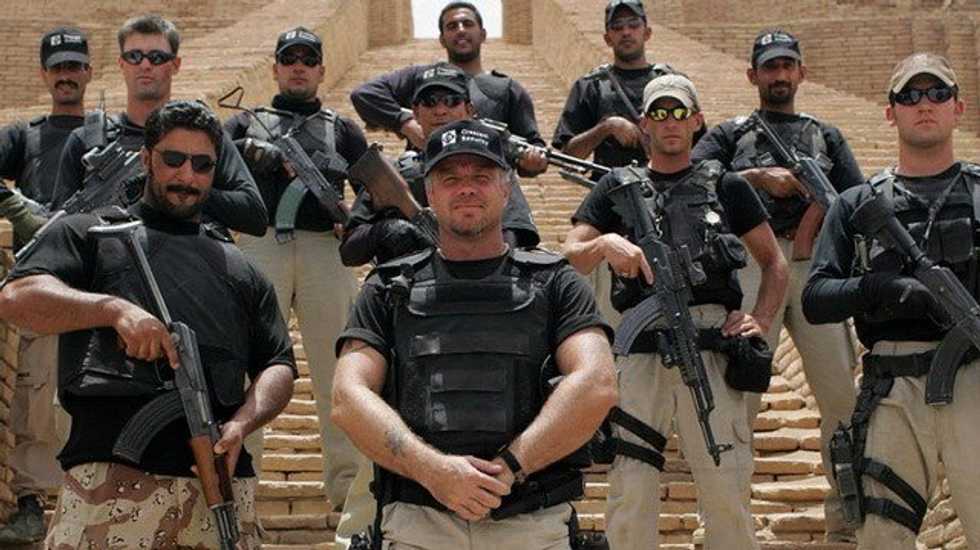
Private Military Companies (PMCs) are used all around the world. They always seem to have some controversy surrounding them yet the public seems generally uninterested in PMCs. The most popular is PMC Blackwater, known for their work in the Middle East in service to the United States. However, PMCs are harmful to countries that use them and to those where they are deployed.
The first issue is state sovereignty.
PMCs create a crack in the state's monopoly on its use of force. In 2004, the German Parliament submitted a proposal which stipulates that the privatization of the military “could lead to a fundamental shift” between a nation’s armed forces and its government as “the state’s monopoly on force could be called into question or even possibly eradicated.” The implications of this are that once the use of force is not dictated by the state, complications begin to form which deter actual progress. Conflicts of interest form and this gives corporations with their own agenda a reason and way to push. We can see this happening in the United States with private companies providing supplies to increase their influence in the Pentagon. According to the Center for Research on Globalization, "they build and supply weapons to our military as well as supply them with the needed materials so that the military can fight wars, they profit from when the US goes to war and may be likely to encourage American military action abroad." This means companies make decisions, not our elected legislators.
The second issue is legality.
There is generally no way to successfully regulate PMCs. This can be proved in Rolf Uesseler's book Servants of War: Private Military Corporations and the Profit of Conflict which accounts events in Iraq in 2004 when PMC Blackwater employees entered into the city of Fallujah and “under the pretense of looking for terrorists, [they] had carried out nighttime raids, mistreated women and children, and tortured and murdered local men and teenage boys.” Generally, state forces are required to follow the NATO set Rules of Engagement (ROEs). ROEs are directives that define what uses of force are allowed and are followed by most nations in both individual and joint operations. PMCs, not being affiliated with a nation, are not required to follow ROEs. Despite not violating ROEs, PMCs still violate international law by being under government contracts and committing human rights violations. However, the government contracts keep confidentiality for the PMCs. This makes investigations stagnate and there is no justice to the innocent people hurt by PMCs.
Private Military Companies bring about issues to everyone except themselves. The people who hire them lose their influence on their owned armed forces. The people who the PMCs are supposed to help (the people who live in the areas PMCs are sent) are exposed to violence and human rights violations without the PMCs being held accountable. PMCs monetize war and make jobs harder for politicians and taxpayers and ironically hurts the same people we try to help.