
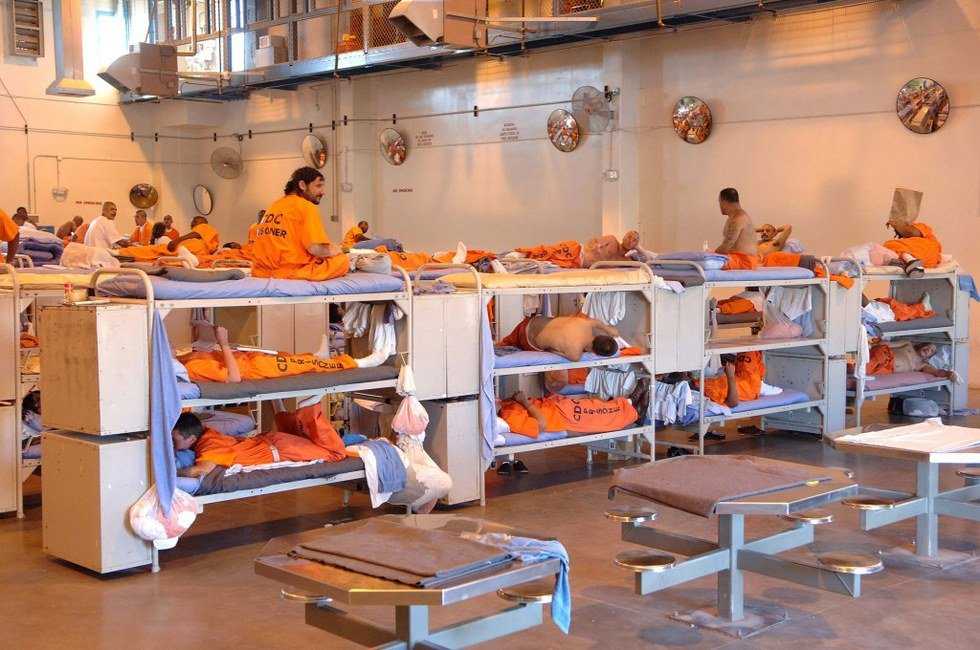
“In 2013, the United States population was 316.5 million. 2.3 million of those Americans were in the prison system. This means that 7.3% of the American population was in the prison system. That is higher than the unemployment rate in 2013 which was an average of 6.7%” (“Prison State”). We lock up harmless people every single day which then causes unnecessary overcrowding in prisons, some with almost 500 more people than the maximum that they are able to hold. By establishing resentencing for nonviolent criminals and finding other alternatives such as fines, rehabilitation, and community service, rather than automatic prison sentencing, it is possible to reduce and even diminish overcrowding in prisons.
The United States is currently facing overcrowding in prisons due to a high percentage of inmates being locked up for nonviolent crimes. Prison sentencing nowadays is often seen as the primary option for both violent and nonviolent criminals. The normalcy of incarceration is what has brought the United States a rapid increase in prison populations, thus causing overcrowding. In a radio broadcast on the topic ‘Right on Crime’ with the Illinois Public Radio stated that, “Prison is for the people we're scared of, not the people we're mad at. In other words, prison is for the people that need to be incapacitated while they receive rehabilitation or while they receive their punishment” (Cohen). Prison is a way to protect our society from violent criminals that we fear, not a place for drug enthusiasts, that got caught, who did not and do not pose any danger to our society. Prison is also supposed to be a place of rehabilitation and learning while they serve out their sentence; to ensure that when they are released, they are released as noncriminal beings that perform efficiently and transition smoothly back into our society. It is far too often that after past criminals are released from the system, they find their way back in. This is one of the main causes of overcrowding, along with the new criminals coming in, the same ones are finding their way back in as well. These frequent flyers return so often because when they were in prison, which was supposed to rehabilitate them, they did not receive the rehabilitation necessary for them to be capable of living in our society and being able to function without criminal acts. They instead go back to living their life in a criminal fashion, only because that is what they know, not what they want to resort too. A statement from Holly Harris, executive director of the U.S. Justice Action Network was displayed in a research article talking about how the senate is moving to reduce sentences for nonviolent criminals by saying, “People are being entangled in the justice system who just shouldn’t be...And when they come out, they’re better criminals, they’re not better citizens…too many people are in prison...and we’re not getting the public safety return we deserve” (Ohlemacher). Not everyone belongs in prison. With nonviolent offenders being intertwined with violent offenders for months on end, these nonviolent offenders learn to be violent offenders. Adding in the lower specialized security in prisons due to overcrowding, they have all the opportunity in the world to not be rehabilitated, but to learn to be better criminals. Overcrowding in prisons has not just led to people sleeping on the floors; it has led to lack of control in prisons, and making criminals better criminals instead of functioning people in society.
Some may argue that we shouldn't put resources into rehabilitating people that are bad for our society; that criminals are criminals and they should be locked up and away from society. One of these individuals, Charles S. Clark, author of an article entitled, “Prison Overcrowding” stated that, “experience shows clearly that the first step in fighting crime is to keep violent criminals off the streets” (97). Yes, that is true; we have to keep violent criminals away from society since they pose a danger. What there is a lacking of is the fact that we are not just locking up violent criminals, we are also locking up nonviolent criminals, and those are the ones we want to release into rehabilitation, give fines to, or assign to community service projects instead of being in prison with the violent criminals. These oppositions to keep all those incarcerated, incarcerated is a blind move being that prisons are overcrowded and there is no longer room to keep the nonviolent offenders in prison. Eventually in the piece of writing and in agreement with reducing overcrowding, Charles S. Clark states that, “society will always need to incarcerate those who endanger the community but for certain offenders it is time to consider possibilities that already exist, cost less than prison, and hold offenders accountable for their crimes...too often sentencing practices, laws and prison release policies, needlessly hold offenders in prison sometimes for long terms when community-based alternatives would serve society's interest in punishment” (97). Some minds are still caught in the track of thinking that if you do something wrong, you go to prison. They are unaware that the ideal setting of prison was only meant for violent criminals with rehabilitation in the prison itself, and for other forms of sentencing time through rehabilitation, fines, and community service for nonviolent criminals.
By exploring the reevaluation of sentences for nonviolent criminals, alongside finding alternatives to prison sentences such as fines, rehabilitation, and community service we can lower the population of nonviolent criminals in the prison system. With those reforms enforced it is possible to reduce overcrowding and help criminals into society, while still providing social safety. It is no secret that our prison population has erupted in the past few decades with facts, as mentioned earlier, stating that the prison populations in the United States in 2013 are higher than the rates of unemployment in the United States in 2013. Stephen Ohlemacher, a writer for ‘Time.Com,’ made a similar statement stating that, “Since 1980, the federal prison population has exploded, in part because of mandatory minimum sentences for nonviolent drug offenders. In 1980, the federal prison population was less than 25,000. Today, it is more than 200,000” (Ohlemacher). These rapid increases in prison populations are not ideal and have made overcrowding in prisons a nationwide issue. Prisons no longer have room for every single offender the system wishes to incarcerate. What needs to happen is a reevaluation of every single prisoner; sort out the nonviolent offenders from the violent offenders, those unnecessary to lock up and those necessary to. Taking the nonviolent offenders out by sending them to rehabilitation, giving them fines, or assigning them community service projects, is the key to lessening overcrowding in prisons. Jonathan Simon, writer of “Prison Overcrowding” stated that, “American prisons, both state and federal, are remarkably overcrowded. The federal prison system was operating at 130 percent of design capacity in 2013. Statistics for that same year show that 17 states were operating at more than 107 percent…” (29). The United States prison system genuinely does not have enough room for everyone they want to lock up. What needs to happen here? Eliminate prison overcrowding to make the system more effective by releasing prisoners who pose no danger to society and instead assigning them with rehabilitation, fines, or community service projects. The prison system operating at percentages higher than it is capable of strikes fear into the prison managers, staff, and prisoners themselves. This is due to the fact that basic operations such as fundamental medical care, family visits, and rehabilitative programming that they have attempted to enforce are often cancelled or put on hold because the demand is too high. This is caused by overcrowding, being that there is not enough resources or time to deal with the basic functions for all the prisoners since the occupancy is far above what the prisons can handle. The prison system is running out of resources and lacks the ability to lock up everyone who breaks a law.
With changing sentencing forms for nonviolent offenders from incarceration to rehabilitation, fines, and community service it is then possible to reduce overcrowding in prisons in ways that won’t affect social safety. Jonathan Simon, writer of “Prison Overcrowding,” made a statement about this saying that, “Overcrowded prisons assail the human dignity of both prisoners and staff on a daily basis...Given these realities, politicians should stop treating overcrowded prisons as an unfortunate consequence of protecting public safety; in fact, it is endangering public safety” (29). By combining violent offenders with nonviolent offenders and not having enough enforcement, prisons become a cocktail of violent people just waiting to give their new knowledge of crime a try when their release date comes up. With saying that, of course, we cannot just release all of the nonviolent offenders freely into the world, they still committed crimes that come with punishments and may have become harder criminals during their time in prison, which is exactly another reason why reforms are needed. By placing nonviolent criminals in rehabilitation programs, enforcing fines, and/or assigning community service to these nonviolent offenders they can serve their time without overcrowding the prison system. Therefore, violent offenders who seek different forms of rehabilitation that will now be able to participate in them without cancellation, being that the overcrowding of nonviolent criminals is no longer present. The Illinois Public Radio continued its talk on the ‘Right on Crime’ by saying, “An ideal criminal justice system works to reform amenable offenders who will return to society through harnessing the power of families, charities, faith-based groups, and communities” (Cohen). Exploring and enforcing these reforms will both reduce overcrowding and slowly bring our criminal justice system back to the way it was intended to be from the start. They concluded in saying, “The corrections system should emphasize public safety, personal responsibility, work, restitution, community service, and treatment—both in probation and parole, which supervise most offenders, and in prisons” (Cohen). For those in the prison system we need to offer them more “real-world experiences” and opportunities so that when they are let into the real-world once again they have experience, confidence, and more than a dime in their pocket to get them started. The criminal justice system in the United States has to bring itself back to its roots with reforms that will make a difference and keep people out of prison and into society as highly functioning individuals with a second chance. The system created overcrowding and now has to solve it by doing what should have been done in the first place; by enforcing re-sentencing for nonviolent criminals through rehabilitation, fines, and community service to become the ideal criminal justice system.
To put these changes into effect society must first pass legislation for reevaluating prison sentence lengths for nonviolent criminals. When dealing with how these changes will work is by focusing on the approval of rehabilitation, fines, and community service for people that don't pose a direct danger to our society. To promote any sort of solution in the criminal justice system there must be a strong governmental backup. For a long time the government neglected the rising issues in our prison system when looking at overcrowding, but now that they realize it is being caused by nonviolent offenders who could be serving time in a different, more sustainable, and more efficient manner they are starting to make progressive changes in their sentencing of nonviolent criminals. In a statement from the Illinois Public Radio on the “Right on Crime” they mentioned that, “In the deal struck between some of the Senate’s most conservative and liberal members, judges would have the discretion to give sentences below the mandatory minimum for non-violent drug offenders. Some current inmates could get their sentences reduced by as much as 25 percent by taking part in rehabilitation programs, if they are deemed a low risk to offend again” (Cohen). This is how changes and solutions are made and how this problem will be solved. The combination of government members, working together in agreement that there is a major problem with the overcrowding in the prison system, has already shown promise that changes will be made. Through resentencing and rehabilitation, low risk offenders are getting the chance to break free from the prison system that is meant for high-risk offenders. Those high risk offenders will then regain the normal occupancy of prisons thus allowing them to receive the rehabilitation they specifically need. Proof of how these changes through rehabilitation for nonviolent offenders, such as drug offenders, have already shown promise that rehabilitation is a real solution. Claire Axiak, writer for the Malta Medical Journal stated that, “Inmates who were not administered any opioid substitution treatment were 74% less likely to offend” (43-44). That is only one treatment change focused more on counseling than another pill. Imagine if other rehabilitation services, such as mental therapies versus medical therapies, became the norm for nonviolent offenders. The percentages of those less likely to offend would only keep growing. Rehabilitation services create a separate section in the criminal justice system for those dealing with detoxification. The individuals receiving this outside treatment would be nonviolent criminals who just need a location to recover from the hard times they have faced and gain some self-confidence in order to start a better life and function successfully in our society. By shaking off the old habits of the ‘lock them up’ technique as the ‘go-to’ solution for every social disturbance, for some, we should psychologically and sociologically find out why something happened and take the appropriate approach from there. Many nonviolent criminals don’t belong in prisons; we put them there because we don’t know what else to do with them, which then create overcrowding. Without causing harm or risking the safety of our society it is possible to enforce rehabilitation, fines, and community services to these nonviolent offenders is what will lead to overcrowding in prisons being just a part of history to learn from in the criminal justice system.
It would be extremely practical and economically smart for the prison system to reduce overcrowding in prisons by releasing and reevaluating sentences for nonviolent criminals. With the recurring problem of criminals of all kinds being thrown back into the system since they were not rehabilitated to do so in a successful way, is a major cause of the overcrowding in the prison system. These individuals known as the frequent flyers of the prison system always find their way back to prison. Due to the lack of education through rehabilitation they start to think after a few times in the system that they do great in prison and that getting locked up is just a part of everyday life. These individuals, that were not even necessary to have in prison even the first time, have cost the prison systems millions of dollars that could’ve been saved by instead enforcing a structured rehabilitation. Frontline PBS published a documentary entitled, “Prison State.” Part of “Prison State” mentioned an example of how feasible releasing these nonviolent criminals can be and the benefits that shadow it. The documentary stated that, “If we let go of one harmless "criminal" six months early, the state would save around $15,000. That's $15,000 per every "criminal" that we let out 6 months early!” (“Prison State”). The state of Kentucky has become the role model for this test. They have seen an overall positive impact from letting prisoners go who shouldn't have been there that long in the first place. Kentucky has said that in the next decade, many of the “non-violent’ offenders will be released early. This solution is incredibly feasible because the money saved from releasing these “criminals” will be used to provide mental, medical, and emotional help to prisoners along with helping people detox whilst they are in prison. The state of Kentucky is now trying these ideas in the juvenile system since they were such a success in the adult prison system. By reforming the money spent in the prison systems it is being found that there are more efficient ways to help both violent and nonviolent criminals while diminishing the vast overcrowding in our prison system.
Overcrowding in the United States prison system still stands to be a major issue due the high percentages of inmates being locked up for nonviolent crimes. By exploring the reevaluation of sentences for nonviolent criminals, alongside finding alternatives to prison sentences such as fines, rehabilitation, and community service it becomes possible to change sentencing forms for nonviolent offenders from incarceration to instead enforcing rehabilitation, fines, and community service. Therefore, prison populations will say goodbye to overcrowding in a way that won’t negatively affect social safety. By working with governmental legislation for reevaluating prison sentence lengths for nonviolent criminals it is found that it would be extremely practical and economically smart for the prison system to reduce overcrowding in prisons by releasing and reevaluating sentences for nonviolent criminals of whom the nation is paying astronomical amounts to be there that indeed do not need to. Some may argue that we shouldn't put resources into rehabilitating people that are bad for our society; although, nonviolent criminals that would instead flourish in society while still maintaining the safety of our society by rehabilitation, fines, and community service do not need to be in prison, nonetheless, are just the cause of overcrowding in prisons.
Works Cited
Axiak, Claire. "The Effect Of Community-Based Drug Rehabilitation Programs On Recidivism In Malta."
Malta Medical Journal 28.1 (2016): 41-47. Academic Search Complete. Web. 11 May 2016.
Clark, Charles S. "Prison Overcrowding." CQ Researcher 4 Feb. 1994: 97-120. Web. 11 May 2016.
Ohlemacher, Stephen. "Senate Moves Toward Reducing Prison Time For Non-Violent Offenders."
Time.Com (2015): N.PAG. Academic Search Complete. Web. 11 May 2016.
Prison State. Frontline PBS. N.p., 29 Apr. 2014. Web. 3 May 2016
<http://www.pbs.org/video/2365235229/>.
Right on Crime. Narr. Derek Cohen. 1 July 2014. Illinois Public Radio. Web. 2 May 2016.
Simon, Jonathan. "Prison Overcrowding." Insights On Law & Society 16.1 (2015): 29. Academic Search
Complete. Web. 11 May 2016.
Have something to say or a story to tell? Request to join our Wausau community at https://muse.theodysseyonline.com/apply.