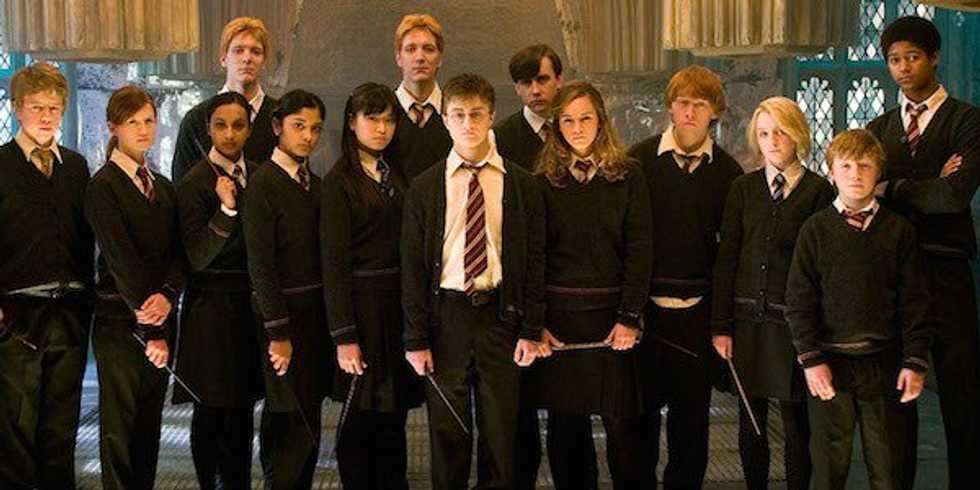
Although pretty much anyone's intuitive answer would be "Hell no!" But not Graeme Whiting. Whiting is the principal of a British private school who wrote at reasonable length in a blog post recently about how "Harry Potter," and similar modern literature, "... can damage the sensitive subconscious brains of young children..." Yeah, if you're thinking he couldn't be more wrong, then we're on the same page.
Before you just dismiss him out of hand, though, remember this is the principal of a pretty well known British private school. Even the LA Times reported on his blog post! Not only is he in the position to influence a lot of people, but his view could easily be taken as authoritative by teachers anywhere (even where you live!). It isn't fair or productive to say he's wrong and leave it at that. We should understand why, so we are prepared to counter it the next time a claim like this arises (and it will, this is a pretty recurring idea).
If you are just interested in a beat-down, go ahead and skip to the last couple paragraphs.
It would be one thing if he said he didn't like modern literature. Critics have had harsh reactions to some very well known books, and that is at least a perspective that can be defended. But, let's look at exactly what he said, and see if he makes a good point.
"In today’s world of transformational humans, millions of therapists worldwide make a living from trying to understand, and reveal, by various methods, what lies within the subconscious brain of those patients who come for help because of anxieties and fears, experiences and memories, often pictorial images of events that helped to shape their lives; predominantly bad memories, which is why they seek therapy."
Who here has taken psych 100? Freudian views of mental illness have largely fallen out of scientific and therapeutic favor. The subconscious is potent, yes, and holds a lot of what makes us who we are, but that is only the tip of what causes mental illness.
"[...] my view is that we should strive, as human beings, to ensure that children are protected during their developmental years from negative experiences that linger within their subconscious and may prevent them from moving forward towards adulthood, unencumbered by such memories, particularly inappropriate images or text that confuses their imagination, as they do not have thinking brains until, at the earliest, fourteen years of age. [...] An eighteen-year-old doesn’t suddenly get a developed thinking as a right, or as a gift, just because in the eyes of the state they have reached adult age!"
This is where things start to go really off the track. Children don't have thinking brains until they are 14 years old? Anyone who teaches children before that age will argue quite strongly. In his defense, he might be talking about Piaget's formal operational stage of development. That would be an extremely narrow view of 'thinking' but it might be where he is getting that from. Even if he is, that discusses formal logic not the ability to comprehend fiction and enjoy literature. He is certainly right about one thing: 18-year-olds don't just suddenly develop 'thinking.' It develops through the entire lifespan, from birth to death. So, what is magic about the age 14? Nothing whatsoever.
"Imagination is so rich and important that I cannot understand why any parent would not actively prevent exposure to modern-world electronic gadgets, screens, films and literature that will encumber the minds and especially the imagination of their children."
Imagination is important, no arguments there. What rubs me the wrong way is his argument that modern life limits imagination. Really? He doesn't explain how it limits, just that it does. Imagination is rich, but how does it get that way? From experience. The more we experience, the more material our imagination has to work with. As such, why would an educator who believes in the importance of imagination be advocating for less experience? The way we consume information is changing, sure. But that doesn't mean the ways it is being consumed are no less valid than in the past. If anything, we can take in so much more than we used to because of how ubiquitous forms of media are.
"At school I had a passion for literature; indeed I felt that by the age of thirty I had read all the books I wanted to read. Those books were a strong influence and created in me feelings about what should be read by children, who cannot discern or understand, and these books helped to shape me as a human being. Of course, there are many wonderful experiences that are also locked behind that door, but what concerns me with the modern world is that there seem to be no doors that cannot be opened by young children. Children can contrive, they can lie and they can get their own way; they can also be wonderful and beautiful if parents take the time to try to understand what childhood really is! Children are innocent and pure at the same time, and don’t need to be mistreated by cramming their imagination that lies deep within them, with inappropriate things."
By age 30, he had read all the books he wanted to read? That sets off all kinds of red flags for me. I understand how education can generate a profound loathing of reading for many of us, but for someone who enjoyed literature so much, this strikes me as very odd. Isn't the idea to continue to learn and grow over your entire life? If so, how do you do that without reading because you enjoy the material you're reading?
Yes, literature can be a double-edged sword for any reader. Books can easily lead us astray because the stories contain characters of various viewpoints, which might be confusing for very young readers without guidance. What does that mean? For parents and educators to guide and help those they educate puzzle through these materials, not take them away! Reading, especially fiction, is huge for children to develop normally. In a study done at Emory University and reported by Psychology Today, researchers found that "becoming engrossed in a novel enhances connectivity in the brain and improves brain function. Interestingly, reading fiction was found to improve the reader's ability to put themselves in another person’s shoes and flex the imagination in a way that is similar to the visualization of a muscle memory in sports."
He's concerned children can read these books without too much trouble. OK, I can see where he is coming from, to a degree. However, if parents are involved in a child's education and the media they consume (of any kind), then his concerns are very poorly founded. If parents are inattentive or neglectful, that is just bad for a child overall, regardless of media exposure.
"I stand for the old-fashioned values of traditional literature, classical poetry, Wordsworth, Keats, Shelley, Dickens, Shakespearean plays, and the great writers who will still be read in future years by those children whose parents adopt a protective attitude towards ensuring that dark, demonic literature, carefully sprinkled with ideas of magic, of control and of ghostly and frightening stories that will cause the children who read them to seek for ever more sensational things to add to those they have already been exposed to."
I hate to burst his bubble here, and I don't have to! In the Plymouth Herald, one reporter wrote, "Ironically, one of Keats' most famous poems, 'Lamia,' is about a seductive serpent woman and Shakespeare's plays are full of ghosts, demons and bloody violence." The writers he celebrates write about similar themes with equal 'darkness' as those very stories that Mr. Whiting thinks so poorly of. If those are appropriate for children, then why isn't "Harry Potter?" I personally would make an argument that "Harry Potter" is more appropriate for pre-teens than Shakespeare is, as much as I enjoy both. A lot of books children read, especially in school, do contain difficult themes. The whole point is so that children learn how to talk about them in a safe and academic space.
"I want children to read literature that is conducive to their age and leave those mystical and frightening texts for when they can discern reality, and when they have first learned to love beauty. Harry Potter, Lord of the Rings, Game of Thrones, The Hunger Games, and Terry Pratchett, to mention only a few of the modern world’s ‘must-haves’, contain deeply insensitive and addictive material which I am certain encourages difficult behaviour in children; yet they can be bought without a special licence, and can damage the sensitive subconscious brains of young children, many of whom may be added to the current statistics of mentally ill young children. For young adults, this literature, when it can be understood for what it is, is the choice of many!"
Here we go, the part I hope you're still reading for. "Harry Potter," "Lord of the Rings," "Game of Thrones," "Hunger Games" – these are some of the most acclaimed books of our generation, for good reason. Each is an epic tale full of elements so important that many fans attribute their love of reading, or even their very lives to reading them. To say they aren't beautiful is to neglect the power of their prose, the imagination of their imagery, the charisma of their characters, the wide appeal of their worlds and their ability to enthrall anyone in a story that feels so real that people can and do cry while reading (I know, I have). You don't get to say these aren't suitable for children as a blanket statement because they contain "dark" themes.
Yes, they contain darkness. But you know what children learn from that? How to overcome it. Read them, entirely, for comprehension, and the most amazing things happen. These stories inspire people to overcome their dementors, make their way bravely through Mordor, uphold their honor even in royal intrigue, and resist propaganda and control.
When I was young I remember reading books by Tamora Pierce. You may not know her work, but I was reading her stories back before I even knew what rape was. I learned what it was by reading one of her books. More than that, I learned the horror a woman experiences when in that situation and the strength it takes to escape. I learned how to accept something that traumatic and move past it, becoming a stronger person than before. If you don't think that lesson is valuable for children, then I question your judgment.
Is he certain these cause "difficult" behavior in children? There is zero evidence to support that claim. Mental illness isn't so straightforward as to be traced back to reading "dark" stories. Most modern theories trace it to a combination of genetics, upbringing and stress. The role of a "dark" story in that is minimal.
"It is the duty of parents to spend time to study such matters and form their own conclusions, not to think that because the world is filled with such sensational literature they have to have it for their children, because everyone else does! Beware the devil in the text! Choose beauty for your young children!"
The world is filled with sensational literature. Literature that engages all the senses and is truly an experience instead of just another story. I choose to share that, as widely as I can. Choose to see the beauty in these stories because that is what they are. They are about the beauty that ultimately comes from the conquest over evil. I can think of no lesson that everyone, regardless of age, needs right now.