
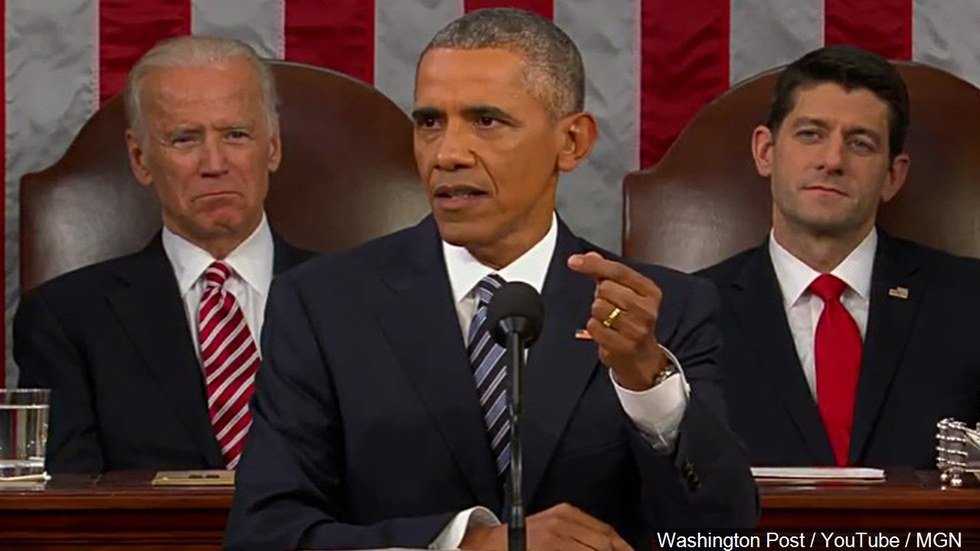
In his State of the Union Address for the final year of his term, President Barack Obama - whether you love him or hate him, and often I find, there seems to be very little in-between - made a statement which, I hope, we can all agree upon, our differences aside. He said, concerning the present condition of our political climate,
"The future we want — opportunity and security for our families; a rising standard of living and a sustainable, peaceful planet for our kids — all that is within our reach. But it will only happen if we work together. It will only happen if we can have rational, constructive debates. It will only happen if we fix our politics."
And for America, I think we can all agree, that's true. Frank discussion and intelligent investigation is the only way democracy works. For the goals he listed, and as he put it, for "The future we want" as a country, we must put aside our divisive rhetoric and come to the discussion as equals.
But I do not consider myself, primarily, an American. The President is not my Lord, the Stars and Stripes are not my banner, and I pledge allegiance to a higher Master. The standard of living I seek is a matter of ethics, not economics, and the sustainable, peaceful planet I'm after will be the result, not of policies, but of peaceful lives, and of the Prince of Peace whom I am convinced will one day rule all things forever. That is not to say I don't want sustainable energy or a more stable dollar - it is to say that those things aren't the point.
So we've established that the President and I might want different things - and indeed, that you and I might want different thing, whether you want a sustainable future, or a great revival, or lower taxes, or peace in the Middle East, or the end of poverty, or just to feel welcome in your church this Sunday. The 'kingdom' of America is divided - by race, by party, by creed, and this division stands in the way of the prosperous future we, as Americans, dream of.
What I'm suggesting is that in the President's recent words we might find ancient wisdom.
The kingdom of God likewise stands, in spite of the world, terribly divided. We are divided by race. We are divided by politics. We have allowed ourselves to be divided into denomination after denomination by creed. Though our goal is different, it is impeded by the same curse which had beset our earthly nation. This is not a division of disagreement, but a division of disturbance in the underlying peace which the Hebrews call, 'shalom' - in the essential wholeness of our body of believers. It is not that we believe different things - the beauty of the gospel is that across 2000 years the centers of Christianity, the central matters of our reflection, the issues that challenged us and our responses have been incredibly diverse - but I still look to Augustine, to Origen, to Pope Francis, Pastor Bradley and Billy Graham as my brothers, with no conditions.
No, I do not believe our disagreement is the root of our division. It is that many of us, myself included, don't know how to approach the table as equals. Our church politics need to be fixed. They always have, as we have always been mortal people, and Paul wrote to address that very point in his letter to the Ephesians. I challenge you, whether Christian or not, to read chapter four, one of the most beautiful descriptions of a unified band of believers I have ever read. I wish only that I had the space to transcribe all of it here. The line I wish for all of us, as people, as servants of Jesus Christ especially, to take from it is this:
"Let no corrupting talk come out of your mouths, but only such as is good for building up, as fits the occasion, that it may give grace to those who hear...Let all bitterness and wrath and anger and clamor and slander be put away from you, along with all malice. Be kind to one another, tenderhearted, forgiving one another, as God in Christ forgave you." - Ephesians 4:29, 31
These words are written in the context of the sharp divisions of the Church of the first century, in the midst of a chapter who's central theme seems to be the unity of the Christian church, and a desperate plea for us to stand as one.
I believe the Church stands for that peaceful future I mentioned before. I also believe it stands for feeding the poor. I think it cares for private morality, too, and for loving our enemies and bringing an end to conflict, saving souls and bodies both. It stands for peace, for restoration, for private citizens doing what good they can, and yes, I believe the Church means that when we, as young believers walking into unfamiliar churches in our college towns, or darkening the door of our family's parish for the first time since our Freshman year, or finally getting connected with our roommate's Bible Study, enter into these assemblies, we should enter without needing to feel judged or scared. And as a Christian, I can also see that the way we've handled our conflicts in the past - excommunicating people on the other side of the aisle, calling politicians we disagree with the Antichrist, disowning our unbelieving children or dishonoring our zealous parents trying to do right by God - the way we do politics, now stands in the way of all that we hope to do.
Jesus began his ministry by proclaiming, "The kingdom of God is at hand." President Obama was right to say that our goals are within our reach - for we see the kingdom in every soul turned to God, and in every relationship restored, and in every orphan and widow fed and clothed. But we must learn to work together peacefully, despite our disagreements. We must learn to forgive the wounds of the past, to choose allegiance to the cause of the kingdom over our allegiances to the doctrinal disputes, party divisions, styles of worship, dress, and speech that prevent us from achieving these ends.
Our disagreements are to be expected. Paul claims as much in 1Corinthians, when he told early Greek Christians, worried about whether they could eat meat offered to idols, to not judge those who disagreed as they worked through the issue. But our disagreements must be handled with love, with gentleness, and with a commitment to be, "quick to listen, slow to speak, slow to wrath." I know what it's like to get fired up during a debate. Before you know it, words like, "bigot", "ignorant", and "damnation" - especially in Christian circles - tend to fly like mortars across the proverbial battlements. I am as guilty as anyone.
But it is time for the admissions of guilt to be replaced by the expectation of repentance. It is time for us to come to the table as equals. Whether or not you like President Obama, whether you consider yourself a Democrat or a Republican, whether you hashtag #BlackLivesMatter or #BlueLivesMatter, and whether you worship in a suit or your slippers - may the words of the State of the Union provoke in us a Union of State, of Speech, and of Service, so that in the loving way we interact with ourselves, and all those around the world who disagree with our message, our party, our nation,or our style of song, they might know we are Christians - as indeed Jesus left for us:
"By this all people will know that you are my disciples, if you have love for one another.” John 13:35