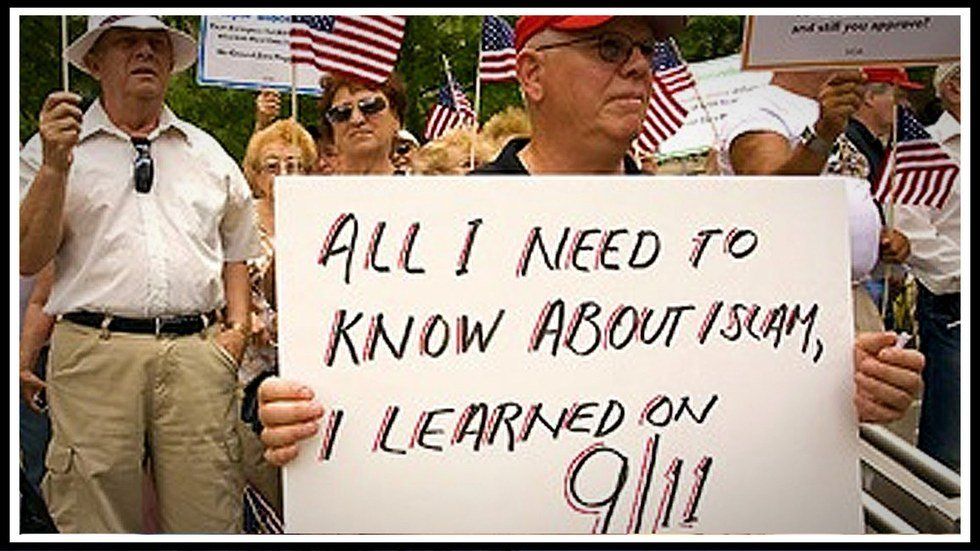
Growing up as an Arab-American, I have always been aware of different forms of Islamophobia. People have misconceptions about the religion, thinking Islam is directly correlated with terrorist attacks and groups such as Al-Qaeda. Then, they generalize aspects of terrorism with all Muslims. This is as misled as believing that all Christians have the same principles and practices as the Westboro Baptist Church.
The United States’ prejudice towards certain religions stems from its close ties with Christianity. Although the United States is a “secular” nation, it is undeniable that it favors Christianity. For example, the Pledge of Allegiance literally says “One nation, under God,” and Congress’s meeting room in the Capitol has statues of Moses and an engraving that reads “In God we trust.” Many of the laws are based on Christian beliefs, and many government leaders practice Christianity. So, even though the U.S. preaches “separation of church and state,” it’s not as separate as people would like to believe. With such a heavy Christian influence, it’s easy for other religions to be marginalized, leading to intolerance and discrimination toward other religions.
With Islam already being marginalized like other religions, it was easy for people to assume the worst when relations with predominantly Muslim populations went south. Since the Gulf War days, American-Middle Eastern relations have been strained. Taking into account the common misconception that Middle Eastern and Islam are synonymous, Islamophobia began to grow in the U.S. As other conflicts began to unfold, and relations continued to get worse, Islamophobia got worse and worse. The attacks of 9/11 seemed to be the height Islamophobia, but it is still ever present in the U.S. I believe that Islamophobia is a result of fear from these events, not the religion, specifically; but since people and society associate these events so closely with Islam, people become Islamophobic. While the recent events did scare many people, the media stirred up much of the fear. The media has a way of connecting things that might not be correlated at all, such as terrorist attacks and Islam.
Ben Carson is the perfect example of an Islamophobe. He recently made comments regarding the religious affiliation of presidents. He stated that Americans should take into consideration a candidate’s faith when voting for a president. He also stated, “I would not ever advocate that we put a Muslim in charge of this nation,” (Kaufman, Salon.com). This statement shows his intolerance and discrimination toward people the Islamic faith. What makes him believe that a person who practices Islam would be less fit to run the United States than a person who practices Christianity? He claims that Islam is not consistent with the values of this nation, but if the U.S. is truly a secular state, is that a valid argument for disqualifying a person from being the president?
Islamophobia is not only present in individuals, but in our society as a whole. Islamophobia is an institutional prejudice evident through tightened airport security for Arabs, lack of welcoming for Mosques, and incidents such as Ahmed’s clock. Many people know about the situation with the 14-year-old Muslim boy from Texas who brought a homemade clock to school. School officials suspected it was a bomb and immediately put him in handcuffs and confiscated the clock. This makes me question how the situation would have played out if Ahmed had been a “traditional” Christian American. Maybe the clock would have been entered in the science fair. Maybe he would have been awarded with some type of inventor award.
Just as Americans should not generalize things about Muslims, we should not generalize Americans. Islamophobia changes, location by location, throughout the world and the U.S. After speaking to people who have experienced Islamophobia, I have noticed different cases in different areas. My friend, Dania Hawat, a Lebanese Muslim who has spent plenty of time in the U.S., shared with me some of her experiences. “In a town near Nashville, Tennessee, they had all kinds of questions. Most of them suggested Islamophobia, but I considered them more of ignorance. ‘Does your family encourage suicide bombing?’ ‘Since your family comes from a military background, have you been involved in any live shootings?’ ‘Do you regularly use weapons?’ ‘How much bloodshed do you see around you?’ My experience in Kirtland, Ohio, was very different though. People were more aware of the situation around Lebanon and understood that the conflicts in my country don’t judge its people.” I also spoke with Hassan Harb, a graduate student at University of California, Merced, who has had a very positive experience. He explained that on the West Coast, the population is very diverse; therefore, people are much more accepting.
The presence of Islamophobia in the United States is undeniable. By raising awareness of the issue and correcting the negative stereotypes, it may be possible to reverse the irrational fear. The U.S. would be much more of a melting pot if the population were more accurately represented in Congress. Hopefully in the future, the U.S. will involve religions other than Christianity in lawmaking and be more accepting of other religions all around.
"Ben Carson’s Islamophobia: “I Would Not Ever Advocate Putting a Muslim in Charge of This Nation”." Saloncom RSS. N.p., n.d. Web. 25 Sept. 2015.