


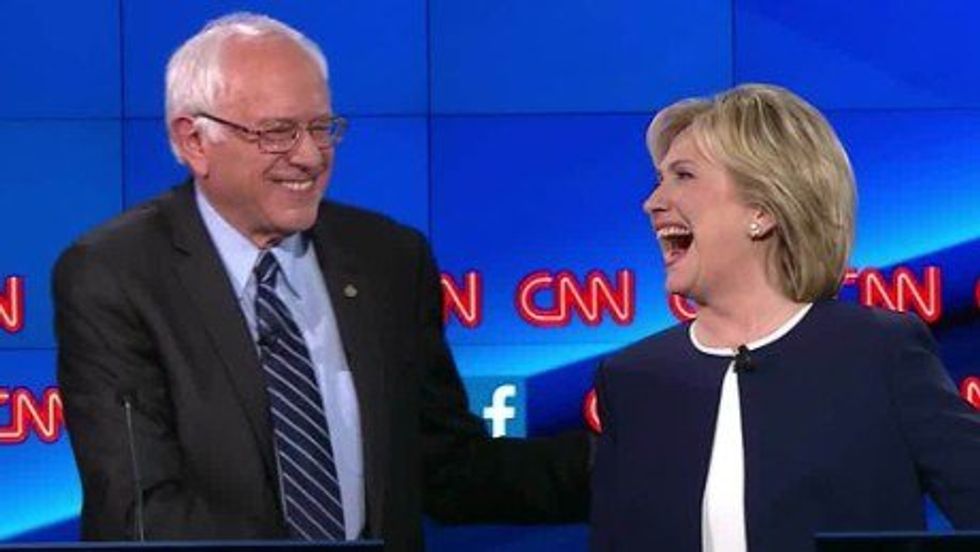
Immediately after the first Democratic debate last Tuesday, news articles flooded the Internet with verdicts on “who won” out of the five candidates: Hillary Clinton, Bernie Sanders, Martin O’Malley, Lincoln Chafee, or Jim Webb. The purpose of this conclusion is quite mystifying, for determining a winner is a highly subjective process that involves a variety of factors. If one critic evaluates based on style and another on content, there is a high possibility that their respective victors will differ and lead to two separate winners. It all depends on perspective.
Yet despite the futility of deciding a definitive winner, the press attempts to do so regardless. In taking this inevitable behavior into account, it becomes clear that mainstream media outlets executed a gaping discrepancy in their debate coverage Tuesday night.
The New York Times churned out article after article lauding Hillary Clinton on her win -- even a piece with a neutral headline that referred to Clinton as the victor in its second sentence. By contrast, there were no profiles of Bernie Sanders’ debate performance, despite the fact that the media reluctantly touted him early on as the primary threat to Hillary Clinton. Not only is he Clinton’s biggest competitor and thus deserving of exclusive debate coverage, but Sanders also racked up the most votes from polls and focus groups that crowned him the winner.
This contrast deepens upon examination of the types of media coverage Clinton and Sanders received after the debate. Highly circulated publications such as The New York Times and CNN declared Clinton to be the victor. Meanwhile, articles focusing on Sanders’ success appeared in lesser-known outlets such as Alternet and The Hill.
An explanation for this gap is evident in the analysis of Sanders supporters, who have circulated a reminder that Time Warner -- the corporation that owns CNN -- has been a consistent and formidable Clinton donor. Whether or not one chooses to believe the bias this endorsement may inspire in CNN coverage, Clinton does have a corporate advantage over Sanders, who atypically refuses to accept donations from super PACs.
The debate coverage mainstream media showcased and the gaps it revealed in acknowledgement of Clinton versus Sanders illustrate how the conversation does not end with the debate. Rather, post-debate news has produced an instantaneous dialogue regarding donor influence and the voices of the people versus those of political pundits and media powerhouses. This discourse was fervent to the point where The New York Times felt the need to respond after facing slews of critical comments on their Facebook posts featuring Clinton. It is noteworthy that the New York Times responded not with a stand-alone article but rather with a newsletter mention. Also, a keen commenter points out that the term "fans" in the title is condescending and undermines Sanders and his supporters.
Ascertaining the sole winner of a debate is entirely subjective, but dominant media outlets, in their expected fashion, scrambled to announce one after the Democratic debate. Their decision was essentially unanimous: Clinton had won. Whether due to corporate influence or a continued underestimation of Sanders, the gap in mainstream coverage and support of the two leading candidates is difficult to ignore. The next Democratic debate is scheduled for Nov. 14. Ideally, in its aftermath, both Hillary Clinton and Bernie Sanders will receive equal, in-depth media focus as prominent candidates.

















