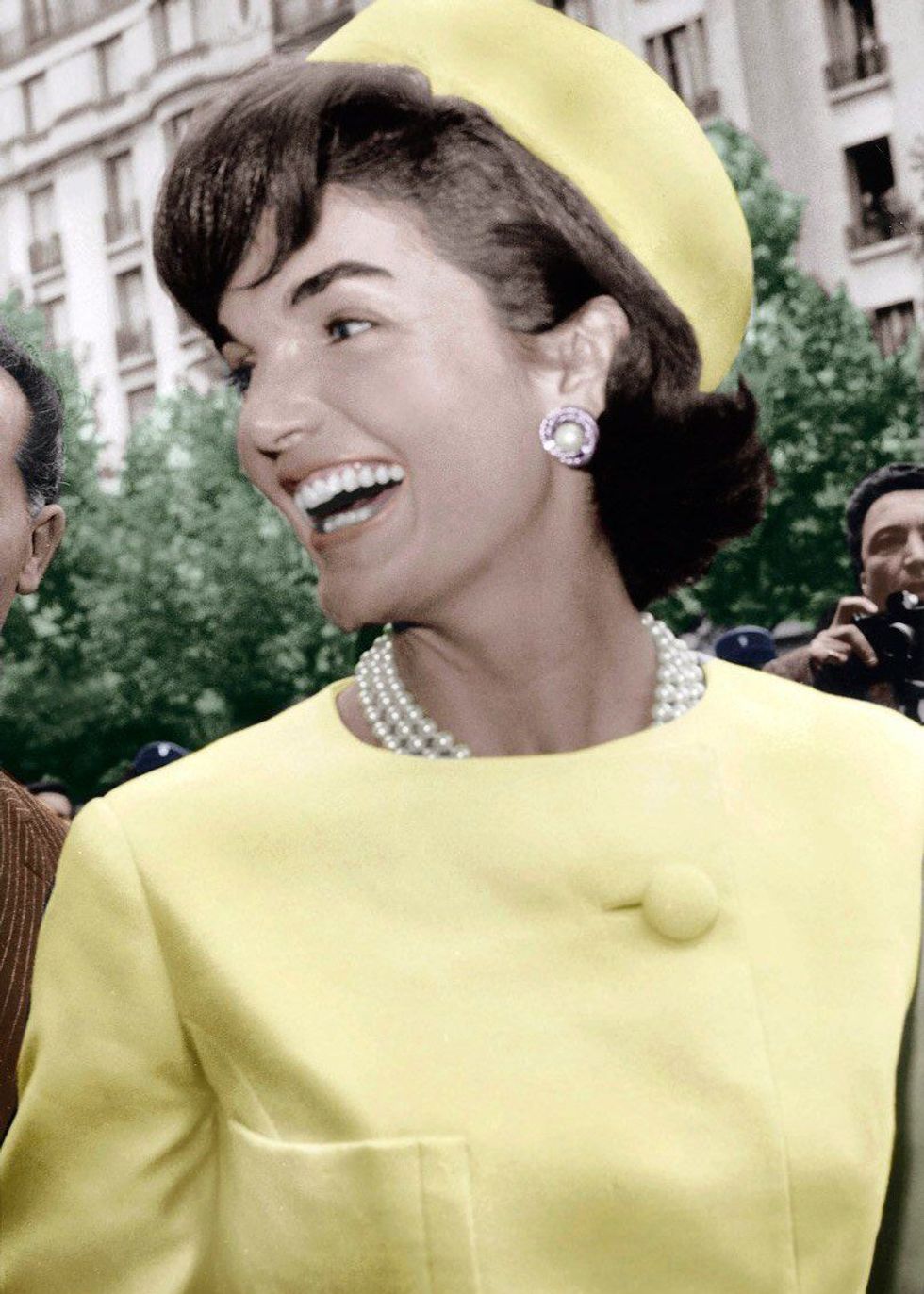
I cannot give an origin point to my infatuation with Jacqueline Lee Bouvier Kennedy Onassis. Honestly, I have no idea where it came from, much less when or how it began. I can remember as a child hearing about the famed former First Lady. I balked at the notion that she was as important or great as young women thought her to be. She seemed superficial and inconsequential to me. I thought women only liked her for her style or because they thought JFK was attractive. Now, I can barely believe my younger self was ever so blasphemous.
Maybe it was Katie Holmes’s portrayal in “The Kennedys.” Maybe it was the segments chronicling her life in Bill O’Reilly’s "Killing Kennedy". Whatever spark it was that ignited my inner fire to learn all about Jacqueline, I have since learned that it will never be quelled. She is a riddle wrapped in a mystery inside an enigma. She was as far from superficial and inconsequential as one can be. Though she undoubtedly had style, the most alluring parts of her nature come from that which cannot be seen. She was an intensely private and intensely passionate person.
My junior year of high school, as part of AP United States History, each week every student would present a biography of a prominent historical figure from our current unit to the class. Most presentations ran about five minutes. We had to choose our historical figure from a preapproved list. When we reached the unit covering the 1960s, I was appalled to find Jacqueline missing from the list. I approached my teacher and stated my displeasure. I argued that Jacqueline was of immense importance and her contributions to our country could not be ignored. In the end, my teacher relented (probably because she knew I would never give up, and she felt indebted to me for never taking my movie suggestions). I prepared my biography of Jacqueline Lee Bouvier Kennedy Onassis. I presented it on my seventeenth birthday, and when I was stopped by my teacher, I realized I had been talking for around forty-five minutes. I was not nearly finished, so I sped read through the high points and returned to my seat. A forty-five minute speech did not even begin to delve into the importance of this woman who had not even been on the list initially.
Don’t worry. I am not about to give you a forty-five minute speech extolling the virtues of Jacqueline Lee Bouvier Kennedy Onassis. I am merely going to try to shed some light on the captivating woman in honor of what would have been her eighty-seventh birthday on July 28th.
You may have noticed I type out Jacqueline’s long and cumbersome full moniker. I have not once referred to her as Jackie. That is entirely intentional. Jacqueline’s given middle name, Lee, was her mother’s maiden name. Prideful to a fault, names meant everything to both Janet Lee and Black Jack Bouvier. As a matter of fact, Jacqueline’s younger sister chose to be known by her middle name, making her Lee Bouvier (and of course later Lee Radziwill). The Bouviers considered their name their creed. Family members claimed that the Bouviers had historically important ties to French royalty. This was actually entirely false. It is fitting that Jacqueline’s family history was built behind a harshly-forged facade of fame and fortune considering that she would go on to live her entire life behind a similar mask. Jacqueline actually vehemently loathed the nickname Jackie. She got used to it later in life, but it was never her favorite thing to be called. When future sisters-in-law Jacqueline and Ethel, were introduced, the latter called the former “Jackie” and repeatedly mispronounced “Jacqueline.” Finally, young Jacqueline fixed her with a steely glare and corrected, “It’s Jacqueline. It rhymes with queen.” Ethel scoffed, “How fitting.” The only thing Jacqueline hated being called more than Jackie was First Lady. She said it sounded like the name of a cheap racehorse.
Though she did not want a name like one, Jacqueline did love horses. As a child, nothing gave her more joy than horses and books. She was exceptionally lively and vivacious. When her parents’ marriage deteriorated, so too did some of her energetic demeanor. Jacqueline became more introverted following the divorce of Janet and Black Jack. She loved her father dearly, and days spent with him were her favorites. They developed their own code with car horns. When she heard a certain string of beeps, she knew Black Jack had arrived to pick her up for a fun daddy-daughter day.
Jacqueline’s school career was tumultuous to say the very least. After debuting as “Debutante of the Year,” she pursued her education at Vassar. An avid Francophile all her life, she did a year abroad at the Sorbonne in Paris. She then relocated to D.C. and ultimately graduated from George Washington University (#RaiseHigh!). She passed up an internship with Vogue at her mother’s insistence. She and her sister, Lee, who had just graduated high school, traveled Europe as a graduation present from their mother and step-father.
After graduating, Jacqueline decided to try her hand at journalism. She was hired by The Washington Times-Herald (not to be confused with modern D.C. or Indiana newspapers), an ambitious but now defunct publication that produced ten editions of the paper per day. Jacqueline was known as the “Inquiring Photographer Girl.” Essentially, her job was very similar to modern-day Humans of New York. She roamed the city, speaking to and polling citizens whose pictures she would snap after conversing. The only known copies of her work reside in the Library of Congress and the JFK Memorial Library. Some of her questions seem almost prophetic now. Who was your favorite First Lady? Which famous death or assassination most affected your life? If you had a date with Marilyn Monroe, what would you do?
While working as the Inquiring Photographer, Jacqueline was introduced to John F. Kennedy. He told the story that they “[...] were flirting with each other at the dinner party. I found her attractive, so I leaned over my asparagus and asked her for a date.” To which Jacqueline corrected, “They didn’t serve asparagus.” Jacqueline set her sights on the noted bachelor. She was engaged when they were introduced, so she invited her fiance out to Hammersmith Farm, her step-father’s home, for the weekend. When she returned him to the airport after his stay, she nonchalantly removed her ring and handed it to him. She pursued Jack Kennedy. She easily won over his father, Joe Sr., who saw Jacqueline as an asset to Jack’s political future. Jack was smitten, but he wasn’t sure if he was ready to settle down. Jacqueline used her position with the newspaper to goad him along, asking questions like Would you rather vote for a bachelor or a married man? And At what age should a man be married? She would also sometimes drop by the senate cafeteria to have lunch with Jack. He soon got the message and proposed. While waiting to make the formal announcement, Jacqueline traveled to cover the coronation of Queen Elizabeth II. Little did she know, she would soon be considered by some as the Queen of America.
Despite her time as the Inquiring Photographer, Jacqueline had little to no tolerance for the press. She despised their heinous violations of her rights and privacy. She detested their following her children. She fought most of her life against photographers and journalists, often pursuing matters in court. She did not want to be written about or hounded for information.
Perhaps the only relationship Jacqueline had that was more volatile and neurotic than her relationship with the press was her relationship with her father. After losing much of his once barely-existent fortune, Black Jack resorted to hitting the bottle pretty hard. He loved his girls, he just had extreme difficulty showing it. Janet looked for every opportunity to embarrass him or keep the girls away from him. The night before Jack and Jacqueline’s wedding, Black Jack got very drunk. His sister called Janet the next morning to inform her that Black Jack was slightly hungover, but that he was getting ready and would arrive shortly. Janet told her to tell him not to bother. She forbade him from coming to the wedding and walking their daughter down the aisle. Jacqueline was crushed. After embarking on her honeymoon, she sat down and composed a letter to her father telling him how disappointed she was but that she still loved him. Later, after being diagnosed with liver cancer, Black Jack requested to see Jacqueline. She did not arrive in time before he slipped into a coma. His last word was reportedly, “Jacqueline.”
Jacqueline proved indispensable and invaluable to Jack’s political career. Since she spoke fluent French, she would often translate things for him. When he was incapacitated due to back surgery, she accumulated the interviews and writings he would need to compose "Profiles in Courage". She discussed issued with his advisors. She threw herself into the political arena wholeheartedly and could not detach herself from it emotionally. She suffered a miscarriage after the 1956 Democratic National Convention due to the immense stress she put on herself. Anyone who slighted Jack, she would not longer tolerate. She could not bring herself to force friendships just for political benefit. She had the head for politics, just not the heart.
Jacqueline was also quite useful for charming dignitaries and other couples. Winston Churchill--one of JFK’s heroes--was quite taken with her, while he believed Jack to merely be his waiter. Jack was mortified. Jacqueline quietly reprimanded him, “I told you not to wear a white jacket.” Once JFK became president, Jacqueline continuously wooed influential leaders. Khrushchev reportedly threatened JFK with nuclear war at a summit, only to slide his dinner chair across the floor hours later in order to be closer to Mrs. Kennedy. They talked literature and art, and he was so besotted he eventually came to respect her husband on some level as well. Jack joked on a trip to France, “I am the man who accompanied Jacqueline Kennedy to Paris.” And he really was.
Prior to the Kennedy administration, the White House was in shambles. It was an utter mess with holes in the walls, clutter in random places and not nearly enough historically important furniture pieces. The glory we think of when we imagine the interior of the White House is only thanks to Jacqueline Kennedy. When she wasn’t busy charming foreign leaders, she threw herself into the work of restoring the White House. She hated it when people called her venture “redecorating.” It was much more than that. She personally tracked down many historic portraits and pieces and convinced their owners to donate them. She worked with congress to fund her project. She is solely responsible for the fact that we can buy White House memorabilia, an idea she came up with to help pay off her restorations. This is also where the journalistic practice of using numbers to refer captions to certain pictures originated. Jacqueline thought it to be simpler and more efficient than any other way of captioning pictures, so that way was employed in picture books made about the White House.
Jacqueline’s favorite job was not being First Lady or any of her many political ventures. It was being a mother to Caroline and John John. She spent as much time with her children as the family’s hectic schedule would allow. She loved reading to them and encouraging them to be artistic and creative. Jacqueline also sought to restore culture and art within the White House. She frequently entertained great musicians and artists. She arranged for the Mona Lisa to visit the United States. She met with authors and actors. She made sure that creativity was restored within the White House just as much as any of her many physical restorations to the building.
The death of their third child, Patrick Bouvier Kennedy, shortly after his birth caused a shift in Jack and Jacqueline’s marriage. Jacqueline had always been aware of Jack’s dalliances, and while they had always troubled her, she accepted them as a part of her husband’s nature. The night of his inauguration, he snuck away to attend a party with girls arranged by Frank Sinatra under the pretense that he was going out to get a newspaper. Jacqueline, knowing his tricks, smirked at him upon his return, noting that he had no newspaper. “What are the headlines?” she asked him. He sheepishly grinned in reply. After Patrick’s death, however, Jack became more serious. Jacqueline and he really attempted to focus on their marriage. The night before that fateful day in Dallas, he opened the door to their adjoining rooms (they did not usually share a bedroom because of differing sleeping practices) and fell into her arms. They embraced and slept in the same bed that night.
Following Jack’s death, Jacqueline was inconsolable. She could not sleep unless her sister shared her bed. She stayed up the first night and wrote a letter to Jack. She asked the children to do the same. The letters were buried with JFK. She planned Jack’s funeral and set about preserving his legacy. Terrified that her children could potentially be targeted, she married Aristotle Onassis, believing that he could offer protection and privacy. Her chief concern was always her children. She remained with Onassis until his death.
Jacqueline later returned to her first love of literature and became an editor. She lived in New York and built her life around her job and her children. Her love for Caroline and John John was unlike anything else. They were her main source of joy for many years.
The thing that enamors so many people about Jacqueline Lee Bouvier Kennedy Onassis is that everyone knows who she is, but no one knows her. She never allowed herself to be truly known by anyone but Jack and their children. She was intricate and impassioned, cautious and charismatic, lively and laidback, alluring and aloof, entertaining and enigmatic. She was a myriad of contradictions.
In her high school yearbook, each students’ portrait went next to some facts about them. Most were funny and unimportant, but at the bottom of each list, students were asked to write their greatest aspiration in life. Jacqueline’s simply reads, “Not to be a housewife.” At first, this seems ironic. She was perhaps the world’s greatest and most well-known housewife. But then the more one thinks about it, the more one realizes that title does not cover it. Throughout her lifetime Jacqueline Lee Bouvier Kennedy Onassis was many things--she was a poet, a literature enthusiast, an equestrian, a daddy’s girl, an inquiring photographer, a shrewd political mind, a fashion icon, a strong advocate of restoration and culture, an editor, a dazzling conversationalist, and a loving mother--but a mere housewife definitely was not one of them.