An exceptional article by Fr. Stephen Freeman discusses the terrifying, yet fascinating, idea that eminent ethicist Alasdair MacIntyre discussed in his landmark book,"After Virtue." In this book, MacIntyre dissects what he contends went wrong with the overall discussion of ethics, tracing it back to a breaking away from the language of virtue, and tracing this to the enlightenment. In essence, he makes the claim that not only have we wandered away from correct moral dialogue, but we have lost the very tools with which we can even have this dialogue. All of this, because we decided to stop using the notion of virtue, instead focusing on more mathematical methods of right/wrong such as utilitarianism and deontological ethics.
Regardless of whether one agrees with his faulting of the enlightenment project, one must pause at the grim voice when he discusses the situation ethics finds itself in, contending that it is analogous to the Dark Ages, “If my account of our moral condition is correct, we ought also to conclude that for some time now we too have reached that turning point. What matters at this stage is the construction of local forms of community within which civility and the intellectual and moral life can be sustained through the new dark ages which are already upon us.”
This is the language of surrender is in his voice. Or rather, of retreat. We must regroup, he claims, fall back to the communities that will sustain the virtues as society as a whole falls into decay. Quite grim, really. Bleak, but we must wonder nonetheless, is he correct?
The prescription is hard to dismiss. Stanley Hauerwas, a contemporary of MacIntyre's and also a well-respected ethicist, maintains that communities are not only excellent conduits of virtue, that they are the only good method of carrying virtue throughout the generation. More specifically he cites the stories a community tells itself, passing them down through the ages.
Make no mistake, these two are no radicals, standing on soapboxes and shouting that the sky is falling. These are two of the most respected ethicists of our time. And while Hauerwas never quite proclaimed that the enemy is not only at the gate, but inside the walls, he did express that our ethical systems are broken so long as we do not have the language of virtue. Both of them contend that so long as we lack the notion of virtue as a way of dealing with ethical conversations, we are fundamentally lacking the tools to be an ethical society.
The description, on the other hand, may be a bit more difficult to confirm or deny. How does one judge the ethical capacity of an entire nation? I initially thought to point to the two candidates for election as our leaders, because, in a democracy where the leaders are chosen, they will represent what is thought to be the best of us. And this is clearly damning for any sort of claim to ethical high ground.[1]
But perhaps we can look at the dialogue itself. Both sides, right and left, seemingly miss each other whenever there is dialogue. Both use wrong and right, but neither seem to properly contextualize whatever statements they are making. Seemingly the purpose of politics is to open the pathway to as much freedom as possible, which, on initial glance, strikes one as a good thing. The government should not be telling me how to live my life.
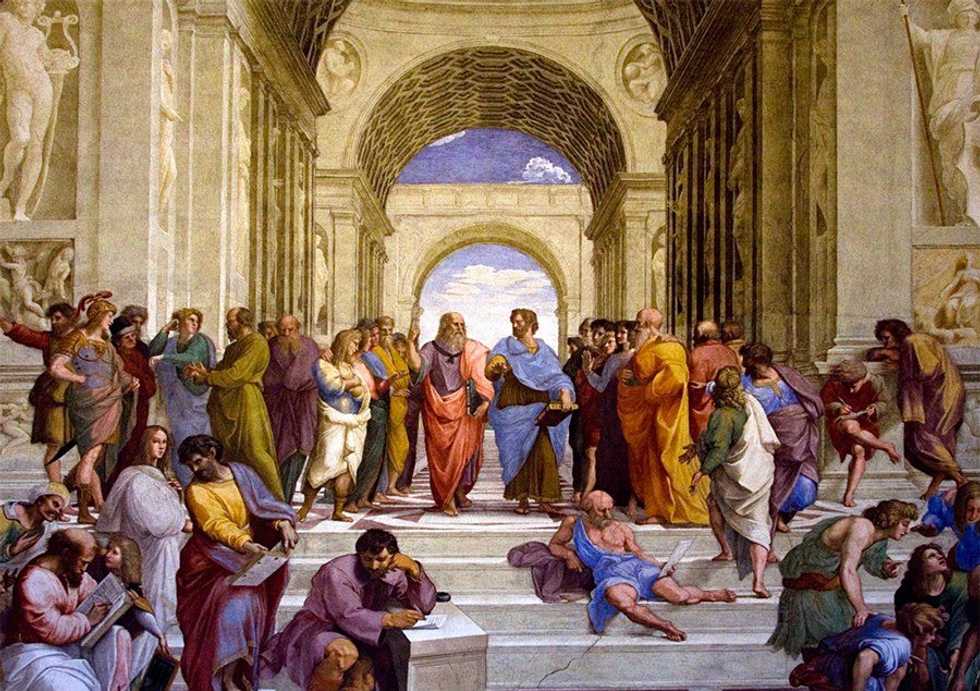
On the other hand, this is actually a fairly recent view.[2] Politics was originally thought of as the way of making citizens, and therefore society, better. Athens, the birthplace of what we now know as philosophy, was very firmly of the belief that politics and virtue were one and the same.[3] Hauerwas understands this when he discusses the ideas of Russian writer Solzhenitsyn, who “takes the classical view that it should be the function of politics to direct people individually and collectively toward the good.”[4]
The question ultimately lies in what we as a society want to become. And this is the question that the election this year, is designed to answer. In electing a leader, we choose the one who best embodies the ideals that we as a society value. “The meaning of authority must be grounded in a community’s self-understanding, which is embodied in its habits, customs, laws, and traditions; for this embodiment constitutes the community’s pledge to provide the means for an individual more nearly to approach the truth.”[5]
And this question seemingly goes unanswered again and again. We often hear promises of what will be done, but rarely will politicians go into the reasoning of things. So in this year’s election, consider not only what action is being promised, but rather the person behind those promises, the motives the actions have, and ultimately where those actions will lead us as a moral or immoral society.
When only the action is examined, but not the end goal, we will inevitably run into trouble.
[1] In my humble assessment of the current political situation.
[2] Not that this implies it is a wrong or bad view, but something to keep in mind.
[3] MacIntyre, After Virtue, pp 133
[4] Hauerwas, Community of Character, pp 75
[5] Ibid. pp 60