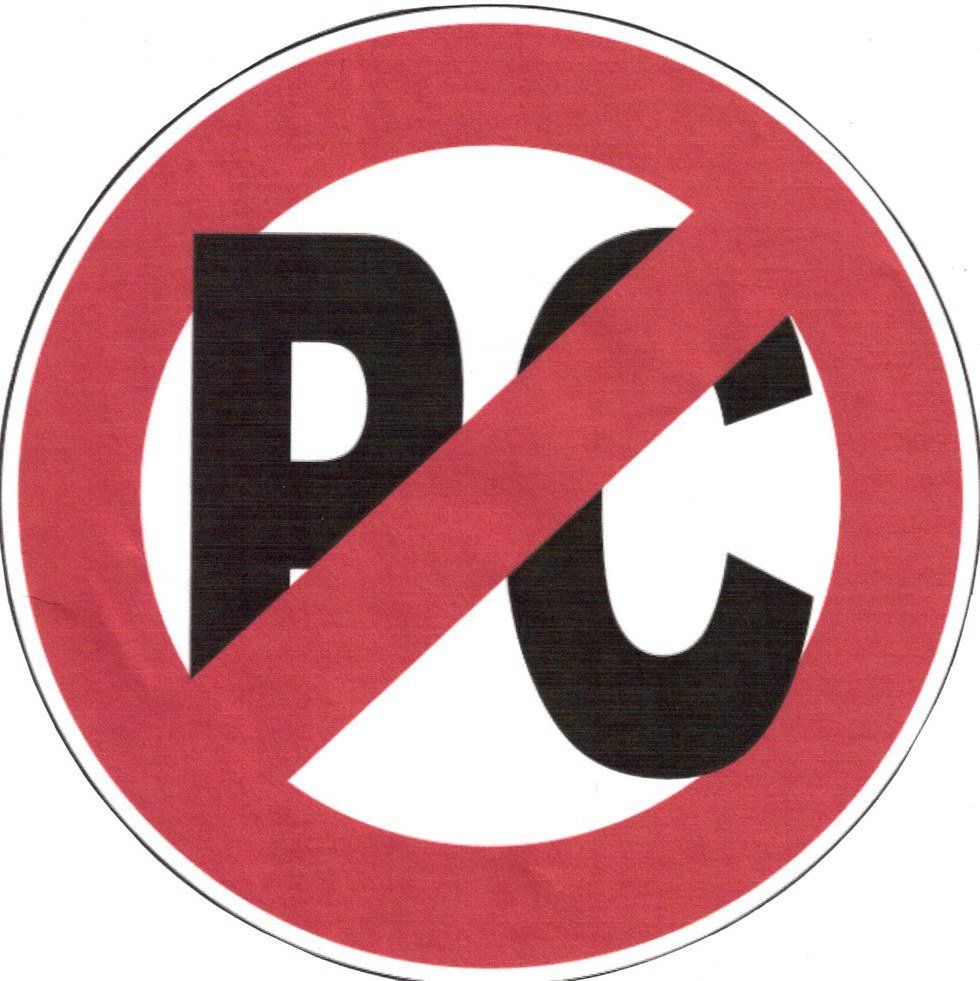
noun
noun: political correctness; noun: political correctitude
- the avoidance, often considered as taken to extremes, of forms of expression or action that are perceived to exclude, marginalize, or insult groups of people who are socially disadvantaged or discriminated against.
In case you haven't heard, We the People are plagued with it.
What a notion! Western Civilization is, well, civilized. The term "politically correct" is not as recent as one may think. In fact, one of the first recorded statements using the term was in 1793 during a Supreme Court judgement in the case of Chisholm v. Georgia. Justice James Wilson contends that it is the People who wield full authority of the United States, not state legislatures. Therefore, a toast given to "The United States" is not politically correct, and rather should be addressed to the "People of the United States."
"The states, rather than the People, for whose sakes the States exist, are frequently the objects which attract and arrest our principal attention... Sentiments and expressions of this inaccurate kind prevail in our common, even in our convivial, language. Is a toast asked? 'The United States', instead of the 'People of the United States', is the toast given. This is not politically correct." Chisholm v State of GA, 2 US 419 (1793)
Easy enough to understand, it seems that a term which does not resonate with reason is not politically correct.
Fast forward to 2016, and we have a President who chooses not use the term "radical Islam." In his own words, “The reason that I am careful about how I describe this threat has nothing to do with political correctness and everything to do with defeating extremism.”
It seems that our President would rather not include an entire religion with the hateful extremism that seeks to abuse and demean the very fabric of that religion. Yet, he is accused of defending terrorism and being evasive – being too politically correct.
Terms like "P.C. police" and "social justice warrior" seem to suggest that there are individuals seeking to undermine free speech and condemn those who simply want to tell it like it is. Take a certain republican presidential nominee who has been quoted using the term "illegals" when addressing undocumented immigrants in the United States. One might argue that he is simply stating the obvious – except he isn't. The term is jargon and cannot be found anywhere in U.S. Immigration laws – it is simply a negative connotation.
Why you ask? Because being an undocumented immigrant is not a crime. I repeat: mere unauthorized presence in the country is NOT a crime. Again, it is not punishable by criminal penalties. In fact, as of April of 2014, the Associated Press announced that "illegal" would no longer be used to describe any individual because the use of the word would be improper.
Terms rooted in racism and xenophobia are improper – they show an utter disregard for social progression and the english language. We are no more offended than we have been in the past, but it is because we have strived to be better that they ought not be used.
When the Food Network declined to renew a contract to a renown chef for using the N-word during a deposition and an Australian prime minister publicly apologized on the country's behalf to the Stolen Generations, it was not in the name of political correctness. Rather, they were acts of progress toward a promise that we will do better. We are better.
As a public relations practitioner, I have an affinity for the eloquence of speech and the expressive competence it takes to deliver it. It is there that We the People find the true, free speech marketplace. A long-established American custom, which is everything but an excuse for prejudice.