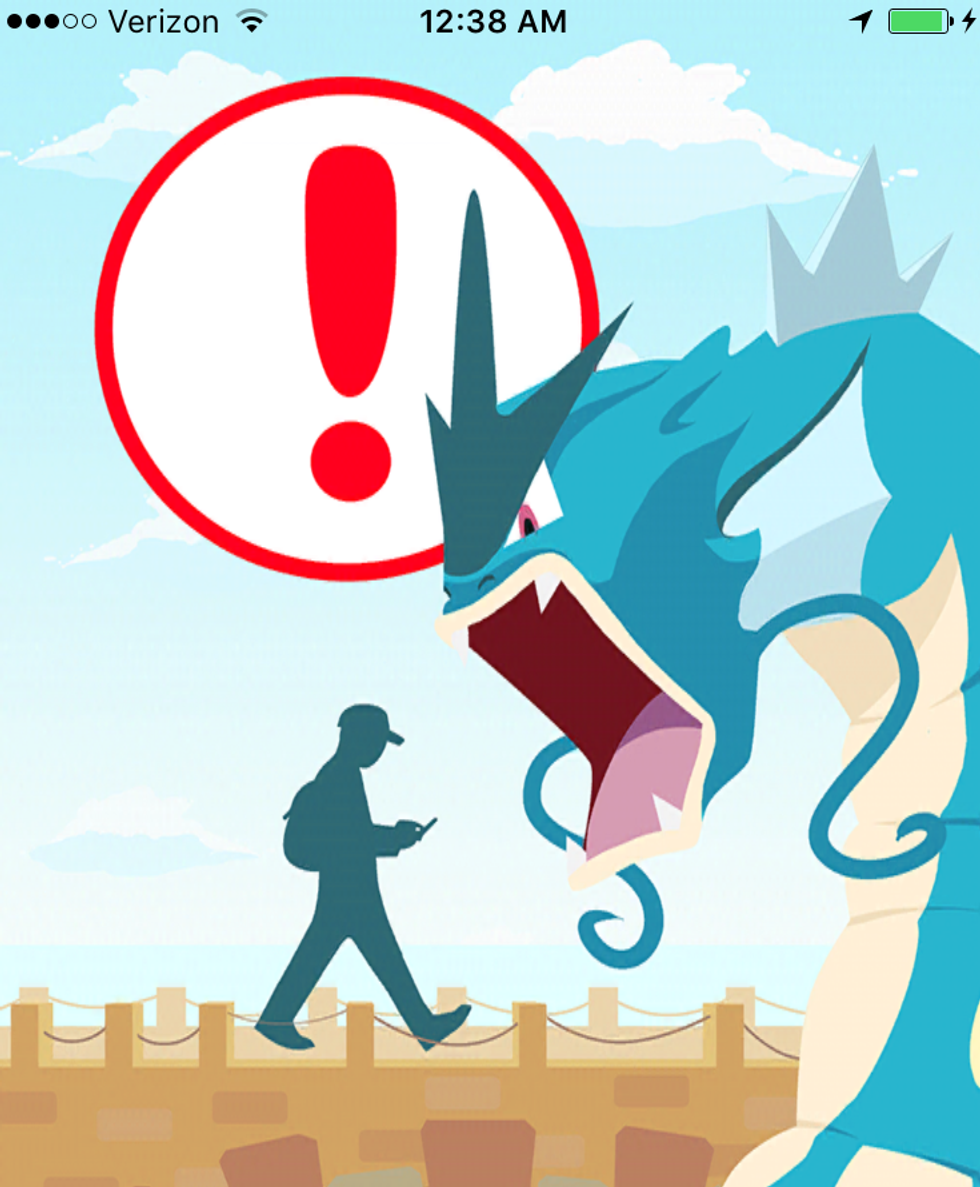
I just spent 30 minutes sitting near an abstract sculpture outside of an academic building. Staring at my phone, I patiently waited for the telltale vibration that signaled the spawning of a Pokémon. Someone had installed a Lure Module on this Pokéstop, and I was going to take full advantage of the half-hour of increased Pokémon appearances.
When I did look up, I nodded knowingly to the 15 or so other college-age people around me, all looking intently at their smartphones. We exchanged smiles and awkward laughter as someone who just joined the crowd noted, “Well, I know why you’re all here!”
Look around you. If you happen to be in an area frequented by the millennial generation, like a college campus or large park, you may very well be surrounded by Pokémon trainers, wandering around, seemingly aimlessly, smartphone outstretched, occasionally stopping and swiping at the screen.
"Pokémon Go" has taken the world by storm; not only did this free app bump the Nintendo stock price up over 25 percent since its release last week and offer the company higher-than-expected profit through in-app purchases, "Pokémon Go," in less than a week, is already a more popular app than Tinder, and is quickly gaining on Twitter.
What is it about this app that draws young people to leave their homes and wander far and wide in the summer heat to catch and battle Pokémon? To fight through the week-old app’s all-too-frequent glitches and server errors? Here are a few ideas:
1. Nostalgic Value
The Pokémon franchise, beginning in 1996 with the release of Pokémon Red and Blue in Japan, has sold over 210 million games in the last 20 years, not including the sales numbers of many spin-off games. Looking at these numbers, one can easily see that Pokémon has touched (and taken up many hours of) many millennials’ lives.
This is a game series we played after school and on the playground, battling and trading Pokémon with our friends through link cables and then wirelessly. Our generation has stuck with "Pokémon" from its original Gameboy platform, to the Gameboy Advance, to the Nintendo DS, and to the newest Nintendo 3DS. Now, with Pokémon Go, the franchise has brought itself to our smartphones, which we are seldom without (and we don’t have to buy another console!).
Nintendo also played to childhood nostalgia by filling the Pokémon Go world with only first generation Pokémon, the original 150. With over 700 existing Pokémon within the now six, soon to be seven, generations, sticking to the originals appeals to that decades-old memory of simplicity.
2. Accidental Exercise and No More FOMO
"Pokémon Go," seemingly unintentionally, fulfills two common desires: a wish to stay healthy and at least somewhat active, and to go out and explore nearby areas as to not miss out on fun experiences.
As the first generation raised entirely surrounded by home-based, video game technology (the Nintendo Entertainment System was released in 1985, Sony’s first PlayStation in 1994, the Nintendo 64 in 1996), millennials have, collectively, spent a lot of time indoors, working out their thumbs. We love our video games, but we also occasionally need Vitamin D, fresh air, and a little physical activity.
Very few people leave home without their phones, so by hopping from consoles to smartphone applications, Nintendo solves this lack-of-activity issue. "Pokémon Go" gives players incentive to get up and leave their homes to explore the world, searching for Pokéstops (landmarks where players can find items and Pokémon eggs), Pokémon gyms (where players can battle for dominance), and Pokémon themselves. Gameplay is sorely limited if a player stays in one place.
In addition to traveling around, Pokémon trainers must actually walk to complete some areas of gameplay. To hatch Pokémon eggs, for example, players must walk a minimum of two kilometers (or sometimes five or ten!) before an incubated egg will hatch.
This incentive to leave the house has a dual effect for aspiring Pokémon trainers. In addition to providing a fun distraction while one exercises, "Pokémon Go" can give players an extra reason to go out with friends.
Although many people do not need the promise of Pokémon searches, new Pokéstops, and gyms to spend time with friends, there are significant subsets of young people who experience some form of social anxiety. Social anxiety is no joke, and "Pokémon Go" (probably) won’t erase anyone’s anxieties, but some may benefit from the knowledge that the place their friends want to go may be home to some rare Pokémon.
3. Making Like-Minded Friends Who Will Let You Use Their Lures
The sheer number of people who play "Pokémon Go" ensures that one active player will almost undoubtedly run into another. One learns to read the signs: holding phones up a little higher than usual, occasionally looking around to match the virtual topography to the real world. Between this and looking around a Pokéstop with an activated Lure Module, players can easily find each other.
Besides simply giving each other knowing glances, "Pokémon Go" players can easily start up conversations with one another. They already have one interest in common to talk about! This aspect also aids players who experience social anxiety. They do not need to come up with a topic of conversation if they want to speak to someone — there is already a topic provided.
Of course, there is another advantage to spending time with other "Pokémon Go" players: when they activate a Lure Module, you can get in on that action, too.
4. Exploration
Millennials brought the term “FOMO” (fear of missing out) into popular use, so it’s not a reach to speculate that this generation is particularly preoccupied with a desire to get out into the world and experience all they can. Millennials are already 23 percent more likely to travel than past generations, and are willing to spend more money on that travel.
Of course, travel is simply not an option for many, due to the expense and other commitments. "Pokémon Go" steps in here, and offers the excitement and discovery of travel within one’s own community. Pokémon, Pokéstops, and gyms are not confined to areas frequented by high school and college students; rather, churches, sculptures, museums, gardens, and even graveyards also hold these areas of gameplay, causing ambitious players to explore these locations to complete their Pokédexes, ending up in areas they would have never gone otherwise. This feeling of searching and discovery is almost empowering; Pokémon Go players must explore their region, whether that be Kanto, Hoenn, or wherever else, if they really want to catch ‘em all.