The reverse engineering of the human digestive process of food paralleling the countless lies spewed in defense of high ranking religious figures who abuse and tarnish the trust of their congregants. Countless modern ideologies put into perspective of how they painfully stand out from similar principles, their parodies assuming the forms of a critically acclaimed, Tony Award winning Broadway play and a rendition of musician R. Kelly's Trapped in the Closet chronicles. Statements going so far as to invite violence against the artists for announcing to the world their efforts to bring a visual representation of the Muslim prophet Muhammad on screen- a blasphemous act punishable by death in some countries- all for the antithesis of censorship's stake. Even the NCAA and foods high in trans fat (Kentucky Fried Chicken) are compared to slavery and addictive drug abuse respectively.
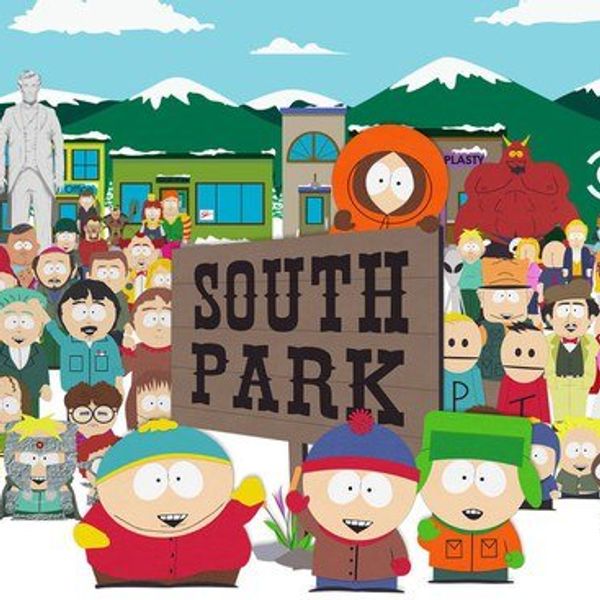
In its 19 years of being on-air, Comedy Central's animated series South Park has managed to remain near-consistently fresh amidst a competition with the yellow pigmented denizens of Springfield, futuristic delivery personnel, and whatever comes out of Seth MacFarlane's head. And every year, comedic animation duo Matt Stone and Trey Parker have brought the same type of madness the rest of the world is fueled on to their absurdist, hyperbolic cartoon, recapping what viewers happen to miss when caught up with certain media or social hysteria.

Crusaders of indefinite free speech, Stone and Parker never pull any punches or shy away from pushing the envelope to address their weekly issue of choice in as ridiculous a manner as possible. Offense is assumed when the animators release episodes for the world to see. Politicians of both sides, conservative or liberal, celebrities, religion, they are all figurative targets in this open hunt for revelation within satire.
The saturation of most comedic content's offensiveness has grown to be a problem. What is not exactly the problem- most good comedians can find a context to place any touchy subject in, poke fun at it, and open a discussion for it. Laughs are usually automatic at first, followed by gasps of weary discomfort uncertain if the subject is laughable. What is the problem is how easily people get offended over something, an offhand joke, simple common phrasings, differences of opinions that do no really matter that much. In order to critique the politically correct, Stone and Parker had to renovate their small Colorado mountain town into the headquarters of everything they lampooned: the on the rise "PC Culture."
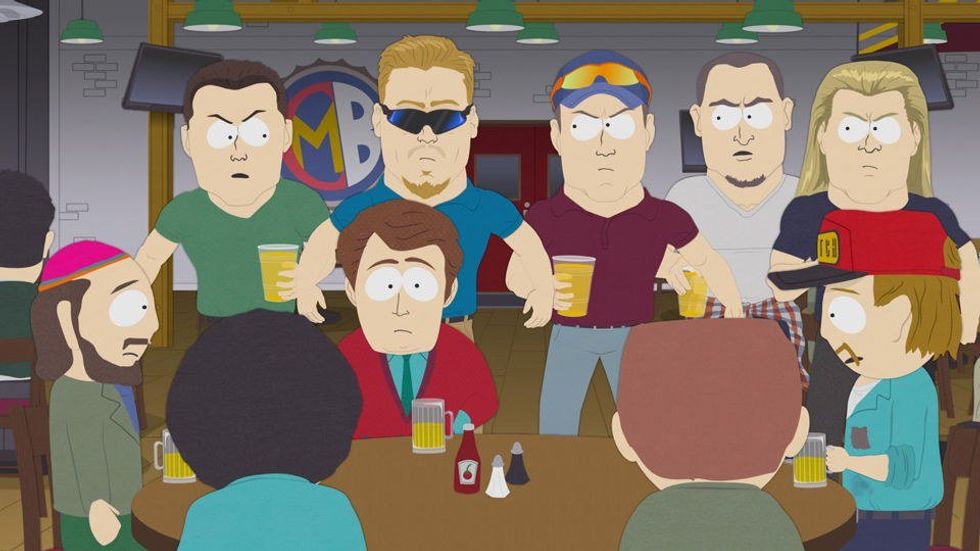
Cue PC Principal's entrance, South Park's newest resident, whose name and self-introduction alone establish a foil challenging the backwards shenanigans continually enabled by the irrational adult townspeople.
“You know, there’s still some people out there that say 'What does being PC really mean?' Well, I’ll tell you what it means. It means you love nothin’ more than beer, workin’ out, and that feelin’ you get when you rhetorically defend a marginalized community from systems of oppression.“
Continuity is still a new concept the series is playing around with, contradictory when one of the four lead characters, Kenny, is known for being killed in nearly every episode. Episode-to-episode transfer of story lines originated from last year's season 18, where South Park became gluten free and Stan Marsh's dad, Randy, was secretly the singer Lorde, recording incoherent babblings as songs in the sanctity of his office's bathroom. This year, the PC culture is here to stay and its presence is felt as the underlying tone of every episode even when it is not the subject matter directly mocked.
"Stunning and Brave" debuted South Park's 19th season, making PC Principal and the PC Delta frat house, full of "like-minded individuals in [the] town that defend social minorities," canon with the rest of the main cast regulars. Refusal to adhere to PC Principal's overly tolerant views drives him to violent outbursts against students, often over unintentional microaggressions such as "spokesman" or "gypped." This puts him at odds with more often antagonistic protagonist Cartman, channeling Tom Brady and Bill Belichick's trademark mantra of cheating the system- "screwing the rules"- with no repercussions. The new PC movement proves strong enough to even dissuade Kyle from breaking out into long-winded speeches saved for the end of the episode, a trope summarizing the moral message encrypted into the ridiculous events of the episode.

The title of the premier itself is the politically correct way of referring to Caitlyn Jenner's lifestyle change, recited by PC Principal and his PC brethren. Jenner's public coming out as a member of the trans community is interchangeably described as "brave" or "courageous." Held to the PC principle- the Principal's name a play on of this term- Jenner can only be referred to in a good light. Anything negative opens you up for attack. Much like Jenner's winning the Arthur Ashe Courage Award over double amputee veteran Noah Galloway at this year's ESPYS, no one could determine whether personal courage equivocated to patriotic bravery.
A distillery in tasteful logic, South Park chose to focus on Jenner's overall character rather than the latest watershed moment in tabloid history. Exaggerating her involvement in a fatal car accident from February leaving one woman dead, Jenner is mainly seen carelessly running over countless pedestrians. Stone and Parker spare no attempts to make Jenner's appearance match that of the reality of her character; she is controversially drawn to resemble someone having undergone a poorly planned plastic surgery, an indicator of her transition, yet there is no mention or joke aimed at her being transgender.
The creators suggest political correctness disables one's right of free expression, positive or negative, when constricted against by external social forces. No matter how spectacular the media glamorizes an icon, their appearance means nothing without endearing values to support the assertions of what we are told to see.
"There were several candidates during the Canadian elections. One...just spoke his mind...didn't really offer any solutions...just said outrageous things. we... thought it was funny. Nobody really thought he'd ever be President. It was a joke! But we just let the joke go on for too long..."
Political correctness has been invoked constantly in this upcoming presidential election when reviewing the many careless statements put out there by various Republican candidates. Donald Trump, the man we should not be advertising yet we cannot escape from talking about, is the most obvious example.
In "Where My Country Gone?", Mr. Garrison, whose intolerance for most issues stays the same despite his gender and sexuality fluctuating between seasons, runs a Trump-esque bid for presidency after calling out the influx of illegal Canadian immigrants in the town. The italics above explain it all; the A.V. Club blames "the ballooning of outrage culture" to be responsible for all the attention someone as laughable as Trump garners.
The 24 hour news cycle does not alleviate the stress that is the never ending coverage of whatever a figurehead says immediately after he says it. Political correctness in the media spends too much time analyzing what comes out of a candidate's mouth to be right or wrong, it overlooks the fact it is giving these people screen time, saying their names out loud. As the Canadians felt when electing the Canadian Donald Trump, who turned out to be a ruthless dictator forcing them to flee their homeland, they all thought it was funny. They did not realize just how much they were hurting themselves, their political system, or their values by ignoring the lethality of the joke.
The PC culture waits on the edge of every word, readying to pounce on the speaker for the inaccuracies they preach. To The Guardian's Jessica Valenti, preventing hate speech from being spouted is "not stopping free speech; it’s making our speech better." Abolishing harmful rhetoric, such as Trump's, would remove hate speech, fear mongering, and groupthink hysteria, with the premise of improving our freedom of speech. Valenti's limitations are still limits and that still imposes on our freedom to say whatever we want. Comedian Dennis Miller disagreed with identical sentiments, before sitting down to discuss free speech and political correctness with Bill Maher, stating:
"I have no problem with people who respond to what they don’t agree with...Why should even the most repugnant ideas receive the same freedom of expression as more accepted ones? Because the American system is less a 'free marketplace' of ideas than it is a playground. And the best way to dispense with unpopular ideas is to let them roam free, so they can have their asses kicked up and down the jungle gym by the cool ideas."
Like Miller reasons, why fight against free speech of individuals who are bound to lose eventually? Like South Park reasons, do not take things too seriously, cautioning not to take it as a joke either. A hard fall is scheduled for a figure like Trump with the mouth of Trump. Do as Trump or Carson when they face backlash, shrug off their outspoken political incorrectness. This goes for the news, social media, anyone with a blog, you, even me and whatever steaming commentary I post: everyone screaming out into the void creates an echo that will bounce back at us.
Just let what they say go and maybe they will slide back into obscurity. Racists are labeled racists because we know they are wrong and shut them out. If society really wants to change for the better, let the thoughts of these prehistoric ideas die out along with the dinosaurs conceiving them.
"What's the matter with you people?! You're saaad that people are meeean? Well I'm sorry, the world isn't one big liberal arts college campus! We eat too much; we take our spoiled lives for granted, feel a little bad about it sometimes!"
"The City Part of Town" begins the gentrification process in South Park. SodoSopa, the high-class illusion of an enriching arts district, is constructed to convince a Whole Foods representative the town is worthy of one of their market chain stores. The supposed diversity of SodoSopa intrudes on the financially poorer side of town- literally only Kenny's family- leading to the formation of the CtPaTown (say it really fast), the reality of the working class locals and stores.
"You're Not Yelping" marks how far delusions of entitlement and authority have gone, measured by the ego of the common Yelp reviewer. In the arrogance of doing something for the benefit of other people, the South Park residents take advantage of the less powerful to reap the benefits, i.e. building over urban areas or threatening restaurant owners with a bad review.
Fearful of Reality- a personified metaphor- slipping through the cracks of the new PC mirage, Cartman tricks PC Principal into establishing a defense against hurtful online comments by enlisting Butters as a social media filter. "Safe Space" shatters the protective layer the past two episodes have been building up. Choreographing a music video with Vin Diesel, Demi Lovato, and Steven Seagal, Cartman goes to painstakingly lengths to avoid any kind of shaming online. Reality serves as the painful truth people must come to terms with, leading as the only honest character in the episode even though he is a villain.
Reality's cold truths said in "Safe Space", makes mention of "liberal arts college campus[es]", the breeding ground for intellectual disputes. In this time of social sensitivity afforded by the PC "invasion", it is the colleges that are stirring up the most trouble. The Guardian's Dave Schilling made note of Princeton University students' petition to have former president Woodrow Wilson's name removed from one of their departmental schools. Weighing out the positive reflections- Wilson led us through World War I and formed the League of Nations- with the less amicable- reinstating segregation within the government- such sensitivity is still questionable, while following an understandable reasoning.
Lebanon Valley College in Pennsylvania, on the other hand, possesses an extremely low diversity rate, a factor common in many small liberal arts schools. Among a group of concerned students' list of demands for possible change included the alteration of the name of the Lynch Memorial Hall, named after influential former school president Clyde A. Lynch, just because the word has "racial connotations." In this case, people are quick to be offended simply because of a man's surname. Lynch is credited with helping the school survive the Great Depression. There is no dirt to sully his reputation. Many should be reminded that our favorite cinema hero, everyman Forrest Gump's namesake is that of real-life Confederate Lieutenant General Nathan Bedford Forrest, one of the founding members of the Klu Klux Klan.
The true irony lies within the show's latest strain of the social justice warrior syndrome, the quasi-activist type Stone and Parker have made it a priority to ridicule throughout their careers. The fraternity stands on par with other characters obsessed with social righteousness for all, like Aging Hippie Liberal Douche (literally his name and title). The frat brother archetypes implementing the new politically correct mindset in the new South Park contrast with the activities of actual Greek life at American universities. The frat star personas match up to their sources, with names/identifiers like Topher, PC Chino Hills, Brad, and PC Ohio State, arms bared in an eternal flexing position. The newsworthy headlines of a University of Oklahoma fraternity's racist chants provide a stark polarity between the content of character of the factual and fictional groups. PC culture is presented as groupthink through fraternity/sorrority assimilation, pressuring others to conform or face punishment reminiscent of over the top college hazing.

Sticking to signature insanity, South Park's Season 19 was executed to resemble the all too conscious politically correct attitudes of college age American youth. Colleges are so conscious of PC dissections, they cannot discern comedy from everything else they hear. Any type of comedy with an edge to it, let it be South Park's cartoon animation or infamous stand-up comics, is endangered on campuses, its free-form routines on social subjects critiqued as harshly as everyday speech or politicians' rhetoric.
Jerry Seinfeld incessantly speaks out against performing at colleges. Although not known for edgy material, Seinfeld acknowledges the fact of the changing culture taking place on college campuses and admonishes his associates to follow him in avoiding performances that may cause overcritical uproar about the stand-up material. Confrontations, mainly online, now stem from the over-accumulation of what the average student finds offense now. In most cases, it is not what the individual finds offensive, but what they should find offensive.
The sanctity of laughter is now corrupted by the aversion of exclusion. Detailing the stress of being a hired performer for PC colleges, The Atlantic's Caitlin Flanagan quotes "two white students from an Iowa college" stating: "We're a very forward-thinking school...That thing about the 'sassy black friend'? That wouldn't work for us." In the same article, Chris Rock criticizes colleges for being conservative,"mean[ing] that they were far too eager 'not to offend anybody.'"
Flanagan later describes the students on Western Michigan University's event planning committee to be "inclusive...in the best sense of a loaded word..." Everybody worries less about what offends them and more of what will offend others. They feel for other people who have experienced something they have not. Inclusion does not include only other people, but it creates the notion you include yourself into something you do not belong in, a mismatched puzzle piece.
Soothing the crudeness of the outside world, on college campuses already creating a bubble of separation from the real world, is well intentioned. Not really. Bans on rhetoric, specifically for comedic purposes, are bans on freedom of speech. What is more offensive than being hurt by words is someone making vicarious judgements for me, controlling what I want to hear, inversely controlling what I want to think.
Comedy was intended to bend the lines of what we can and cannot laugh at. The spectrum of jokes are now limited to observational and everyday common sense. No story can involve a black or gay friend without audiences jumping to the conclusion the joke is based off of racism or homophobia, a comedian told Flanagan. Without touching the extremes of the comedy spectrum, college students hardly grasp the moderate center of it. From the degrees of over sensitivity reported, it sounds like certain colleges would not be able to tell a black comedian expertly criticizing the dominant roles whites have had in society (Dave Chappelle) and a white comedian erupting into a stanza of racial slurs, pure, blatant racism (Michael Richards) apart. Realistic criticisms of anything containing a dash of vulgarity frightens them.
| "Yeah. And like, if you're gonna belittle and make fun of PC people like that, then who's to say he won't do it to other marginalized groups like us?" |
Looking past Stone and Parker's satire on the quick to offend culture spreading throughout college campuses, we must first remember that there is huge difference between the annoyance over slightly politically incorrect statements and the reaction to genuine racism or homophobia, or any other ism and phobia for that matter. Being oversensitive to topics that do not even relate to you is one thing, but that does not compare to becoming a victim in a tragedy you cannot escape from.
College students protest sermons making them feel bad for not showing their love enough to friends and families: that is being oversensitive in a safe space where discomfort apparently counts towards marginalization. College students becoming actual victims in racially motivated assaults: that is real racism.
As a new chapter in South Park storytelling unfolds, the bar has been raised for Stone and Parker to repeat this masterpiece season. Stan's closing words for the season sum up the future success of the show, extended to continue till 2019, and the ongoing PC culture in the fictional Colorado town: "This is going to be really hard."