


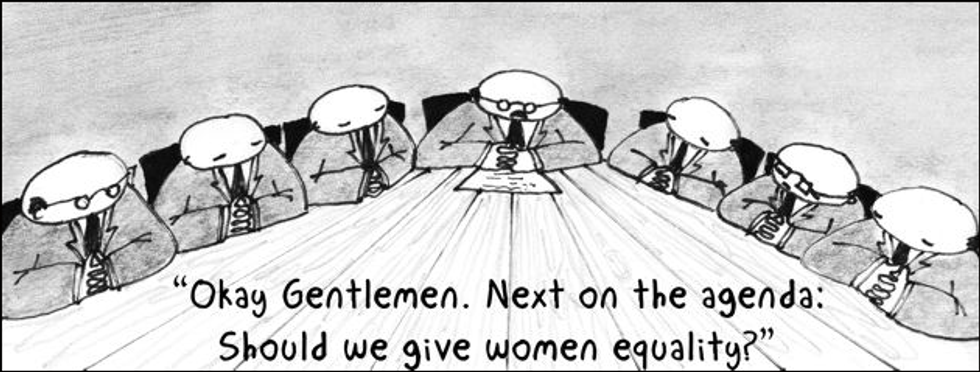
Patriarchy is a social system in which males hold the power of politics, morality, privilege, and property. Patriarchy is rooted in oppression. The patriarchal power dynamic promotes male dominance; females are degraded via methods of rape, physical abuse, and verbal ridicule.
Patriarchy and feminism are direct opposites of each other. In "What Is Patriarchy," Malise Rosbech states that women “should abandon the concept of patriarchy…[and] look towards the future of intersectional feminism.” Today’s feminism centers on the social, political, and economic equality of the sexes. For example, Feminists who are actively attempting to break down the walls of patriarchy. Via social media blasts, like the #BringBackOurGirls campaign, and protests like SlutWalk, women are now being empowered in more ways, and thus systematically breaking down patriarchy. Patriarchy “invokes a generality of male domination.” In history, women have always fought for the natural rights endowed to men. For example, in the United States, property was inherited via primogeniture. The oldest son would inherit the land, leaving women destitute and dependent on husbands and brothers. Women were always forced to be dependent on men. Alice Walker’s "The Color Purple" is centered on a character who is a victim of patriarchy. Celie, only 14 years old, is forced to marry a man double her age because he needs a live-in nanny and unpaid maid. In actuality, Celie was a slave -- to her husband, and the patriarchy.
Patriarchy encourages violence against women. For centuries, women have been subject to violent crimes, yet they are blamed for the circumstances they endure. In recent times, victims of rape have been accused of lying and trying to slander their attacker’s reputation. For example, the victims of Bill Cosby’s allegedly torrid affairs have been accused of trying to ruin Cosby’s legacy. Society, as opposed to rallying behind the alleged victims, demeans them and their struggles. Through literature, feminist writers such as Sapphire have attempted to shed light on patriarchal victim blaming. In her novel "Push," the main character, Precious, is the epitome of a victim. Raped by her father and impregnated twice (much like Celie), she has no other options. Her circumstances have made her destitute. However, as opposed to helping her, her mother allows the abuse to continue; thus, making Precious completely dependent on the male-centered government.
Patriarchy also extends to learning environments. Statistically, women are more likely to be victims of sexual assault than men. Steps have been taken to combat violence against women. In 1994, Bill Clinton signed the Violence Against Women Act (VAWA) into law. VAWA funded rape investigations and was an impetus for changing the way sexually based offenses are handled. Congress even passed the Campus Save Act, which forces colleges receiving federal funding to dedicate money to fight sexual assault. However, the Safe Campus Act (SCA) threatens to do the opposite. The SCA would prohibit colleges from investigating sexual assault cases until the victim reports it. SCA gives perpetrators of crimes the mindset that what they are doing is justified. It perpetuates the “she was asking for it” stereotype and enhances the patriarchy on college campuses. In "The Color Purple," Celie lives the reality of the Safe Campus Act. She cannot report the physical and mental abuse she endures, so she must live in silence. Mister (her husband) is her master and not her equal. He feels he is justified in his actions, thus leaving Celie with no hope for a better life -- further perpetuating the living demon that is the patriarchy.
Patriarchy is rooted in oppression and focused on the degradation of women. It directly opposes intersectional feminism. It encourages violence against women, and promotes victim shaming and blaming. It extends to learning environments, and thus leaves no safe spaces for women.

















