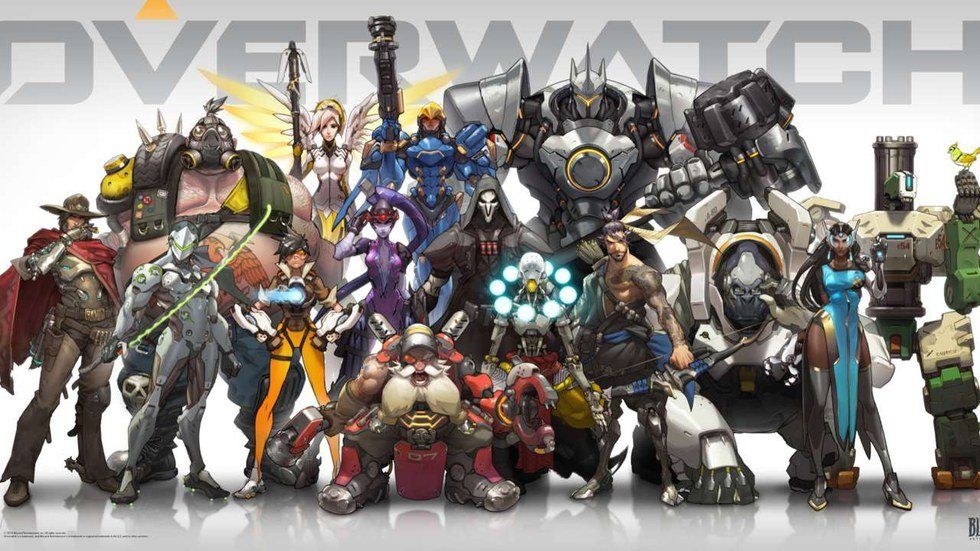
Blizzard’s new FPS game, "Overwatch," has been a smash hit; over seven million players have joined since its release in June. Along with it’s MOBA elements and major developer title, a major selling point for the game has been its focus on heroes, rather than classes (looking at you, "Team Fortress 2"). Overwatch boasts a diverse cast of twenty-two heroes; almost half the cast is female, and over fourteen countries are represented as well as varying age ranges.
Despite "Overwatch's" diverse cast, there has been some problems regarding racism in response to the portrayal of many of the non-white characters. There have been claims that some of the legendary skins in the game tokenize and appropriate the cultures they are trying to portray.
In this article, people that are part of the cultures that are represented by the skins are interviewed. Other outside sources are also included to present the full argument from both sides. Bear in mind that one person does not speak for an entire culture; these are singular ideas from individuals.
Reaper: Mariachi and El Blanco Skins
Our first character is Reaper, also known as Gabriel Reyes, an offense hero that hails from Los Angeles, USA. Many fans have assumed that Reyes is Hispanic, likely of Mexican origin, due to his Spanish name and his darker skinned appearance (as seen below). This theory is only strengthened by his two legendary skins, “Mariachi” and “El Blanco” which directly translated means “the white” in Spanish. A mariachi is a folk musician who wears a traditional attire with a large hat and a suit and plays songs in public venues, and are common in Mexico. These two skins dress Reaper as a mariachi.
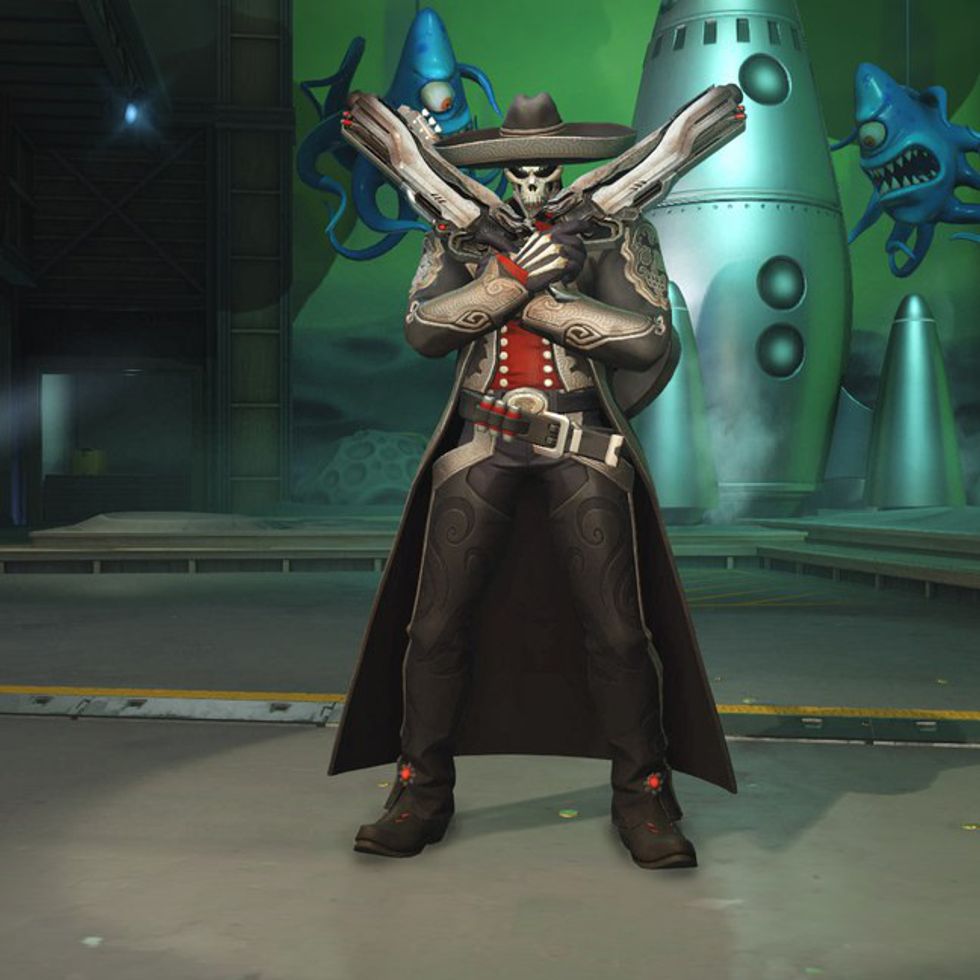 Reaper's "Mariachi" skin.
Out of all the controversial skins, these two have had the least amount of complaints. If anything, the consensus is this: they could be worse. At their best, they’re decent and correct representation. At their worst, at least they’re not that harmful. Of course we’ve seen some cringeworthy comments come from their inclusion in the game, but unfortunately, a lot of that is to be expected.
One one side of the spectrum, there are those that aren’t the biggest fans of the skin.
“I don't trust Blizzard to have the best in mind for players of varying ethnicities to feel properly represented in the game,” says Jorge, 20, from Mexicali. “But I feel like the choice of the mariachi outfit is relatively harmless. There are much worse stereotypes for Latin Americans out there. At least a mariachi is something properly invented by our own culture.” So, while it isn’t a big hit for representation in some minds, it could be a lot worse.
Others are more enthusiastic about them. “Honestly, I love both of those skins to death. They may seem very flashy and overdone, however compared to what my family has described mariachi and Dia de Los Muertos to me, they fit so well.” Maddie, 15, from Denver, was very excited about the inclusion of Mexican culture in the game.
 Reaper's "El Blanco" skin.
“Mexican representation is so very rare. I honestly thought I was going to cry. I even showed my parents and grandparents. They showed the same reaction as I. It made my heart so happy that not only did Blizzard make a Mexican character, but they gave him representation of his race. It's just so rare to see any sort of Mexican representation at all, and for Blizzard to delve into his heritage like this, and give him special skins, it's just a wonderful thing.”
For some, the inclusion of Reaper's Mexican heritage is a slam dunk for representation, while for others it isn't that big of a deal. Whatever the case may be, it can be at least said that the outfits are accurate and represent a culture that the character is actually (supposedly) from.
Symmetra: Devi and Goddess Skins
The second set of skins belongs to Satya Vaswani, or “Symmetra,” a support hero who is from India. Symmetra features two legendary skins, “Devi” (the Sanskrit word for goddess) and, appropriately, “Goddess”. In these skins, she is dressed as a Hindu goddess, with her skin changed to blue.
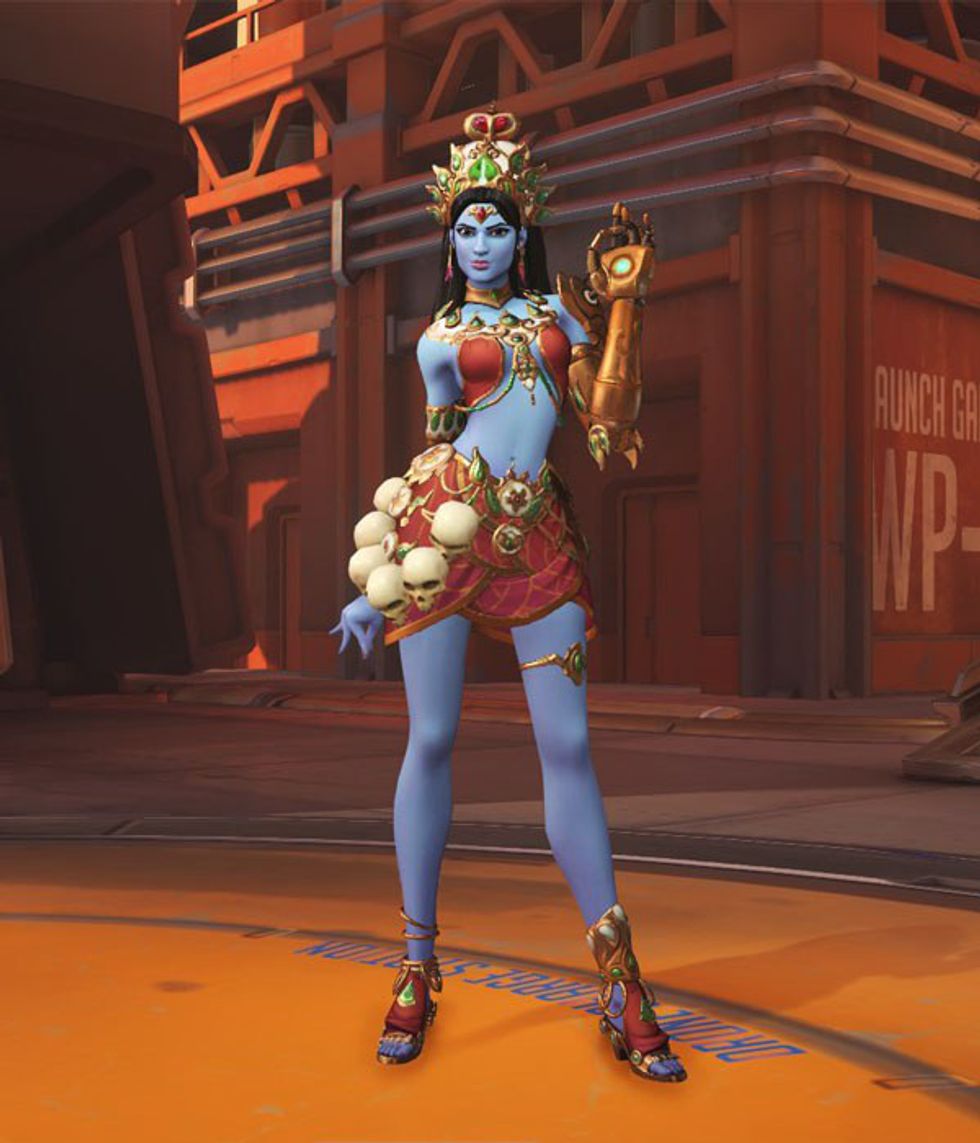 Symmetra's "Devi" skin.
Firstly, who exactly are these skins supposed to portray? This is the stem of many complaints from fans-- we’re not exactly sure. The string of skulls around her waist immediately brings to mind the goddess Kali. That, however, is the only thing that really rings accurate.
Rekha, 18, from Ohio, says: “It honestly doesn't look like Kali at all...the only clue is the skulls. It's so vague and inaccurate that they didn't get close enough. It's just pulling bits and pieces of someone's idea of the religion together into this.”
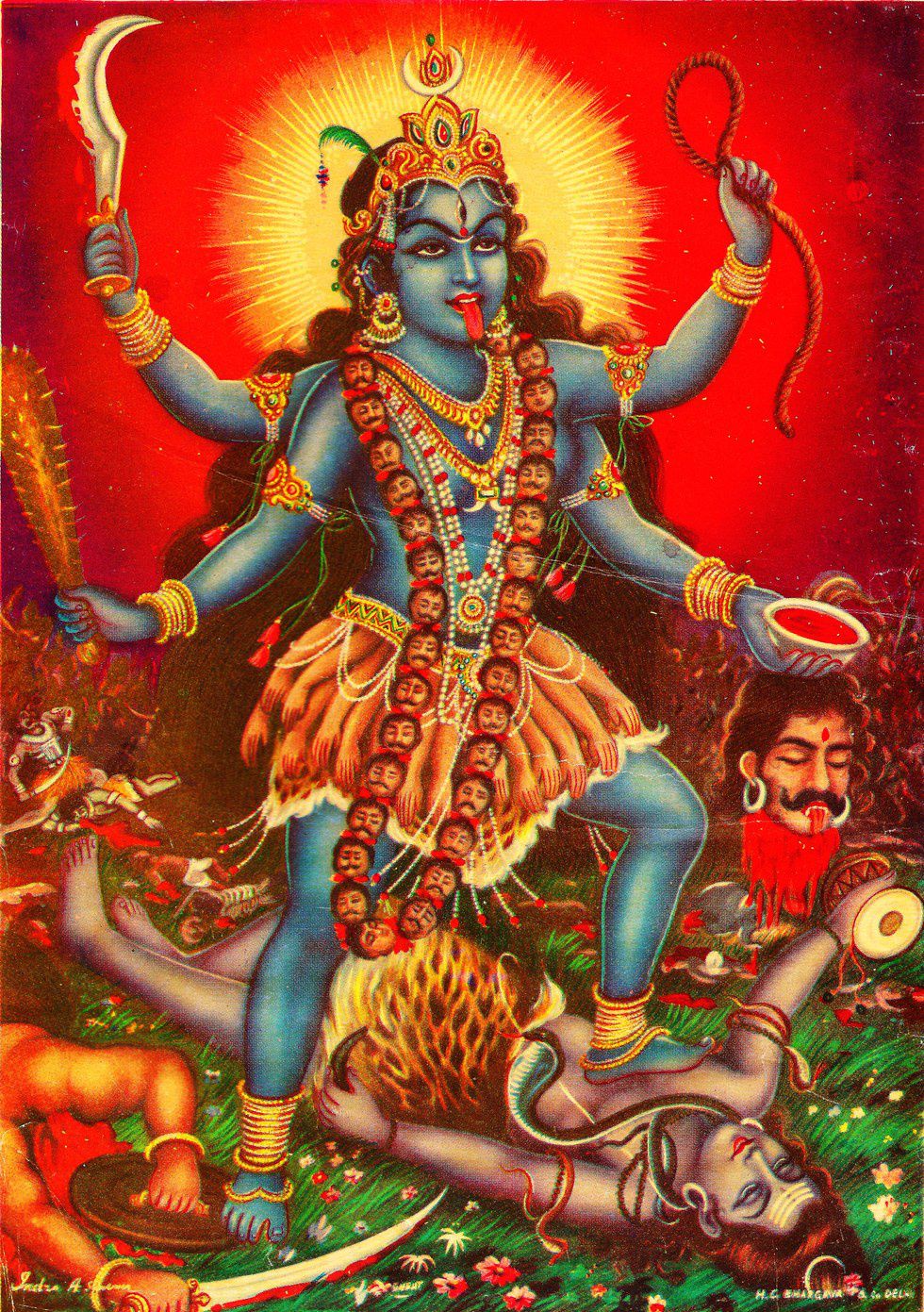 The goddess Kali.
In many eyes, this depiction of Kali (if it is indeed her) sexualizes her in a way that disrespects the power and importance of the Hindu goddess. Rekha commented that “ ...It looks like some kind of "sexy Hindu goddess" Halloween costume. Like I guess this might be an accurate representation of how the west sees India but…’cuter’.” Siddhi, 19, from Dubai, echoes that sentiment, “It entirely takes away from the sentiment Hindus have for their goddesses. It's clear that whoever made this character either has a huge lack of knowledge of what they're recreating, or intends to conform Kali Ma to sexist ideals.”
Another question springs to mind; why Kali? In Overwatch, Symmetra is an architect, builder, and engineer. Kali is the Hindu goddess of power and destruction. So why choose this goddess for Symmetra? “I don't think they did any research. It seems like they just went ‘Okay, India, Hinduism...uh...I saw Kali in a movie once.’ It's always Kali for some reason,” Rekha comments on the strange choice. Shreya, 19, from Georgia, agrees. “It’s a bit disappointing that Kali seems to be the only Hindu goddess people can find on google these days...No one seems to even know about Lakshmi or Parvati, which are some pretty major goddesses.”
There has also been some political controversy surrounding these skins. In fact, a Hindu religious leader called for their removal from the game, claiming that the fact that fact the player could control the goddess was going against the core values and understanding of the Hindu religion. Rajan Zed commented “..faith was something sacred and attempts at belittling it hurt the devotees. Video game makers should be more sensitive while handling faith related subjects, as these games left lasting impact on the minds of highly impressionable children, teens and other young people.’
Clearly, Blizzard has room for improvement in terms of these skins. “I really liked having an actual female Indian character in a popular game,” Shreya says, “and the idea of exposing people to Hinduism through that. But I don’t want it to just be a stylistic choice. I'd rather they actually commit to building this character's identity and melding it with real Hindu culture, and not just the aesthetic of India.” Rekha believes that they could improve the skins “...if they put her in some like traditional armor, like what heroes wear in mythology.”
Roadhog: Toa and Islander Skins
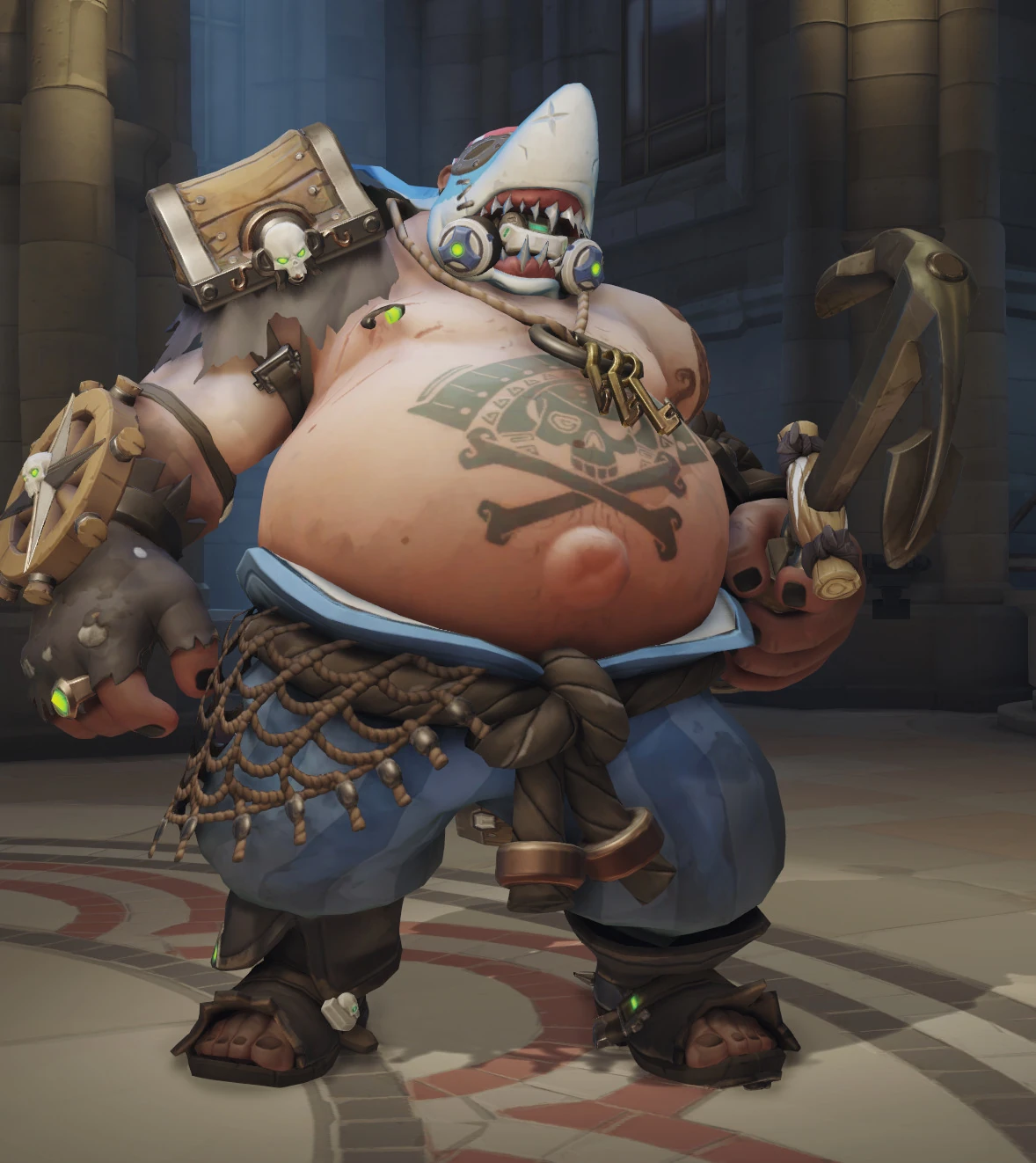
“Roadhog”, also known as Mako Rutledge, is a tank hero that hails from Australia. His set of “Islander” and “Toa” (meaning “brave” in the Maori language) skins are also the cause of some controversy.
 Roadhog's "Toa" skin.
Fans are unsure of Roadhog’s origins. Some people assume that he is of Polynesian origin, due to his name (Mako is a word for shark in the Maori language, and he does have a shark themed outfit in the game). With the presence of the two skins as well, it is possible that Roadhog isn’t simply a traditional white Australian male.
The majority of the criticisms on his outfits come from two factors. The first is that Roadhog’s skin is incredibly tanned in one of his legendary skins. If he isn’t white, as we have hypothesized above, why did Blizzard feel the need to do this in his Polynesian outfit? As pictured below, the colors are radically different. Some people argue that it’s strange that the designers only darkened his skin in those outfits, as opposed to making him a darker skinned character overall. His darkened skin makes him more of a caricature of Polynesian culture, as opposed to an actual Polynesian character.
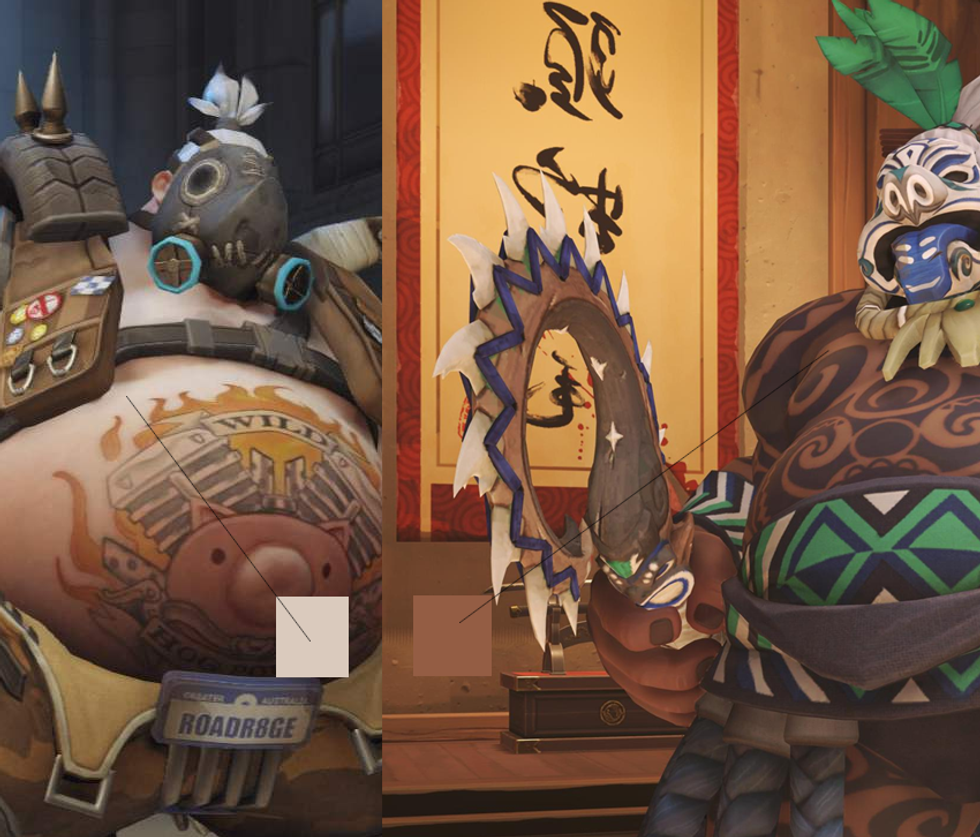 The different colors between two Roadhog skins; images courtesy of the Overwatch wikia.
Secondly, there is criticism surrounding the mishmash of cultures in Roadhog’s designs. In Shahryar Rizvi’s article, There’s Something Off About the Overwatch Alternative Skins, he highlights the disparities between elements in the skin.
“...But the similarities among Polynesian groups makes it challenging to identify the exact inspiration for these skins. The shark tooth hook most resembles a fish hook club from Hawaii...The Toa’s Clothing most resembles a piece called a kiekie, a girdle from Tonga with braided strands falling down to the knees...The tattoos on the Islander skin most resemble Maori body tattoos...the mask most resembles a Tiki-style mask...Much of America’s conception of Polynesian visual design comes from kitschy and stereotypical post-WW2 Tiki bars. Whatever the developer’s influences were, the similarity with Tiki design elements contribute to the accusation of appropriation.” (x)
So, the question is this-- are Roadhog's skins inspired by a legitimate wish to be authentically Polynesian, or did the designers simply pick and choose elements from the culture that don't fit together?
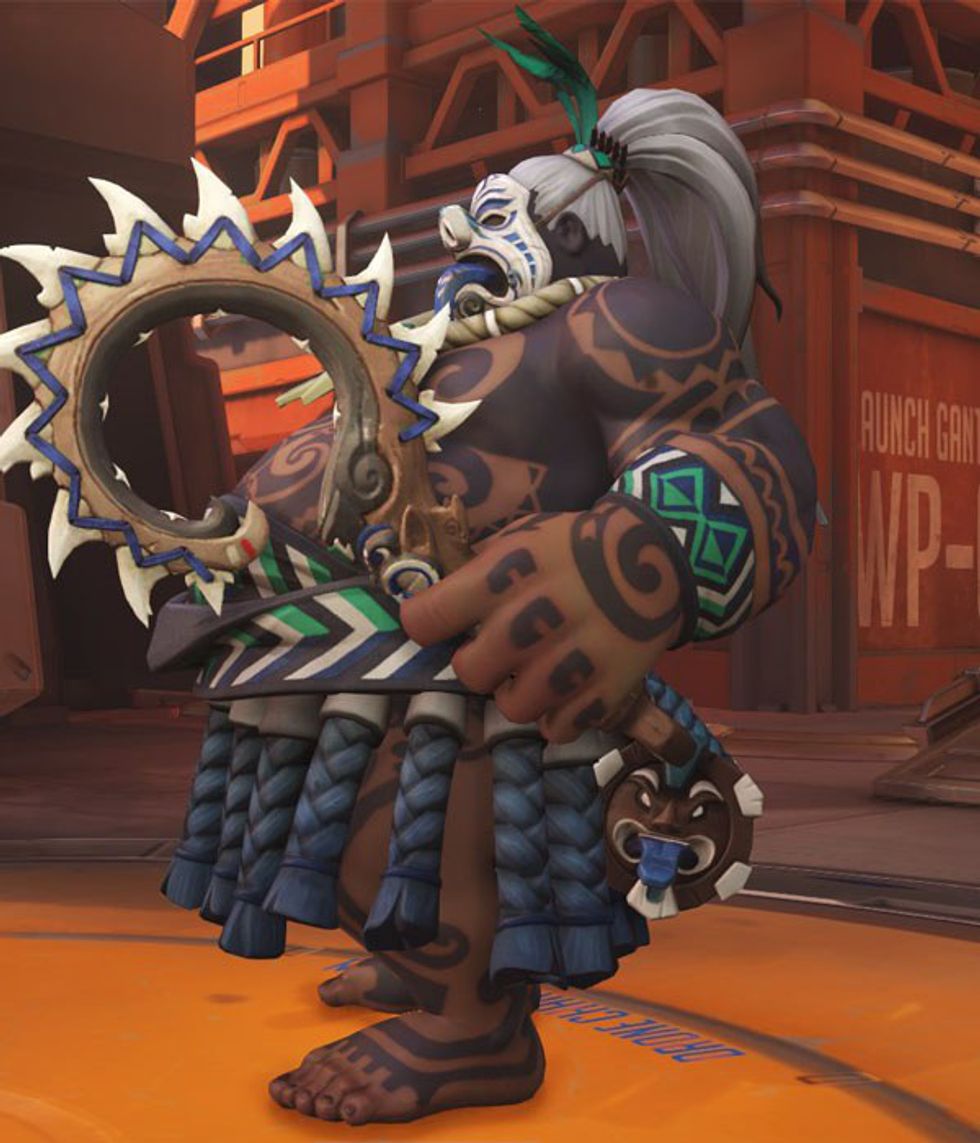 A side view of Roadhog's "Islander" skin.
There are people who adore the skins, though. Trey, 19, from Hawaii, is a big fan of the Overwatch series as well as Roadhog’s alternative skins. According to him, these skins hit incredibly close to home: “The fact of the matter is that Roadhog in those skins looks a lot like the older men that we actually see on a daily basis.” In terms of his outfit, he believes “...[it is] very accurate to what classical Polynesian warriors, but not specifically Hawaiian warriors would wear. His tatau (or tattoos) are very accurate to what you'd actually see on someone of the time period as well.” And concerning the controversial change in skin tone? “Ultimately, we've come to the conclusion that the skin tone change is for consistency with the cultural inspiration of his look.”
Pharah: Raindancer and Thunderbird Skins
The final, and most controversial skins belong to Pharah. Fareeha Amari, or “Pharah” is an offense hero from Giza, Egypt. Her two skins “Raindancer” and “Thunderbird” have been a cause of a lot of criticism.
 Pharah's "Raindancer" skin.
Pharah is an Egyptian character. Although fans are unsure of her father’s origins, we know that she was born and raised in Egypt. Why then, does she have Native American skins? For some people, it makes absolutely no sense. Jude, 22, of Choctaw descent, feels as though “...they’re just interchanging brown people, without any care of where they’re from.” Why is it that the only Native representation is shown on an Egyptian woman? Pharah, along with Zenyatta, is one of two characters that has legendary skins that don’t match their country of origin. In a heated thread on GameFAQ’s, the original poster disliked the skins, saying: “It seems like to other races, Native Americans are just fairy tales and that it's okay to use our cultural words, but it's not. It's upsetting (x).”
Like Roadhog’s skin, Pharah’s skins seem to have a combination of several different aspects of different Native culture. While her outfit is based on the totem poles of the Pacific Northwest (especially the Haida, Eyak and Tlingit tribes), her face paint is likely influenced from the Mohawk tribe from Ontario and upstate New York (although there are other possibilities). Her rockets also turn into what look like Native American knives (which were common among many cultures). We could once again assume this is due to lack of research, and not an attempt at blatant racism. That being said, the line is blurry.
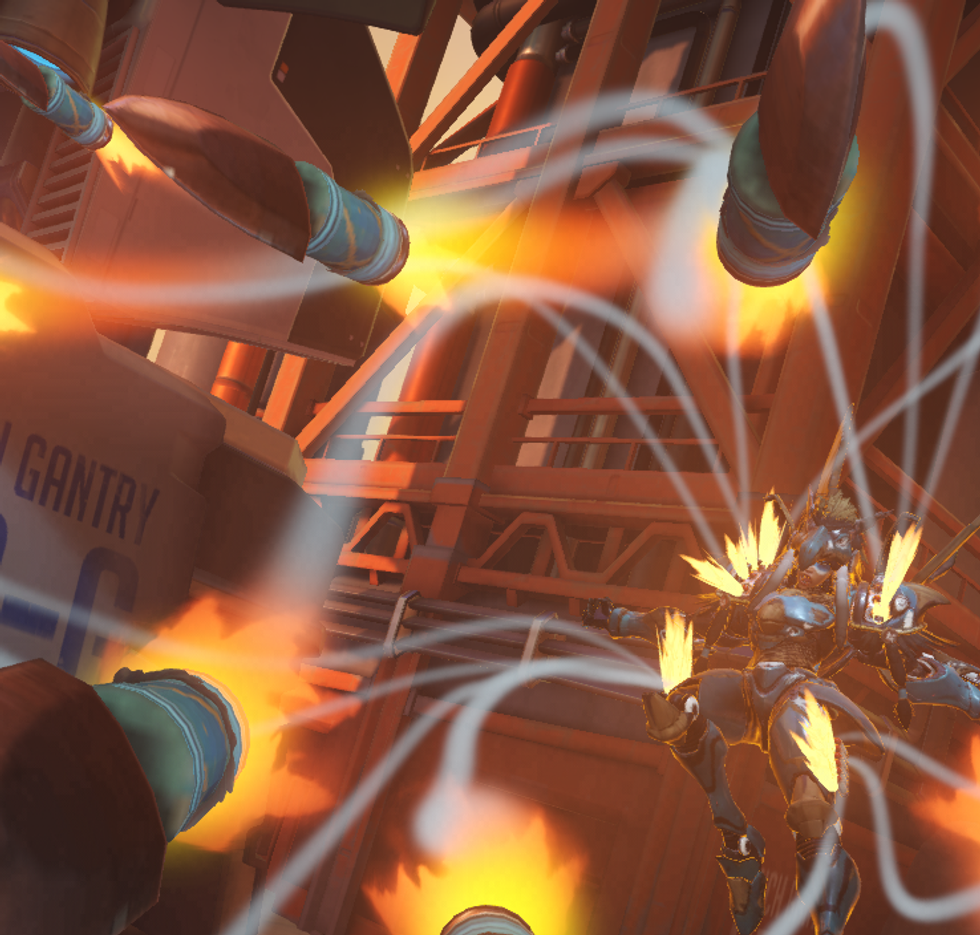 Pharah's former rockets turn into knives.
There are Native Americans that like the skins, despite the faults mentioned above. Robert, 28, who is descended from the Cherokee and Chippewa tribes, thinks that the skins are done tastefully. “The skin isn't a parody like the redskins logo...I understand the offense there...I like the design of the skin as totem poles aren't used that often. It is nice to see something other than a ceremonial headdress.” Pete, 30, a descendant of the Cherokee tribe, agrees, saying “I find it a tasteful tribute and not an exploitation at all.” Ashley, 26, a Mohawk descendant from Montreal believes that her outfits aren’t offensive since they aren’t specifically giving sacred clothing (like a headdress) “...what she is wearing isn't anything traditional from my tribe, or as far as I could tell, other tribes. I know that the thunderbird is sacred in some tribes, but from my experience I've never seen them on headgear like Pharah's; only on ornaments and totem poles.”
As far as Pharah being Egyptian, some have no problem with it. Robert believes that “...we should embrace other ethnicities adopting our culture...I have yet to see anywhere that the skin itself is offensive, only people who are offended by who's wearing it.”
In Conclusion
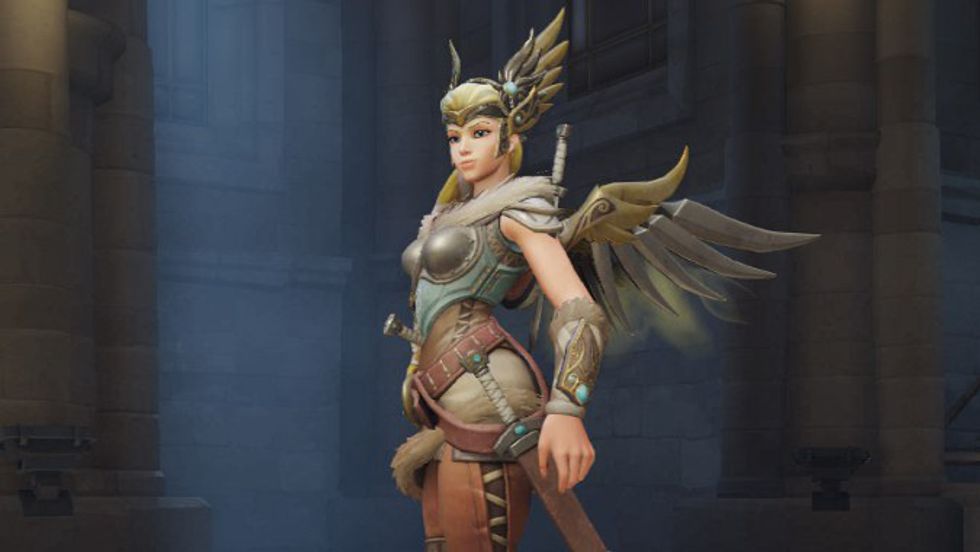 Mercy's "Valkyrie" skin.
There have been many complaints against the claims of racism in these skins. A common argument is that there are white cultures that have costumes portrayed in this game as well. For example, the character Mercy’s “Valkyrie” and “Sigrun” take inspiration from the Norse valkyrie figures. Would it be similar to say that these skins are exaggerating Norse culture, and could be seen as offense? The comparison is a little different. Hinduism is still alive and well, and Polynesian, Native American, and Mexican culture are still around. Ancient Norse religion isn’t widely practiced anymore. Therefore, the argument for Mercy’s skins (and perhaps Zenyatta’s Ra skins, although he isn’t actually from the culture that the myth derives from) could be not as serious.
Like most issues, this one isn’t black and white. There are many conflicting opinions about the appropriateness of including these skins in the game. It’s important that one realizes this, and instead of ignoring the problem, educate themselves on both sides of the argument. Only from there can someone make an informed and logical decision on where they stand.