

Author's note: This essay was written for a class taught by Sammy Rodriguez at Santiago Canyon College. It is based on an interview of Ed Caruthers published in the book "A Different Shade of Orange: Voices of Orange County, California," Black Pioneers written by Robert A. Johnson and Charlene M. Riggins.
The sun was disappearing fast, taking with it all traces of African Americans in sundown towns Orange and Brea. Sundown towns were one of the most perfect representations of racism and discrimination in America, predominantly white cities where blacks were hired to work but forced to leave before nightfall. The rest of Orange County also had (and has) racist views and tendencies. Ever since blacks started to migrate to Orange County in the 1930s, they have been discriminated against, which was justified by both tradition and law. These restrictive laws produced major effects that are still very evident today. Only about two percent of the population is of African American descent, and racial profiling by both police officers and civilians continues to be a major issue.
It was around 1970 and Ed Caruthers was in a little clothing shop in Los Angeles when he ran into John Carlos for the first time in years. Ever since the 1968 Olympic games, Carlos’s life had gone downhill. He went from being a famous world-known athlete to selling clothes from a small store in a big city. On top of that, his wife committed suicide.
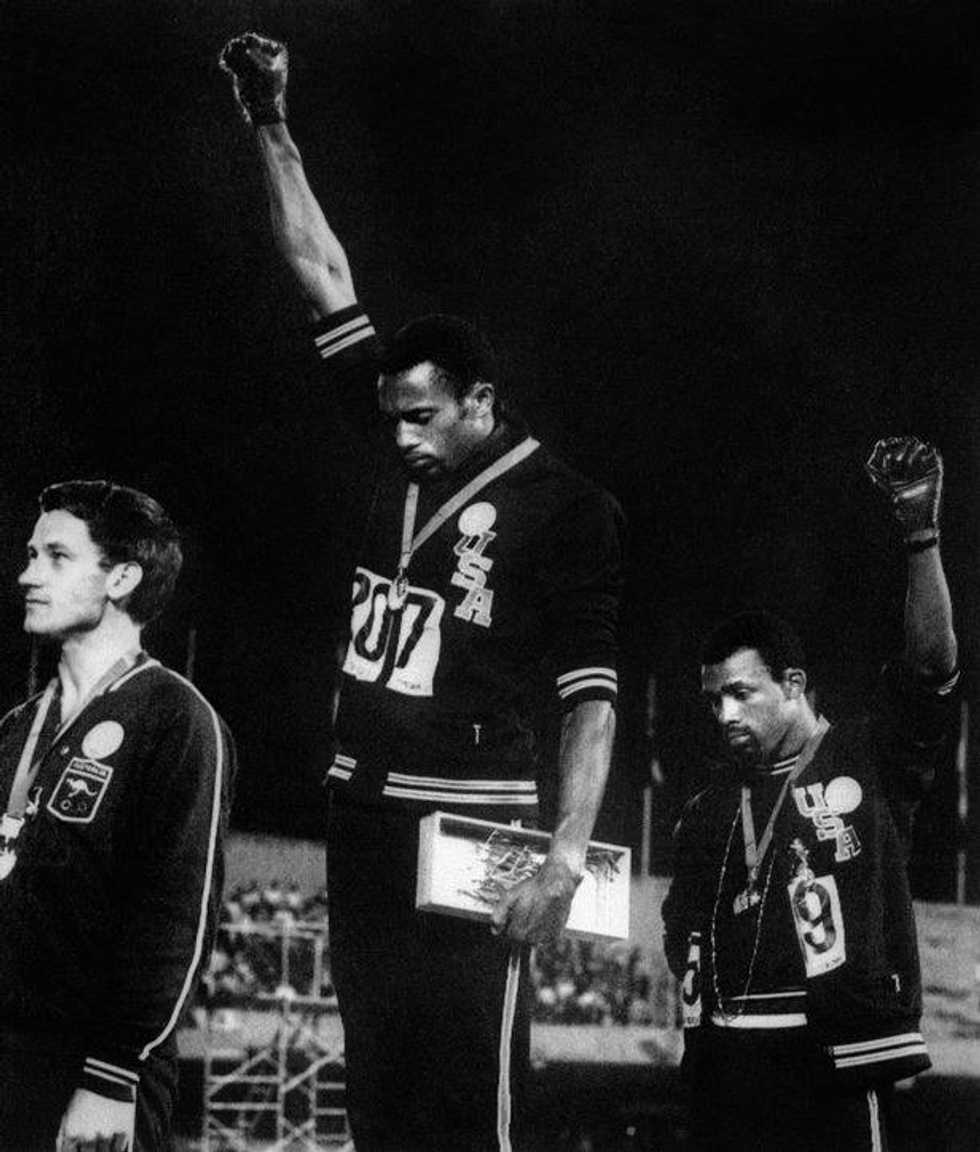
All John Carlos did was try to stand up for his rights. After winning the bronze medal in the 200 meter, he and Tommie Smith, the first place winner, each raised a black-gloved fist during the playing of the National Anthem. They were both immediately suspended from the team and banned from the Olympic Village.
As a fellow black man living in Southern California, Caruthers was shocked at this news. It was one example of racism that was present in all of America, not just the especially unfair Orange County. He also competed in the ’68 Olympics, and won the silver medal for high jump. One of the best feelings he ever had was being on the victory stand, the same feeling that cost John Carlos and Tommie Smith countless opportunities.
The most serious form of racial prejudice that Ed Caruthers experienced himself happened when he tried to buy a house for his family in Fountain Valley. When his family visited the house, the owners were not around to see them, so they accepted the offer. However, the neighbors told the owners that the Caruthers were black and advised them not to sell their house. The previous owner tried to get out of selling their house, and the embarrassed real estate agent didn’t know what to tell the family. Fortunately, the Rumford Fair Housing Act was in place at the time, preventing people from being denied housing based on race. They were therefore able to buy the house, but not until after going through an unfair case of racial discrimination. This is an example of how racism was enforced not by law but by culture and tradition. Anti-black ideas had been imprinted into these white people’s brains all their lives, making it difficult for them to view blacks as equals or even to sell to them.
Ed Caruthers was a very successful black man in Orange County. He grew up in a time when little racism was shown, but it still existed in some important ways. Even with his experiences of racial discrimination, he went on to participate in the 1968 Olympics and win second place in high jump, a huge accomplishment. During his time, laws existed to protect blacks, but whites were still prejudiced because that was the tradition, culture, and views of the time. While racism is not as much of a problem today, the same system is in place. Just two percent of Orange County’s population is African American, representative of its dark history of sundown towns and segregation. This infamous legacy was established decades ago and can only change if we let it.