
272 words. That’s all it took to create one of the most monumental speeches in history. In 272 words, President Lincoln delivered a heartfelt dedication on the battlefield of Gettysburg, that has since raised the idea that maybe it is not the amount of words that comprise your address, but rather the words you choose to relay. While no one would have faulted the president for spending as much time as he pleased to consecrate this hallowed ground, Lincoln understood the value of speaking plainly and directly. His speech alone, redefined the Civil War and gave a wounded and tired nation the courage to charge onward in their pursuit of freedom.
1, 667 words. This represents the number needed to awake a nation to its state of injustice. In only 1,667 words Dr. Martin Luther King Jr. awed the American population with his irrevocable passion and unshakable courage as he further fueled a movement that would change the course of history. During this volatile time of the Civil Rights Movement, Dr. King new that his chances of speaking were few and far between, so he used the times he had to deliver power to a group of exhausted and oppressed people. His “I Have a Dream” speech alone supplied the African American community with the strength needed to fiercely and relentless continue their pursuit for justice.
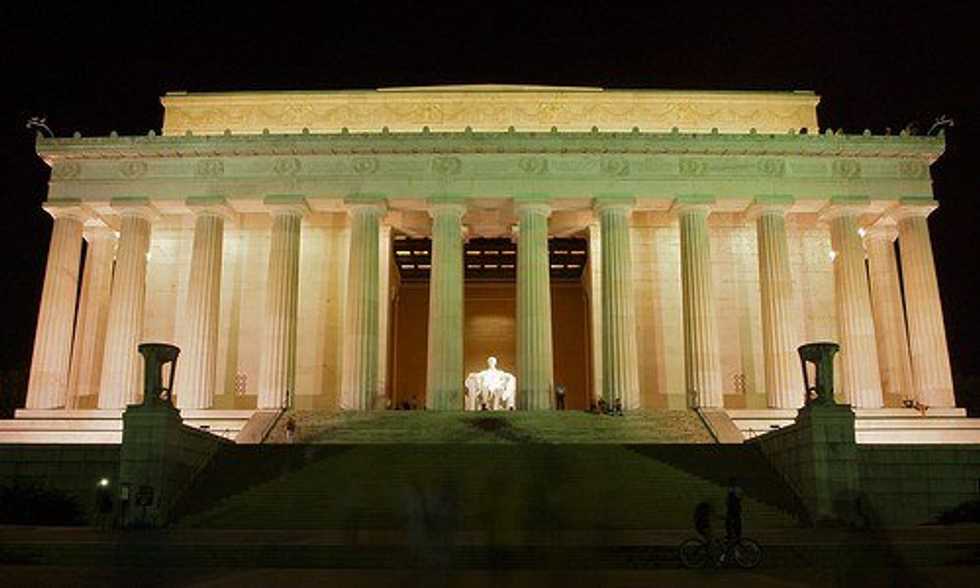
Today, I had the pleasure of standing on the steps of the Lincoln memorial in the exact spot where Dr. King delivered “I Have a Dream” while staring into the kind, molded expression of the Lincoln statue. It was truly surreal, to look out from that tile and imagine the sides of the Reflecting Pool packed with tiny faces, all looking to one man for hope while honoring the man that began their fight for freedom gazing from his marble throne above. Until this evening, what impressed me most about these two men were their speaking styles. I have listened to those speeches more than once, picking them apart and determining how to reflect them in my own forms of writing and speaking. But as I read the Gettysburg address splayed on the wall to Lincoln’s left, I realized that the reason I loved these men was not because of the way they spun words, rather because they taught me about how your words can affect others.
Growing up I had always recognized I had a particular talent for speech. It has always been effortlessly simple for me to communicate with others, whether they were like me or not. In school I began to realize that speaking in front of people held no real fear for me either. In fact, I was dynamic and engaging in front of an audience and received nothing less than joy after executing a flawless speech. Finally, and perhaps most importantly, after my sister passed away I discovered the therapeutic past time of written word. I saw that my writing during that time could have a true impact and I chose to share it. When I came into college I was truly unsure of what I was going to be. I knew that I wanted to be extraordinary. I had an intense desire to have a name worth respecting, a cause worthy of following, or a passion valued by others. I had considered politics, but couldn’t find a way to cut out the useless competition and focus solely on people. And then I discovered my calling. You see, I have always wanted to help people, in particular people affected by oppression. It is the core of my heart and the cry of my soul, to serve those that cannot help themselves. But who was I to throw out God given talents and treat them as useless? Nothing the Lord has given me was to be treated as waste. So I decided to find a way to use it all.
As I begin Communications work with non-profit companies, I will have the chance to speak to millions of people with the purpose of engaging them in a worthy cause. I will have the opportunity to spin written word into heavy and passionate pieces that illustrate the dire need for servanthood. I will rally groups of teens and young adults with hearts similar to mine in a unified mission to stop world hunger, or unclean water, or any lack of social injustice. That is why I honor these men, because they gave me a voice. They taught me the value of my words. They comforted a weird teenage girl with a heart that was too big, and a dream that was too small. These men showed me that with sheer passion and determination, I have the ability and even the responsibility to use my words for good.