To this day, I cannot eloquently reimagine where on my body, but a classmate of mine had struck me and tears began to wet my cheeks without permission. I surely did take me and my five-year-old, but already too big mouth straight to the teacher. By a kindergartner's criteria, I suppose, Ms. Guarnari was not the worst teacher. She was, however, one of the many white women who taught the 98 percent Black and Latino student body of my public school on Fulton Avenue in the South Bronx. I am sure I noticed that, even then.
Whatever the case, Ms. Guarnari asked me if the classmate who had struck me had done so on purpose or by accident. I had never heard those two terms before, so she had to explain them to me. I remember being confused as f**k. Although I had just been given a small lesson about intentions, I was still crying (actually more of a sob at that point), and was still physically in pain. I couldn't fully conceptualize how thinking about whether or not my peer wanted to hurt me would change the fact that I was in pain. My response to Ms. Guarnari escapes me, and I think it is because I don't remember even wanting my peer punished as much as I just didn't wanted to be in pain any longer. I know for certain, however, that there were no repercussions for my striker.
As it turns out, that belligerent fool did hit me on purpose. I know that because it happened again the next day, after one of my walks to school with my mother through Crotona Park. She told me that if I was ever in danger I should call the police or alert any officers near by. My mother raised me to respect police officers. Another day, we left the nineteenth floor of our twenty-story housing project and saw two police officers standing at the entrance of Crotona Park. My mother told me to run to them and shake their hands, so I did. I didn't say anything when I approached them, but I gestured my hands in preparation for a good shake with one of the officers. He actually looked at my hand, then looked at his partner, as if for some confirmation, then looked back at me and told me to shake his partner's hand first. Did he not trust my six years-old hand enough for a shake? He was an officer of the law of the state and the country to which I had held citizenship, in my neighborhood, and was too precarious of me to engage with me as a member of my so-called community? His partner didn't shake my hand either. He just stared at it and chewed his gum, probably continuing his stake-out for somebody that has no business being behind bars. I was too much of youth and bliss to take offense.
Then two years had gone by and I was in the third grade at a school located at the end of Crotona Park. On Fulton Avenue, when students reached the third grade, they were moved from one smaller building to another larger building to the left of it that looked like a castle dungeon with blue gated windows. Recess was held on the baseball field and the playground. About one hundred and twenty third, fourth, and fifth grade students would take to the field after lunch, imitating WWE moves watched on television stations owned by people who did not look like them. One day, someone speared me on the baseball field.
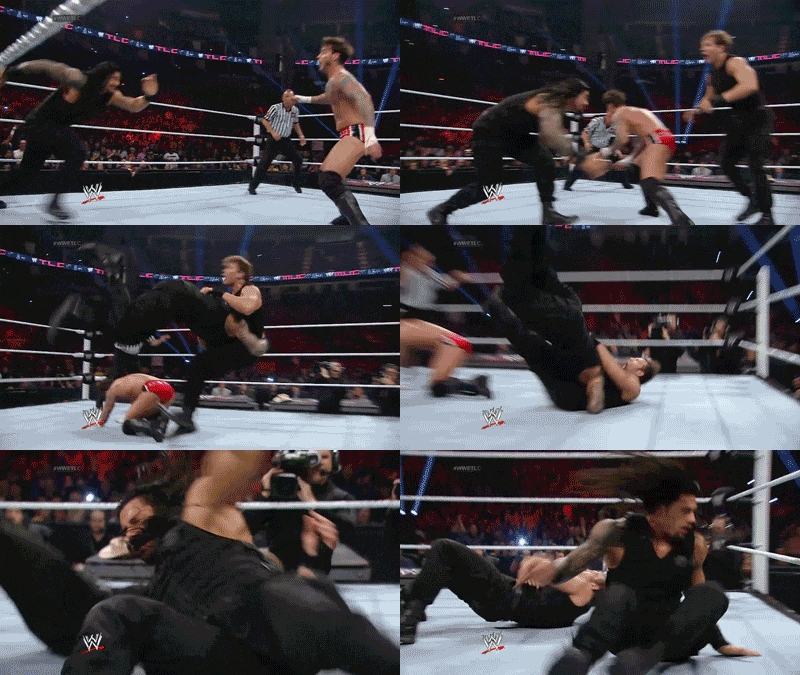 I ran to notify one of our recess monitors that I had a strong pain in my abdomen and that I wanted to go to the nurse. She told me no. She said that she saw me in the baseball field the day before "rough-housing" and I deserved my pain, so she wouldn't take me to the nurse today. I told her I was protecting myself and that she did not see everything that went down during recess so she couldn't tell me that I wasn't deserving of a nurse. I was almost as shocked as my abdomen was sore.
And the pattern repeated, and I grew older, still sore, and officers still refused my handshakes, rolling up slowly to my left side without a siren, randomly asking me, a teenager walking with his friends through the park, if I had a knife on me. I told him no. He told me to stay safe. I told him that all I can do is try. And all of a sudden, this doesn't become an America that I can live in and not be sore. It becomes a classroom of peers striking me in kindergarten and a recess monitor saying I deserved it; it becomes a teenager shot for wearing a hoodie that looks like the ones in my wardrobe; it becomes a woman killed following a traffic stop; it becomes the sounds of the bullets as they enter Alton Sterling, and the empathy makes the sound pierce my ears before it does in my own back; it becomes the agonizing scream of someone who cared for Philando Castile cry for his life after he reached for his wallet in front of an officer the same way I did that one time; it becomes that officer being a minority himself, but still telling me not to reach for my wallet so fast while his partner tells me that he used to jump turnstiles too. When most of the class is striking you, how can the teacher ask you about intentions? How am I to consider the will of each of my strikers individually as I am being struck? Who should be the one to persuade the recess monitor that I have an issue that deserves tending to? Why does acknowledging that I have been struck translate to an infraction on my part?
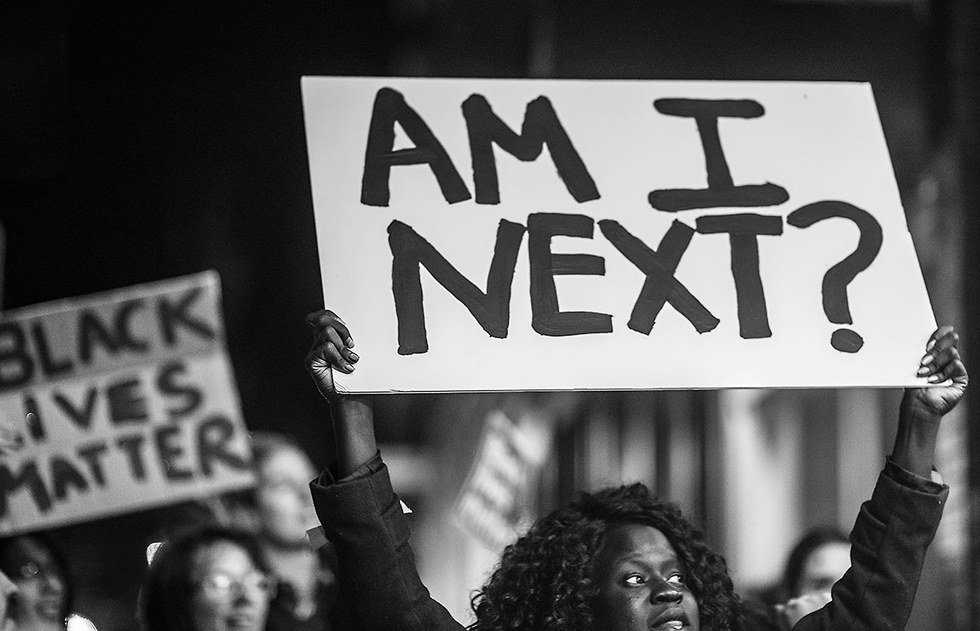
BlackLivesMatter is the headline of a discussion that includes police brutality. In this discussion, the word "Lives" implies prosperity. It's fair to say that opportunity helps beget prosperity and it's obvious that our opportunity is limited. If you're skeptical, look up the graduation and incarceration rates of Black men and women compared to other racial groups yourself if need be. While you're at it, research who is prioritized in the housing market, how minorities were steered away from many suburban communities in a real estate scheme called "red lining." Look up how police brutality and mass incarceration were the reasons we even had gangs to begin with. Either America believes that Black disasters and trauma are the fault of Black America, or she openly admits that she lit our communities to flames herself. Either way, we just need this time to let the world, as well as ourselves, know that our Blackness is the cotton pillow this country rests its head on that we never got reimbursed for.
We're going to be carefree and joyful doing it too. Hashtags such as #CarefreeBlackKids, #BlackGirlMagic, and #BlackExcellence as well as movements such as BlackLivesMatter and the natural hair movement have surged social media in an effort to reverse the mainstream erasure of Black beauty, success, love, and happiness. Black America is currently revolutionizing its relationship among it's self and with it's country. The hashtags, the Black millennial literature on social media platforms, the Black memes that just read "BlackLivesMatter," they are all meant to share some positivity and empowerment to the people of this country that have built it and fought all of its wars, yet remain ostracized by it. Growing up and being told by strangers and family alike that your natural hair is ugly is disempowering. Having little representation in media is disempowering. Having less opportunities for educational and economic success is disempowering. Getting killed on the street by enforcers of the law unjustly is disempowering. All we want is to reclaim that power.