


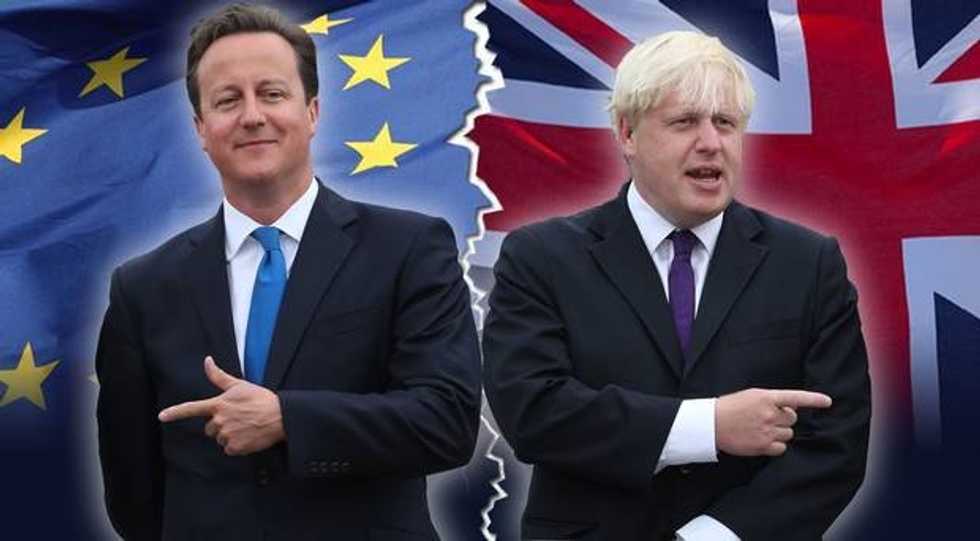
By now, you have already heard the news: Britain has voted to leave the European Union a few days ago. The fallout of the result has already been felt. The stock market has plunged, with the pound the lowest that it has been in decades. Prime Minister David Cameron has announced his plan to resign the premiership in the fall, and Leader of the Opposition Jeremy Corbyn is facing a massive revolt in his own party. Meanwhile, far-right groups across Europe are pushing for similar success, while the centrists in political power are scrambling to undo the damage. And of course, Donald Trump and Vladimir Putin are gloating with glee... but you, dear reader, already knew that.
So how did all of this happen? Well, to be perfectly fair, Britain has always had a testy relationship with the rest Europe, well before the European Union existed. Recently, this took the form of the United Kingdom Independence Party, a far-right group that was gaining ground among those frustrated with the Conservative-Liberal Democrat coalition that governed Britain from 2010-2015. And even though Prime Minister Cameron didn't want this referendum to happen, he made it a campaign promise in last year's elections. And to prevent a split in the Conservative Party, he allowed the party's MPs to pick which side to campaign on.
In hindsight, this decision will be the reason why David Cameron's career will most likely be a morality tale in why British politics places a heavy emphasis on party discipline. But why did the Leave side win, even though it was by such a slim margin? The answer: the same factors that propelled Donald Trump's rise to political power here in the United States. There was frustration over EU regulations. There was concerns over immigration, especially in light of the ongoing refugee crisis. And more importantly, there was a populist movement that fed off misinformation based on a voter base believing their righteous way of life was fading away and the country was embarking on a dangerous adventure.
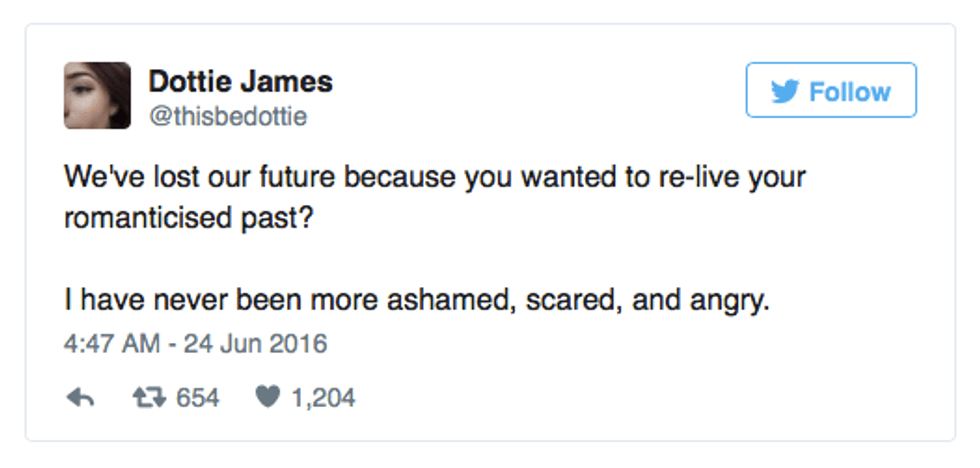
Needless to say, the younger voters that sided with Remain (read: a majority of them) are incredibly unhappy with the results. As an article for Buzzfeed reported, "People aged 18 to 24 voted 75 percent in favor of Remain, versus 39 percent of those aged over 65." Not to mention that there was a petition that called for allowing 16 and 17-year-olds to vote, which had serious political clout. This frustration can be summarized by the following tweet:
Another area of people angry over the results? Scotland and Northern Ireland, the former of which just had an independence referendum that was hard-fought on both sides. Not only was the EU part of the reason why Scottish voters chose to stay in the UK, but most of those same voters backed Remain by a margin of 62 percent to 38 percent. Initially, Scottish First Minister Nicola Sturgeon talked about another independence referendum; more recently, however, it changed into the possibility of the Scottish Parliament blocking the withdrawal process. As she stated in an interview with the BBC, "If the Scottish Parliament was judging this on the basis of what's right for Scotland then the option of saying look we're not to vote for something that's against Scotland's interest, of course that's got to be on the table." Meanwhile in Northern Ireland, where voters backed Remain by a margin of 56 percent to 44 percent, there is already talk of possibly abandoning the government in London (note: the city itself voted Reman by a margin of 60 percent to 40 percent) in favor of the one in Dublin.
This is going to be a very contentious few months, and everybody knows it. And whatever happens, it is certain that xenophobic far-right movements will feel a sense of legitimacy and entitlement.