

Christmas. Whether you celebrate it or not, it has become impossible to avoid. From the nonstop holiday themed advertisements and programs on television, to the broadcasting of Christmas themed music in early November, Americans of all religious backgrounds must experience some modicum of holiday immersion as dictated by society. However, while it may seem to the average citizen that it is indeed late December already, there exists hard numbers based evidence that it is indeed not. In this essay, I plan on demonstrating that, while qualitative evidence might lead to the assumption that it is indeed Christmas, there exists quantitative proof that it is not.
First, one must address the qualitative means for which it may be assumed that it is indeed Christmas. For example, Movin 107.7 has already begun to play holiday themed songs on their station, in addition to 101.3. In addition, Food Network began the latest season of Holiday Baking Championships not a day after Halloween had ended, and sports festive, Christmas themed ads on the Food Network website. While providing a strong claim for the idea that it is on or around the Christmas season, there exists a slight discrepancy for such.
As many people are aware, we no longer use the Julian calendar, but rather the Gregorian calendar. This distinction serves as the most important claim to this essay, as this particular calendar carries the basis on which I make my claim. When consulting the aforementioned calendar, we are able to see that the current date at the writing of this article is Nov. 3, 2015, as evidenced below:
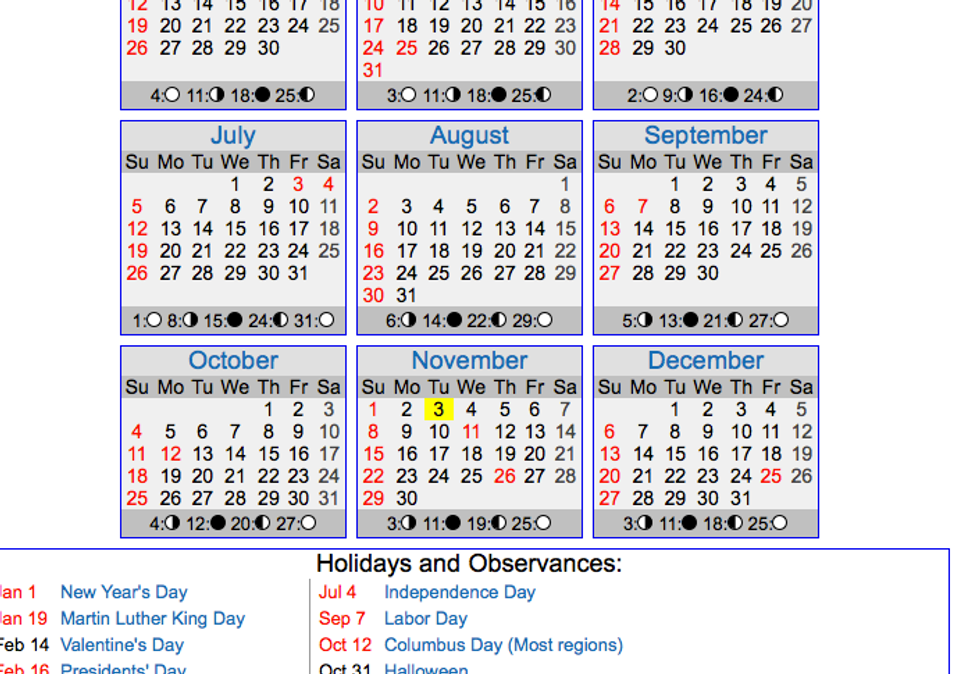
A counter claim may be made in that this article, while written on Nov. 3, 2015, may indeed be published around the date of Dec. 25, 2015, you must place your faith in me that the likelihood of said occurrence is slim to none.
However, this does not account for the claim that the "Christmas season" may begin well before the actual date of Christmas itself. For this, I consulted top sources on the matter to uncover this:
"Originally, the term "Christmas season" was considered synonymous with Christmastide, a term associated with Yuletide, which runs from December 25 (Christmas Day) to January 6 (Epiphany), popularly known as the 12 Days of Christmas. However, as the economic impact involving the anticipatory lead-up to Christmas Day grew in America and Europe into the 19th and 20th centuries, the term "Christmas season" began to become synonymous instead with the traditional Christian Advent season, the period observed in Western Christianity from the fourth Sunday before Christmas Day until Christmas Day itself. The term "Advent calendar" survives in secular Western parlance as a term referring to a countdown to Christmas Day from the beginning of December."
Therefore, those who wish to argue that the Christmas season extends beyond the day of Christmas make a fair claim, but hold no water in reference to the current date and time.
To conclude, the evidence presented proves that the Christmas season, while beloved by many, has yet to begin, and all of those who are confused as to when to wear their tacky sweaters may place them back in the closets from whence they came. For reiteration, it's not Christmas yet. So cool your goddamn jets everyone. It'll get here when it gets here alright? Relax. Y'all don't have money for presents anyway.
All inquires may be articulated in the form of an article share on social media.
















