


For a lot of guys out there, it's a dream come true to be out under the stars with someone at your side. Heck, for most guys, it's beyond a dream to even know what to say when you are laying there. Sometimes when everyday words can fail, it's best to fall back on a topic that's been discussed for thousands of years. The night sky is truly fascinating, it was a sailor's only guide when adrift at sea, the inspiration for countless works of art, even the focus of entire civilizations. Using it as a way to start a conversation with your crush almost feels like cheating, but that's not for us to decide. All that you truly have to decide on is what you think could break the ice on a clear night, with one hand pointed at the sky and the second hand entwined in another's.
We as humans have always tried to find meaning in the stars, and the clearest proof of that is in our constellations. Pinpoints of light strung together in an immortal pattern. Sometimes it's difficult to look up at the sky and not see those paintings left from countless nights past. There are names we can recite from memory, like the Big and Little Dipper or Orion the Hunter. For a lot of stargazers in the northern hemisphere, these are a good place to start. To find Orion, look for his characteristic belt of three bright stars, then search around those to find the four stars making up the shoulders and legs.
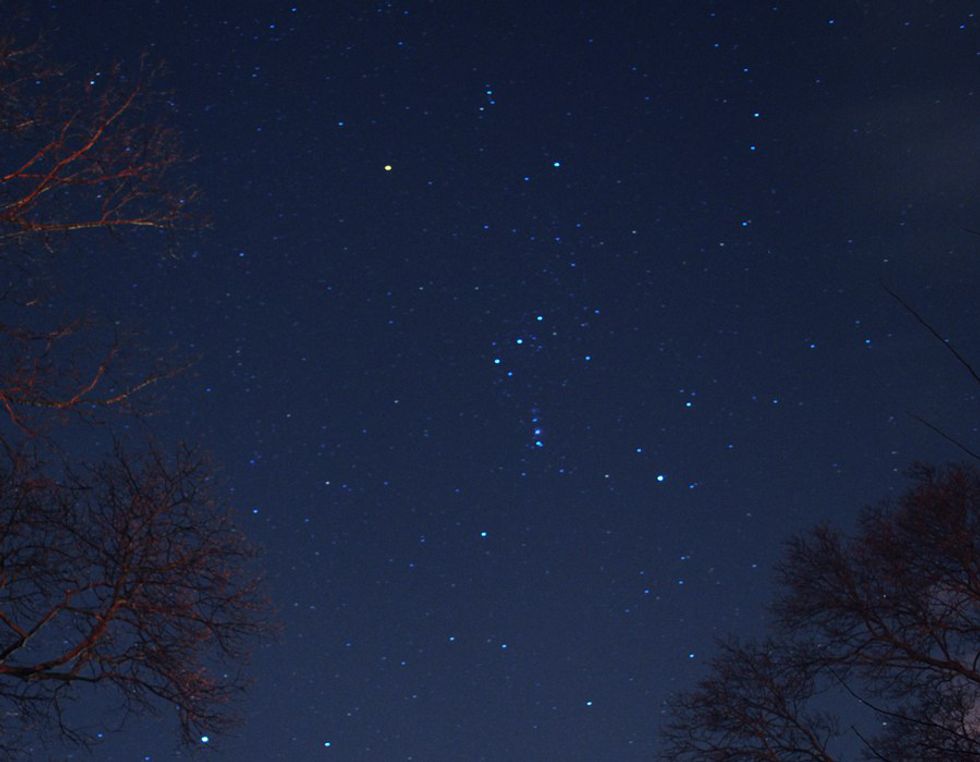
Looking at this image, it's not hard to see how many civilizations throughout history believed that the sky was no more than a blanket covering the world. With what we know now, it helps to add a little bit of perspective to the constellation we know as The Hunter. His belt made up of the stars Alnitak, Alnilam and Mintaka seems as though they're side by side with each other. The truth is, moving from left to right in the image above, the distances of the stars from Earth are respectively 817, 1340 and 916 light years. It can force us to put the night sky into perspective, trying to imagine ourselves not looking up at a veil over the earth, but looking up from the bottom of a well, holding on for dear life as we hurtle through the heavens.
The next two constellations are the Dippers, Big and Little. The best place to start is with the Little Dipper. In the handle of the Little Dipper is Polaris or the North Star. When navigating at sea in the northern hemisphere, if a sailor could spot this star, they would know exactly in which direction lay true north. Polaris rises higher in the sky the further north you travel. A sailor on the equator would see Polaris directly on the horizon, but if you traveled to the north pole and looked straight up, Polaris could be found directly above your head.
We can cheat a little bit today; with compasses on hand, we can find which way is north and look for the north star after the fact. This star lies at the very end of the handle of the Little Dipper. If you can't find the rest of the constellation, don't be worried. The Little Dipper is usually much dimmer than it's counterpart. Finding the Big Dipper can be helped by following a neat fact. As the Earth travels around the sun, the position of stars changes in the night sky. For example, in the spring, the Big Dipper will be upside down, as though it was being poured out.

The Big Dipper rotates counterclockwise around Polaris, so in the Fall, look for the Big Dipper on the horizon with the dipper finally facing right side up again.
Simply knowing these constellations and how to find them is enough of a start to any evening, but there's always more to know about this world, and discovering this with someone else is an incredible experience. When you're looking up at the sky, any moment can feel as if it stretches out to forever. The right person by your side for these moments can be like the stars we've been talking about, igniting a spark of light into your dark and confusing world. If there's someone out there who can be that light for you, treasure them. This life can be dark and uncertain at times, but with a light to follow, you might feel just that much less alone.
















