
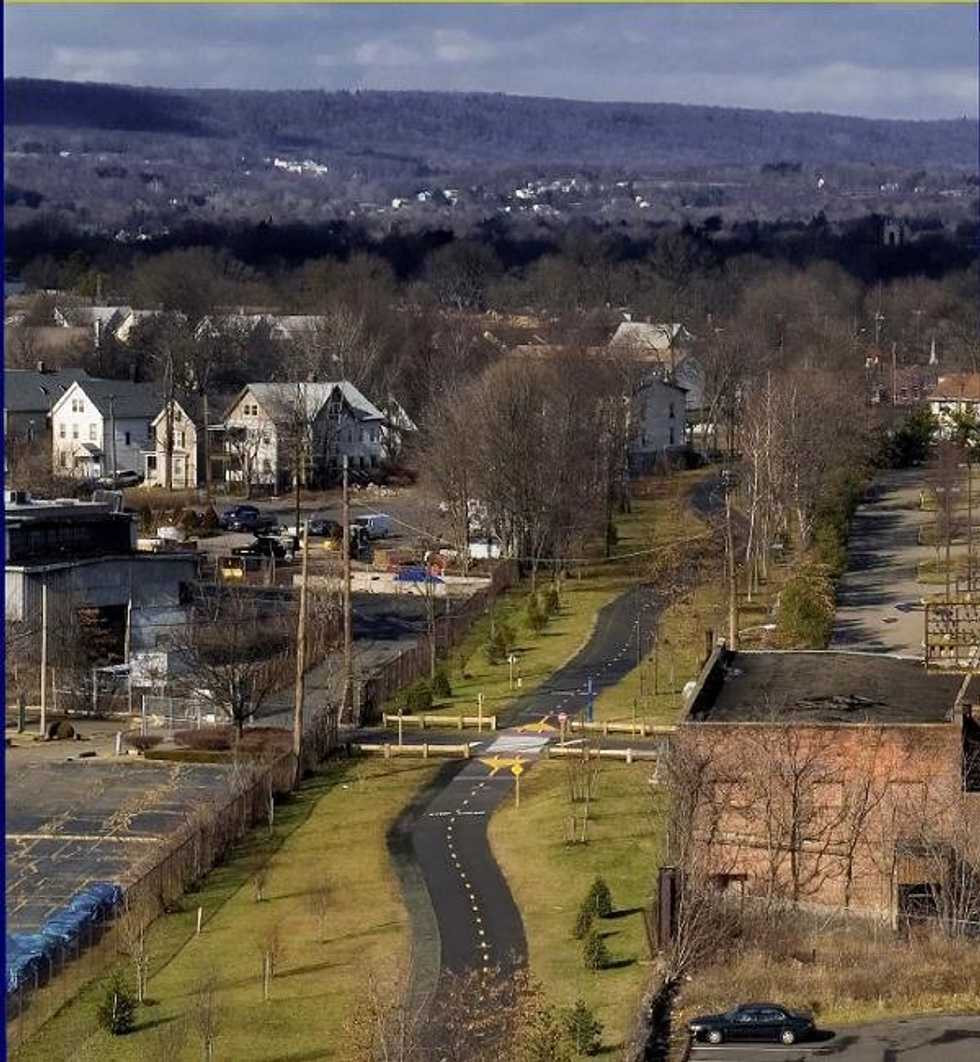
Following a rusty chain-linked fence, the sidewalk led to a back door with “Dee Dee’s Dance Center” scrawled in green ink on a white poster. To the side, a more legitimate metal sign read St. Andrew’s Episcopal Church. The door opened to a high ceilinged room filled with plastic tables and mismatched chairs, paisley curtains that did not quite fill the entire window, fridges and pianos, and Pastor Donald Morris of Newhallville of Light Kingdom Outreach Ministry. St. Andrew’s and Light Kingdom Outreach Ministry share one building for their services.
Lieutenant Sharp, district manager of Newhallville, soon joined Pastor Morris to talk about the various endeavors the community has taken to fight crime and encourage a healthy neighborhood. The two leaders of Newhallville sat next to each other, bound by a shared commitment to the neighborhood. Pastor Morris’s eyes bound by gold-rimmed glasses sat forward on his face, open and curious. Lieutenant Sharp’s eyes hooded by his prominent brow line, a stern face sharpened by the streets of his hometown Cleveland.
In the early 1900s, New Haven was an industrial powerhouse. The Winchester Repeating Arms Factory was a massive source of employment and wealth for the rising middle class to grow from, along with numerous other factories. Within the century, however, most of these factories would abandon the city, leaving thousands of families to find new jobs. The city fell into deep poverty. Education dropped. Crime rose. By the 1990s, crack cocaine found its way into the streets of New Haven, bringing with it gangs and more violence. New Haven became home to gangs like the Red Side Guerilla Brims, a sub-sect of the Bloods gang of Los Angeles, California, infamous for its rivalry with the Crips.
For kids who came from broken families, as most of the families are in Newhallville, gang life became a pseudo family. A place to gain recognition, love, and a sense of belonging. A place where black lambs could find a herd to follow.
“Faith without works is dead.” Pastor Morris emphasize the goal of adopting a community of inclusion. He leads neighborhood mentorship programs, like My Brother’s Keeper, that guide these lost sheep, providing them a purpose in life, giving them hope in the future. That they can dream of a future beyond the neighborhood street corner. During the summer, they hold camps for hundreds of children, feeding them, giving them things to do, making sure they’re taken care of. Pastor Morris walks the streets, praying for the kids in gangs with their mothers, showing them that they have nothing to fear. That they are loved and wanted. That they are part of a community. That someone is always searching and seeking for them. No matter how far they go.
Lieutenant Sharp stresses the important role the coalition of law enforcement, the clergy, grassroots organizations, and families make in keeping Newhallville safe. Although many families in Newhallville have been abandoned by fathers or mothers, grandparents, uncles and aunts, there is a strong community constantly seeking the one lost sheep from the herd. They do not want to oust those kids in gangs, crowding the street corners, dealing out of their backyards. They want them to come back, to return to the real family, even if that means incarcerating sons and daughters of the community.
“Suppose one of you has a hundred sheep and loses one of them. Doesn’t he leave the ninety-nine in the open country and go after the lost sheep until he finds it? And when he finds it, he joyfully puts it on his shoulders and goes home. Then he calls his friends and neighbors together and says, ‘Rejoice with me; I have found my lost sheep.’” Luke 15:4-6.
No matter the cost, Newhallville is seeking its sheep and will not rest until it has reunited its herd. Pastor Morris and Lieutenant Sharp represent this character of Newhallville. A sense of eking out a living in a poverty-ridden neighborhood ironically juxtaposed to one of the most affluent colleges in the United States of America. A sense of community that grows from such an environment. A sense of never taking no for an answer. That a warm encouraging laugh on the one hand and a severe bark from the other will be enough to keep the kids off the street and in real families. Neither man wants to change the laws that encourage juveniles to obtain and fire a weapon—or, perhaps, they are both too aware that changing legislation does nothing for those on the bottom. They just want to bring their kids home.