
After fifteen long years of waiting, two scientists have been awarded the greatest prize in the scientific world.
In the early 1900s, a man named Wolfgang Pauli was studying an apparent lack of regard made to the conservation of energy laws in the event of a beta decay, or the decay of a neutron into a proton and an electron. The conservation of energy laws state that energy cannot be created or destroyed, but only changed from one form into another or transferred from one object to another. Pauli's observation was astounding since this law of conservation had been discovered in the 1700's and tested since then. He postulated that there must be some neutral particle that is present to cause this new-found event.
In 1933, Enrico Fermi named these subatomic particles " neutrinos ," which means "little neutral ones" in Italian. As it turned out, neutrinos were formed around 15 billion years ago, or a little after the formation of the universe. Originally, they were thought to have no mass, but now after many experiments, scientists have determined that they most likely do. Finally, neutrinos were detected in 1956 and were captured in image form in 1970. However, at this point, there was an issue. Scientists were detecting some neutrinos, but certainly not enough compared to how many were predicted. The number of neutrinos that made it to Earth from reactions on the Sun was much less than there should have been.
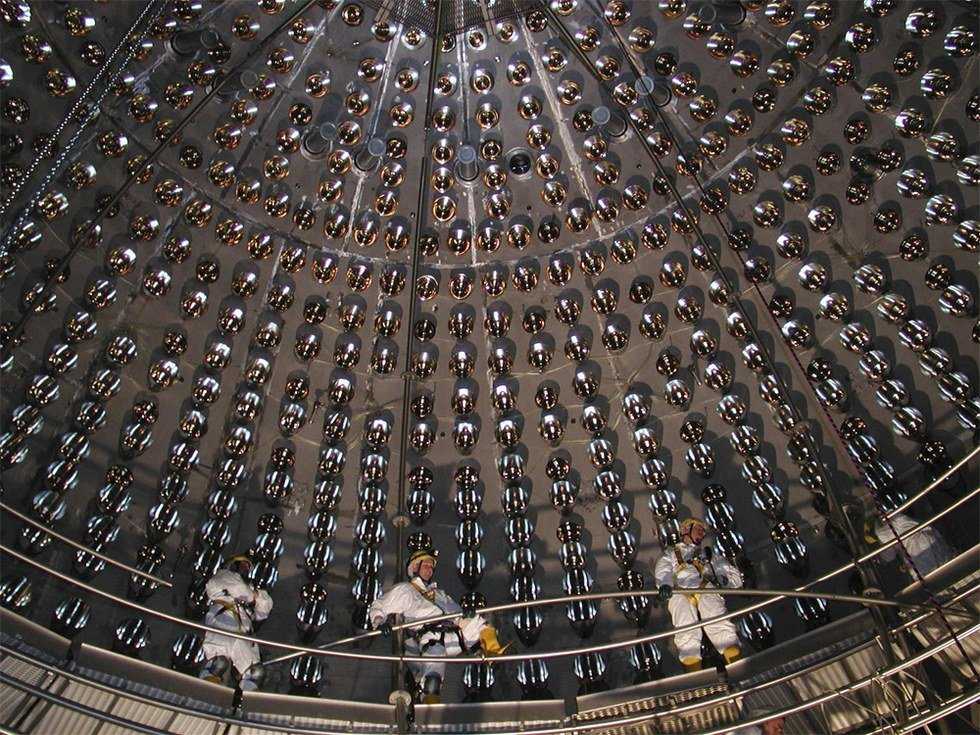
Here we meet what ultimately confused Pauli. How were these neutrinos, particles with mass, disappearing? They weren't. Leon Lederman, Melvin Schwartz, and Jack Steinberger discovered that have three flavors, or species, of neutrinos; electrons, muons, and taus. As was proved in 1998, neutrinos oscillate or change from one form to another. Both Takaaki Kajita and Arthur McDonald, working at the Super-Kamiokande detector in Japan and the Sudbury Neutrino Observatory in Canada, respectively, discovered the ability of these particles to oscillate. They weren't disappearing, they were changing shape.This was a very important discovery since is meant that neutrinos had to have mass.
Now, in 2015, the discoveries of Kajita and McDonald, have been honored with one of the biggest awards in science, the Nobel Prize in physics. Neutrinos have, and will, continue to amaze the scientific world with their many properties.