


In most science classes, we learn about famous scientists and their contributions to the field. From Isaac Newton to Albert Einstein to Stephen Hawking, plenty of names are relatively well-known due to their scientific accomplishments. However, there’s one striking similarity between most of these scientists—they’re male. There’s no doubt that their work is important, yet plenty of women whose contributions to scientific fields are just as exceptional go unrecognized. Here are five women who have shaped science as we know it.
Ada Lovelace

Born in 1815, she is often considered the first computer programmer. She was taught mathematics at a young age and was said to have a brilliant mind as an adult. In 1933, Charles Babbage showed Lovelace the prototype for a machine he built called a Difference Engine, which performed mechanical calculations of polynomials. A few years later, Babbage proposed the Analytical Engine, a general-purpose computer. Between 1842 and 1843, Lovelace translated an Italian paper on this machine, and as an appendix, wrote a detailed set of notes on how it worked. In these notes, Lovelace proposed an algorithm to compute Bernoulli numbers. This is considered the first computer program ever written. In addition, her notes suggested the potential of the device—Lovelace believed that computers were capable of solving many complex problems other than numerical calculations. This analysis was far ahead of its time, and Lovelace’s work was without a doubt highly influential in the field of computer science.
Emmy Noether
 She was a German-Jewish mathematician whose work heavily influenced the fields of algebra and theoretical physics. She graduated from the University of Erlangen in 1903, despite opposition due to her gender, then taught at the University of Erlangen and the University of Göttingen for no pay. At Göttingen, she taught under another professor’s name for a few years. In 1919, she was promoted to the position of untenured professor, but never became a full-time professor. While there, she came up with basic theories of abstract algebra, including invariant theory (certain expressions remain constant, even when the numbers plugged into them undergo a transformation) and commutative and noncommutative algebra. She also came up with Noether’s theorem, a fundamental piece of modern physics that resolved a paradox in Einstein’s theory of general relativity. Noether died in 1935, but to this day, she is considered one of the most influential mathematicians of the 20th century.
Lise Meitner
 An Austrian physicist who defined nuclear fission of uranium. She was born to a Jewish family, and her parents supported her education throughout her life. In 1905, she was the second woman to receive a doctoral degree in physics from the University of Vienna. She then studied under Max Planck and soon became his assistant. While at school, she worked with chemist Otto Hahn on discovering several new isotopes. She eventually became the first female professor of physics at the University of Berlin. However, in 1938, she was forced to escape Germany due to her Jewish ancestry (though she had converted to Christianity 30 years earlier). She began working in Stockholm, but kept in touch with German scientists. Towards the end of 1938, Otto Hahn and his assistant performed experiments that provided evidence of nuclear fission. Hahn wrote to Meitner baffled by his results. She and her nephew, Otto Frisch, proposed a theory explaining how the nucleus of an atom could be broken into smaller pieces. The papers written by Hahn, his assistant, Meitner, and Frisch had great impact on the scientific community, and their work would soon lead to the development of nuclear weapons, though Meitner wanted nothing to do with bombs. Meitner received many awards throughout her life, but did not share the Nobel Prize for nuclear fission won by Otto Hahn.
Rosalind Franklin
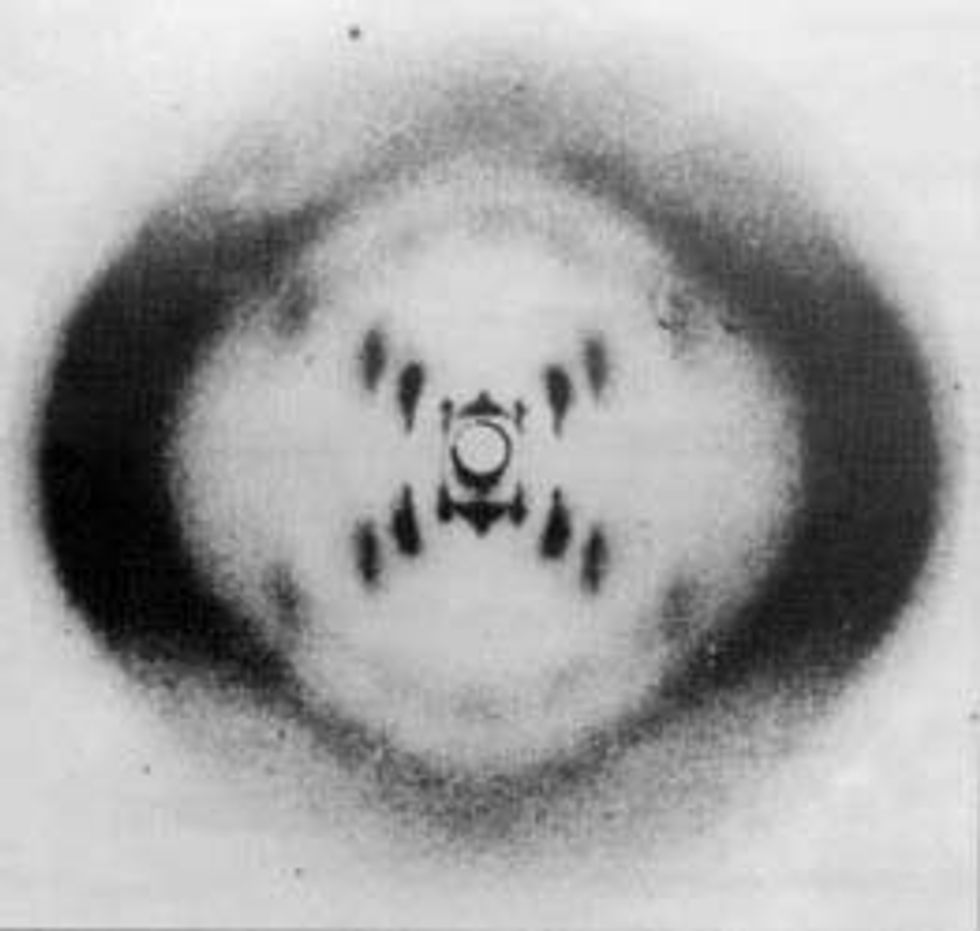
 A chemist and crystallographer whose work was essential in discovering the structure of DNA. After attending college in Cambridge and mastering X-ray diffraction in Paris, she began working in a lab at King’s College in London in 1951. While there, she took highly detailed X-ray photographs of DNA and wrote several unpublished papers highlighting her findings. In 1953, James Watson and Francis Crick, chemists who worked at Cambridge University, began to construct a model of DNA. Their data was heavily influenced by Franklin’s findings—Watson had visited King’s College earlier that year, and Maurice Wilkins, a chemist who led another research team there, showed him Franklin’s photographs. Once they finished their model, Watson and Crick published their work almost immediately. Franklin died of cancer in 1958, and four years later, Watson, Crick, and Wilkins were awarded a Nobel Prize for discovering the structure of DNA instead.
Margaret Hamilton
 She's a software engineer and computer scientist. For a few years, she worked at MIT on a computer program that predicted weather patterns through simulators; this work led her to become the lead programmer on NASA’s Apollo mission. Her team created the software that allowed NASA to navigate and land a spacecraft on the moon. Hamilton’s software was able to recognize when it received an overload of data, warn the astronaut that it was experiencing problems, and keep running. This reliability enabled the Apollo 11 mission’s success. In this way, Hamilton played a vital role in the world’s first moon landing. Since then, Hamilton has founded two tech businesses. She has won several awards and is still alive today.

















