


If you were busy over the last month or so you probably have not heard about the huge possible discovery of intelligent alien life. NASA discovered something in its Kepler space telescope that is very interesting and for a time was very controversial. Many believed that we had discovered alien life in a distant star system. This may sound insane but at first it did sound promising.
First; it is important to explain what Kepler is doing. The Kepler mission is a massive search for livable planets in our universe. The idea is that if the telescope can study a certain area it can determine if there are any planets in a star's orbit. It determines this by checking for a dimming of the star's light. If a star dims slightly enough times they can determine how many planets there are in a given star system as well as how far away those planets are from the star. Both are very important because if one is trying to find habitable planets life could live on it is likely they would need water and a decent climate. Scientists have nicknamed an area where planets like this would be more common. The 'Goldilocks zone' which basically means that it is an area so far away from a star that would allow for a dense enough atmosphere for liquid water to flow on. They call it this because ideally one would like an atmosphere that is not too hot and not too cold to make it impossible for liquid water to flow. A good example of this would be Earth and Mars. Both planets are in the goldilocks zone because they allow water to flow. Since Kepler searches for the dimming stars at all times, eventually there will be something odd to come along.
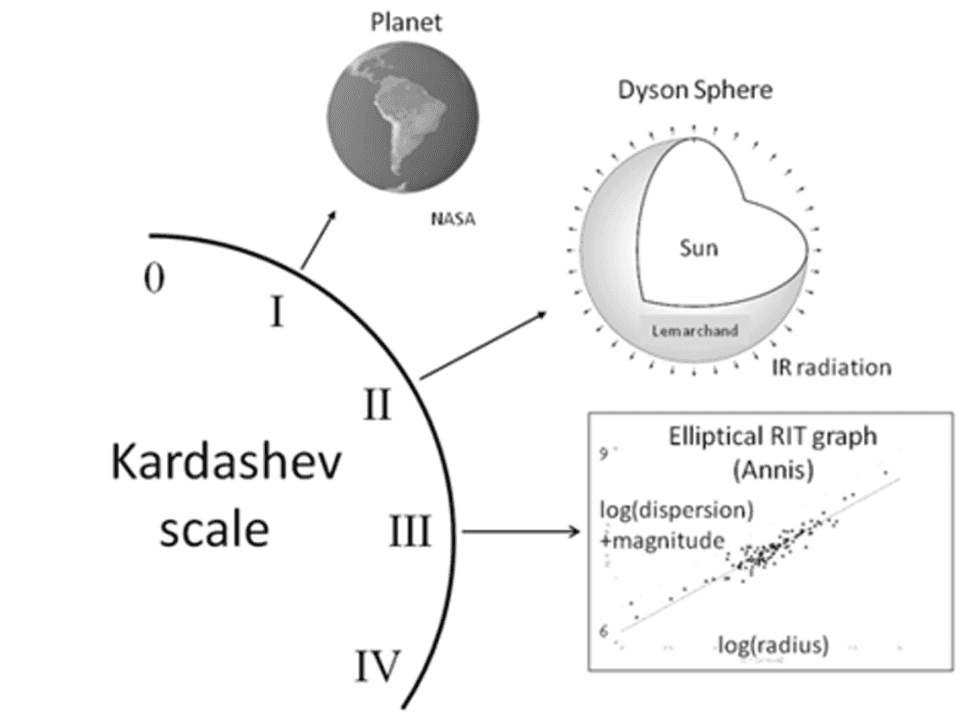
However what Kepler found was far from odd but rather incredibly unlikely. Most planets only dim their star's light by about one percent; in September when Kepler discovered KIC 8462852, a star in a distant star system, an object dimmed a its star by 20 percent. That is a sizable difference which caught the attention of many in the scientific community. For quite some time NASA did not rule out the possibility of intelligent alien life. This is because it has been theorized long before this Kepler incident that an advanced species would eventually build a Dyson Sphere to gain incredible amounts of power for their home world. There is a scale that measures energy outputs of advanced civilizations called the 'Kardashev Scale'. This scale measures energy output levels for civilizations who would be able to master large energy production such as nuclear fusion. A type two civilization on the Kardashev Scale would be able to harness the power of the sun my creating a Dyson Sphere. The Dyson Sphere is a hypothetical mega-structure which could capture a large amount of a star's energy output. So many nerds out there for the last month or so have been going crazy at the possibility of a Dyson Sphere like structure being found. A Dyson Sphere could easily dim 20 percent of a star.
Now I would hate to burst everyone's bubble but sadly NASA has finally gave their opinion on what exactly caused the dimming of KIC 8462852, and that is comets. NASA stated that it is most likely a bunch of frozen comets that did the cosmic trick (http://www.jpl.nasa.gov/news/news.php?feature=4777). The Kepler incident is still a fascinating one and is by no means a waste of time. It is always a great thing to learn more about the vastness of the universe. We are not even close to mapping everything out and we are not close to understanding all aspects. However every single day people a lot smarter than me continue to work hard in order to better out understanding of the stars.
















